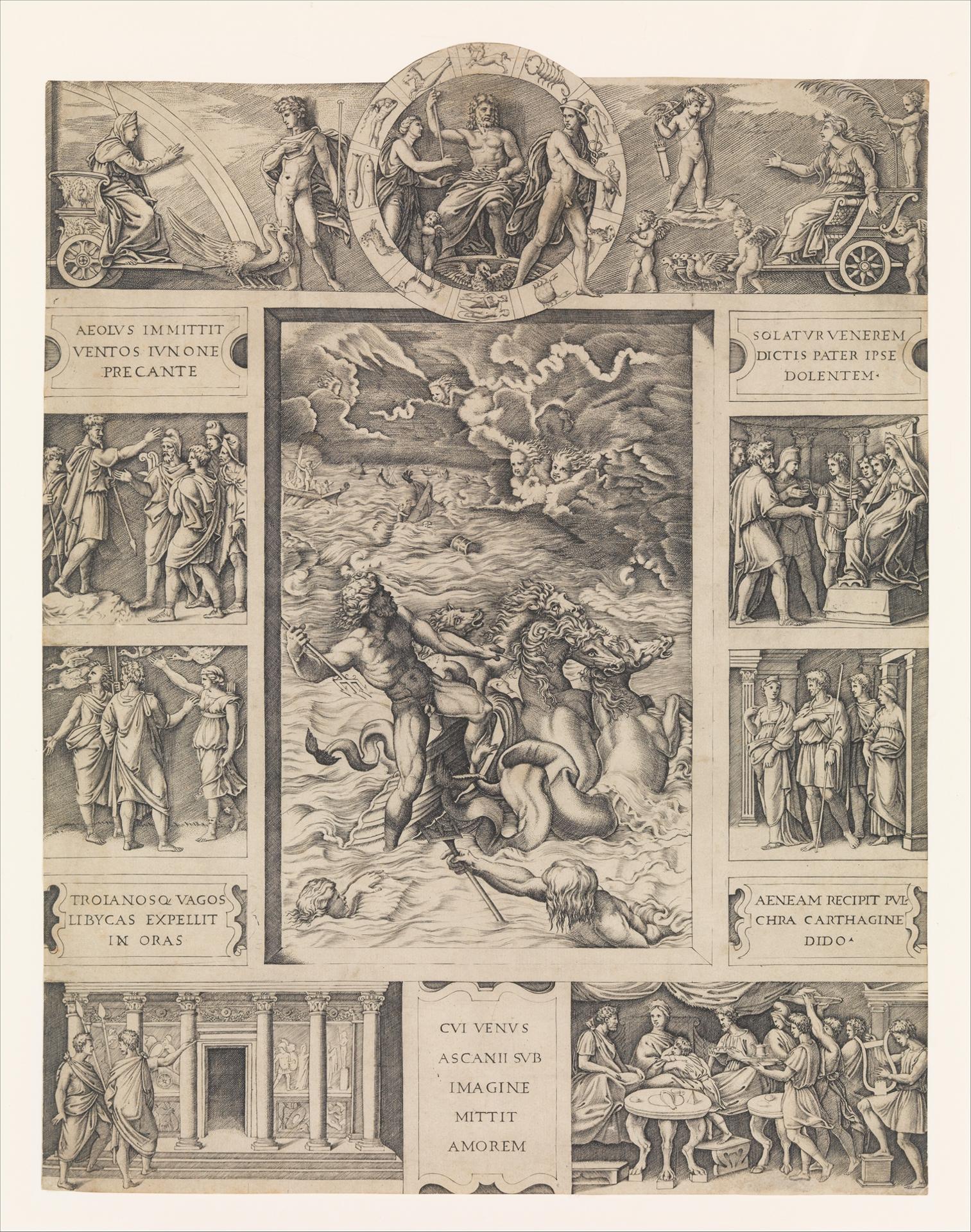
Neptune calming the tempest which Aeolus raised against Aeneas' fleet, from Book I of the Aeneid
Original title: Neptune calming the tempest which Aeolus raised against Aeneas' fleet, from Book I of the Aeneid
kurzbeschreibung
Where related prints treat the storm as a spectacle of nature alone, this engraving by Marcantonio Raimondi puts Neptune's rescuing intervention at its heart. Made around 1515–16, it illustrates an episode from the first book of the Aeneid: the sea god calms the gale that Aeolus has stirred up against the fleet of Aeneas. Executed as an engraving, the sheet measures 42.3 x 32.4 cm.
Description
A medallion near the top holds further figures, each taking a different role in the myth, while below Neptune smooths the churning swell with his trident. Around him horses and a human figure are tossed through sea and wind. Added scenes frame the action and bring before the eye moments from the Trojans' flight to Italy. Figures in classicizing dress are spread across a dynamic arrangement that stresses movement and drama. The whole sheet stays in greys, drawn with precise, richly detailed linework.
Context
Marcantonio Raimondi, an Italian engraver of the Renaissance, became best known for his reproductive prints after works by Raphael. This engraving was made in Rome around 1515–16, where Raimondi worked closely with Raphael. The Aeneid scene follows Virgil's ancient text and reflects the humanist appetite for Roman epic. It belongs to a group of prints illustrating episodes from the Aeneid, intended for an educated audience with an interest in art.
Impact
Precise linework and a dynamic arrangement of figures give the scene a dramatic liveliness that makes the conflict between the forces of nature and divine order vivid. Classicizing draperies and a complex pictorial structure produce a lofty, classical effect that carries the viewer into the world of myth. The clear greys and exacting detail underline the high craft of the print.
Technique
For this engraving the lines were cut into a copper plate and then printed. The method allows fine, precise hatching, used here to render the figures and the movement of the waves in detail. The greys arise from varying the density and direction of the lines, which model light and shadow.
AI-generated description text
Source: Metropolitan Museum of Art · Public Domain (CC0 1.0)