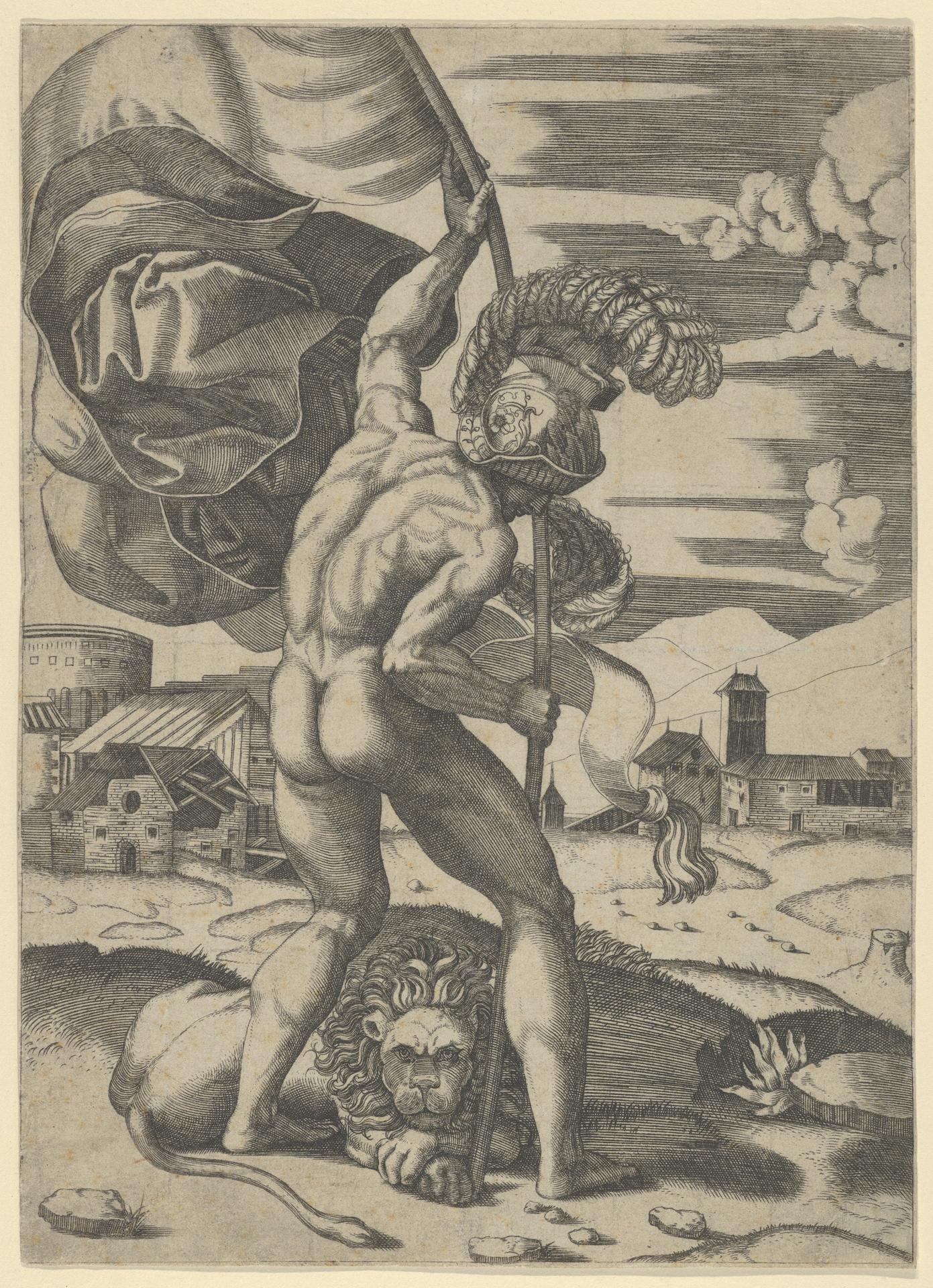
Naked man wearing an elaborate helmet viewed from behind holding a banner, a lion seated on the ground
Original title: Naked man wearing an elaborate helmet viewed from behind holding a banner, a lion seated on the ground
kurzbeschreibung
Marcantonio Raimondi, one of the defining engravers of the Italian Renaissance, here presents a nude man seen from behind. The figure wears an elaborately decorated helmet and holds a banner in his right hand. Created between 1500 and 1534, the print includes a seated lion at his feet, while behind him a landscape with buildings, mountains and clouds unfolds. The motif reflects the printmaking of its time.
Description
A powerful, muscular back fills the image, topped by a richly ornamented helmet with feathers and decoration. The right hand grasps a banner whose fabric flutters in lively folds. Before him on the ground rests a lion, calm and unstrained. Behind the figure, city architecture, hills and mountains are layered under a cloudy sky. Fine hatching and carefully placed textures define the entire structure.
Context
Raimondi, an Italian Renaissance engraver, became known above all for his reproductive prints after Raphael and other masters. This sheet belongs to his mature years between 1500 and 1534, when he worked in Rome. The motif of the nude warrior with helmet and banner may have been inspired by ancient Roman reliefs or Renaissance paintings. His prints circulated widely and helped spread Renaissance imagery throughout Europe.
Impact
Because the man stands turned away, his face remains hidden, creating a peculiar distance. At the same time, the ornate helmet and banner lend him something heroic. The moving banner and the calm lion balance each other, giving the image a poised tension. The detailed landscape behind invites the viewer to explore the depth of the print.
Technique
For this engraving, the lines were cut into a copper plate with a burin. Raimondi used fine parallel hatching and cross-hatching to model shadows and surfaces. The impression on paper measures 24.6 × 17.7 cm and reproduces details such as the helmet ornament and the lion's fur with great precision.
AI-generated description text
Source: Metropolitan Museum of Art · Public Domain (CC0 1.0)