Poetry personified as a winged woman (ca. 1515–50)
Original title: Poetry personified as a winged woman
kurzbeschreibung
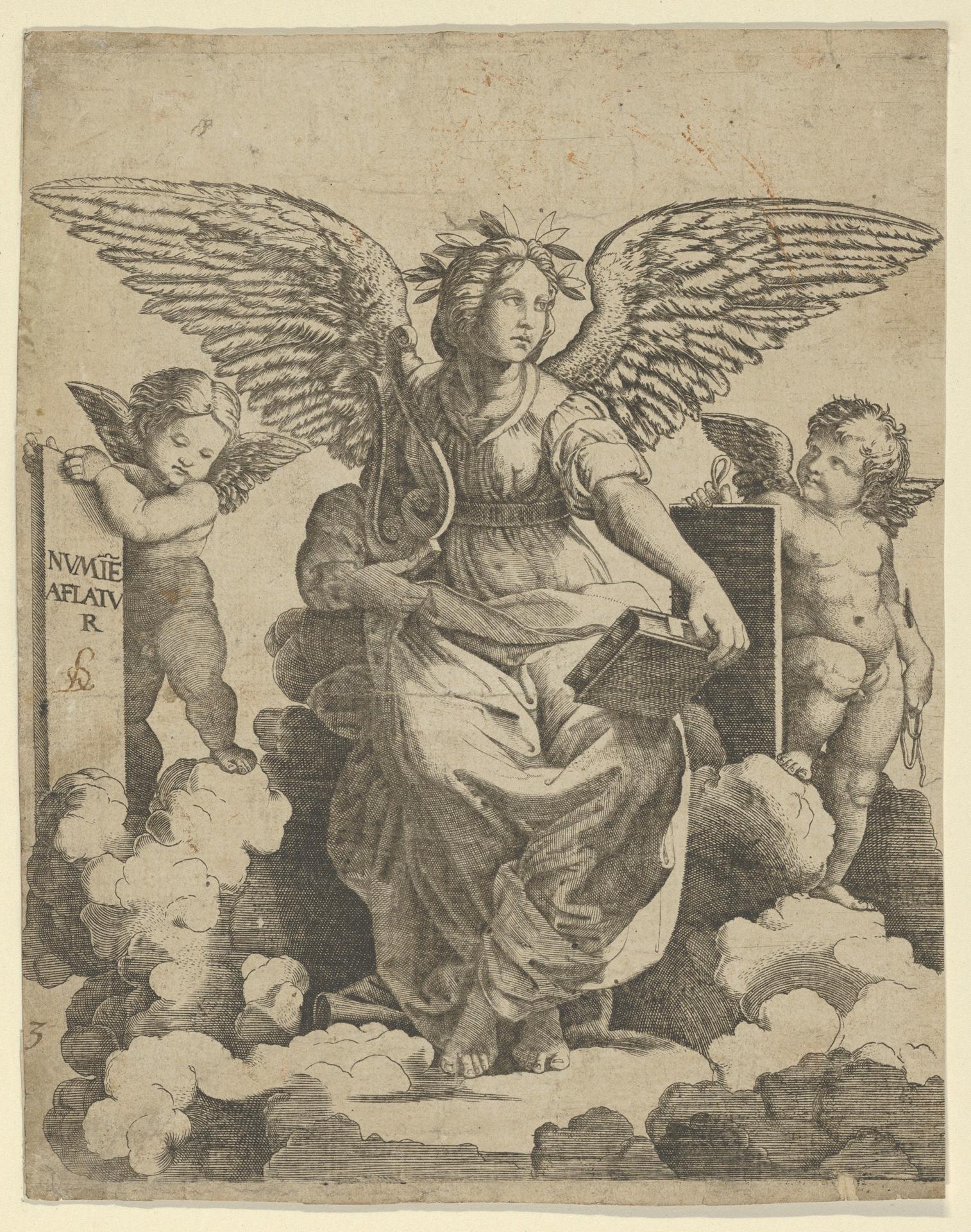
An anonymous artist made this engraving between about 1515 and 1550, showing Poetry as a winged woman. She sits in a thoughtful pose, accompanied by two sleeping putti. The sheet measures 18.3 by 14.5 cm and is executed in the etching technique.
Description
A seated woman with wings forms the main subject; she wears a simple gown and a flower crown. Her calm, pensive posture points to the introspective nature of poetry. Two winged putti recline on either side: the left holds a staff and sleeps, the right a book and also sleeps. Clouds and a suggested landscape behind them emphasize the idea of flight and independence from the earthly. The layout is symmetrical, with the main figure at the center and the putti placed to the sides.
Context
The engraving comes from the Renaissance, an era in which allegories and personifications of abstract concepts such as poetry were common in art. The winged woman with a flower crown draws on ancient and humanist pictorial traditions that linked art, nature, and beauty. That the maker remains anonymous is typical of many utilitarian prints of the period, which often circulated in series or as book illustrations.
Impact
A quiet, contemplative mood emanates from the sheet, supported by the symmetrical arrangement and soft lines. The sleeping putti and the thoughtful attitude of the main figure create an atmosphere of stillness and reflection that invites the viewer to ponder poetry.
Technique
For this engraving, lines were cut into a metal plate and then printed on paper. Gray tones and fine shading arise from the density and depth of the linework, which precisely models the forms and textures of the figures and the landscape. The even distribution of light without strong contrasts is characteristic of this technique and directs focus to the figures.
AI-generated description text
Source: Metropolitan Museum of Art · Public Domain (CC0 1.0)