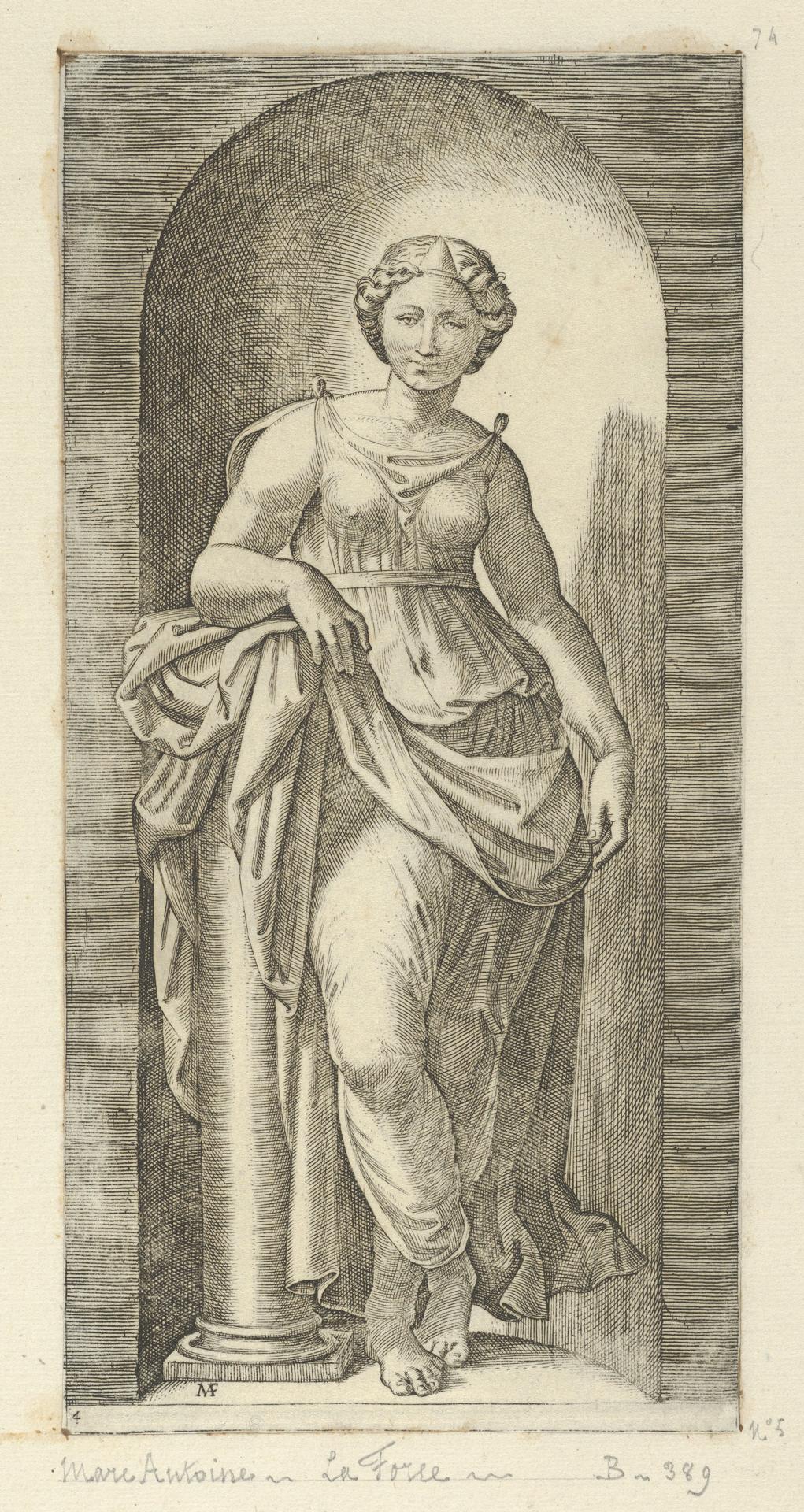
Fortitude or Strength personified by a woman standing in a nice resting her arm on a column, from "The Virtues"
Original title: Fortitude or Strength personified by a woman standing in a nice resting her arm on a column, from "The Virtues"
kurzbeschreibung
Where many virtue allegories of its day rely on dramatic gesture, Marcantonio Raimondi's engraving of about 1515–25 makes its point through calm. A standing woman in antique-style dress personifies fortitude by leaning against a column, the architectural element that stands for constancy. The sheet belongs to the series 'The Virtues'.
Description
The figure stands upright and at ease, her right arm resting on a column while her left hand settles at her hip. A long, heavily folded gown falls across the shoulder and reinforces the classical character. Her face is serious, her hair arranged in soft waves. The setting stays bare, so the figure stands out clearly; delicate hatching models the drapery and the contours of the body.
Context
Raimondi ranks among the foremost engravers of the Italian Renaissance and became known above all for his reproductions after Raphael. The 'Virtues' series appeared at a time when allegorical subjects circulated widely in print. Artists used sheets of this kind as models, while humanist-educated collectors valued them as objects to gather.
Impact
Balanced calm and classical drapery give the print a dignified, elevated mood. With the surroundings pared back, attention goes entirely to the figure, whose composure reads strength as inner resolve. The engraving's delicate line makes the paper look almost like a drawing.
Technique
For an engraving, lines are cut into a metal plate and then printed onto paper. This method reproduces fine detail and shading with precision. Raimondi worked with parallel and crossing hatching to build volume and a sense of depth.
AI-generated description text
Source: Metropolitan Museum of Art · Public Domain (CC0 1.0)