Hope
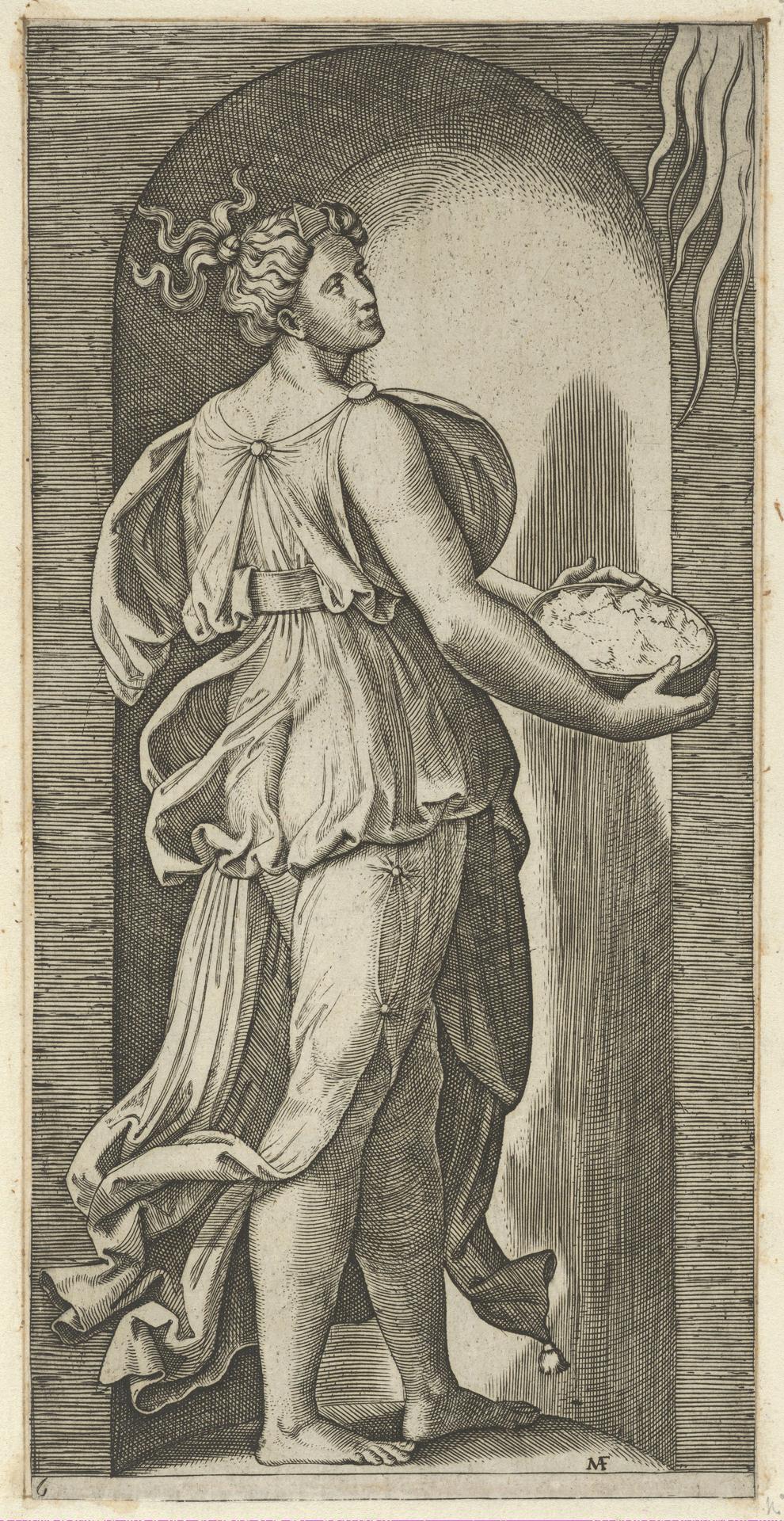
Original title: Hope personified as a woman standing in a niche facing right, holding a container of unleavened bread in both hands, from "The Virtues"
kurzbeschreibung
Marcantonio Raimondi dedicated this engraving to Hope, a figure from his cycle of virtues made around 1515–25. A female personification of Hope stands in a niche, holding a vessel filled with unleavened bread. The print is an engraving measuring 21.4 by 10.8 cm.
Description
Facing forward, the woman occupies the niche, her head turned to the right. Curly hair falls back, her garment is plain and tied at the neck with a bow. Both hands, slightly raised, clasp a container of unleavened bread. She stands barefoot, the fabric flowing loosely around her. Above, a stylized sky with a radiant wreath completes the scene; light enters from there, accenting each form.
Context
Raimondi developed the virtue cycle in Italy during the first half of the 16th century. Hope's appearance with unleavened bread links to Christian imagery, where bread signifies the Eucharist and faith. The artist was known both for reproductive engravings after other designs and for his own inventions. The series likely served as models for other crafts, and through the prints it spread widely across Europe.
Impact
Calm and a gentle expression give the figure a sense of composure and confidence. The way the lines are drawn and the light placed lends the print an elegant, almost meditative mood. The clear layout brings the central figure into focus and emphasizes Hope's symbolic meaning.
Technique
For this engraving, the design was cut into a copper plate with a burin and then printed. Delicate lines and hatching create graded tonal values and a sculptural effect. The execution remains monochrome in black and white, as is usual for this printing method.
AI-generated description text
Source: Metropolitan Museum of Art · Public Domain (CC0 1.0)