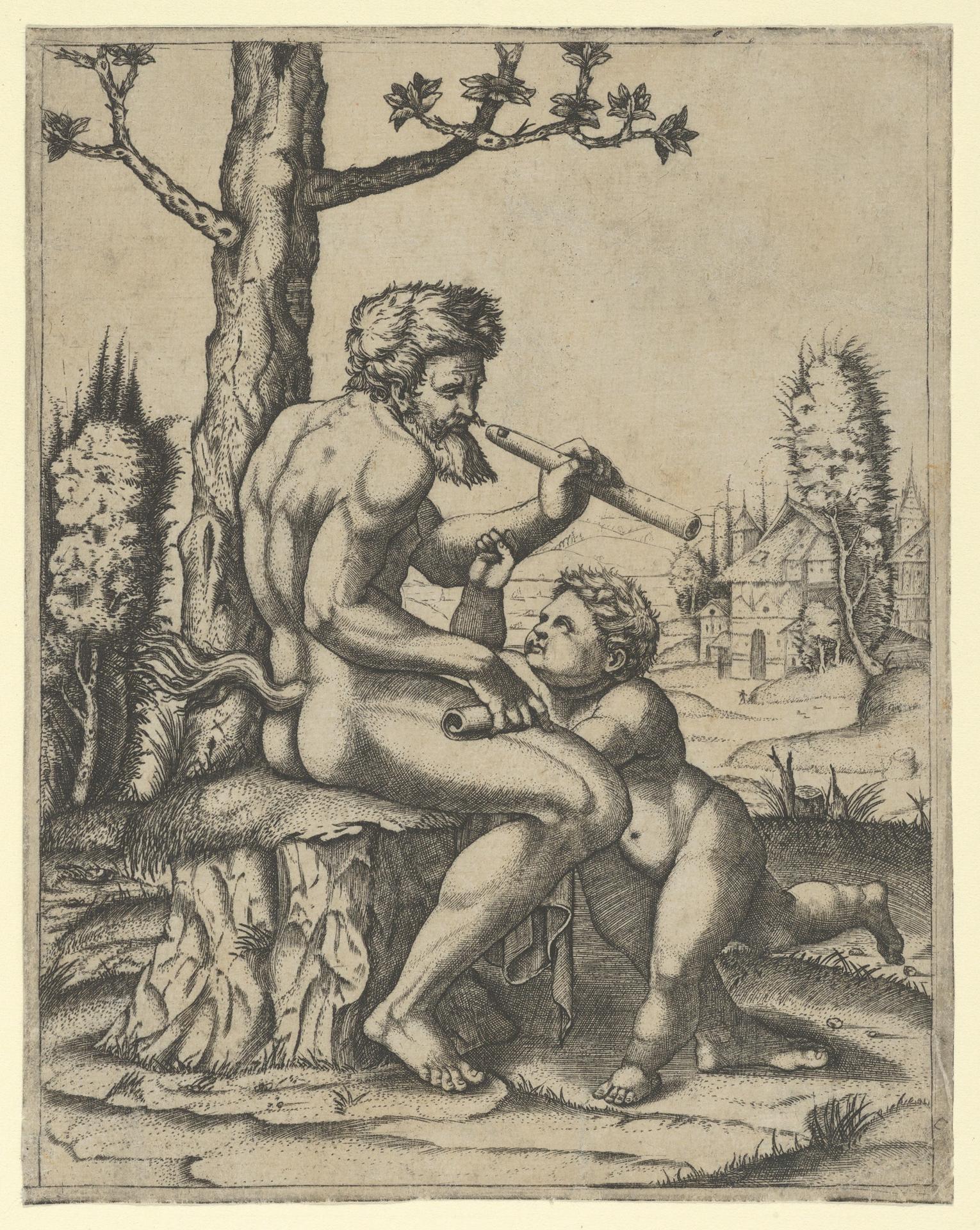
A faun sitting on a rock holding a flute in his left hand; a child stands between his knees
Original title: A faun sitting on a rock holding a flute in his left hand; a child stands between his knees
kurzbeschreibung
This engraving by Marcantonio Raimondi, made around 1510–27, shows a faun seated on a rock, holding a flute in his left hand. A child stands between his knees, reaching for the instrument. The print is one of the fine examples of Renaissance printmaking.
Description
A faun sits on rocky ground, a flute in his left hand. Between his knees stands a child, eyes turned toward the faun, right hand reaching for the flute. Trees, bushes, and a village with houses and towers form the landscape setting. Precise linework and hatching create light and shadow. The style is that of the Renaissance, with carefully detailed lines and clear figure structure.
Context
Marcantonio Raimondi, an Italian Renaissance engraver, is best known for his reproductions after Raphael. This print was made around 1510–27 during his time in Rome. The faun motif was popular in antiquity and the Renaissance and often appeared in mythological scenes. No definitive source for this work has been established, but it demonstrates Raimondi's skill in combining figural compositions with landscape elements.
Impact
The calm arrangement and delicate linework give the print a harmonious yet lively presence. The interaction between faun and child creates an intimate, almost playful mood that draws the viewer into the scene.
Technique
Engraving as a technique involves incising lines into a metal plate and then printing them on paper. Raimondi used precise hatching to achieve effects of light and shadow and to give volume to figures and landscape. Measuring about 17.7 x 13.8 cm, this is a compact, highly detailed print.
AI-generated description text
Source: Metropolitan Museum of Art · Public Domain (CC0 1.0)