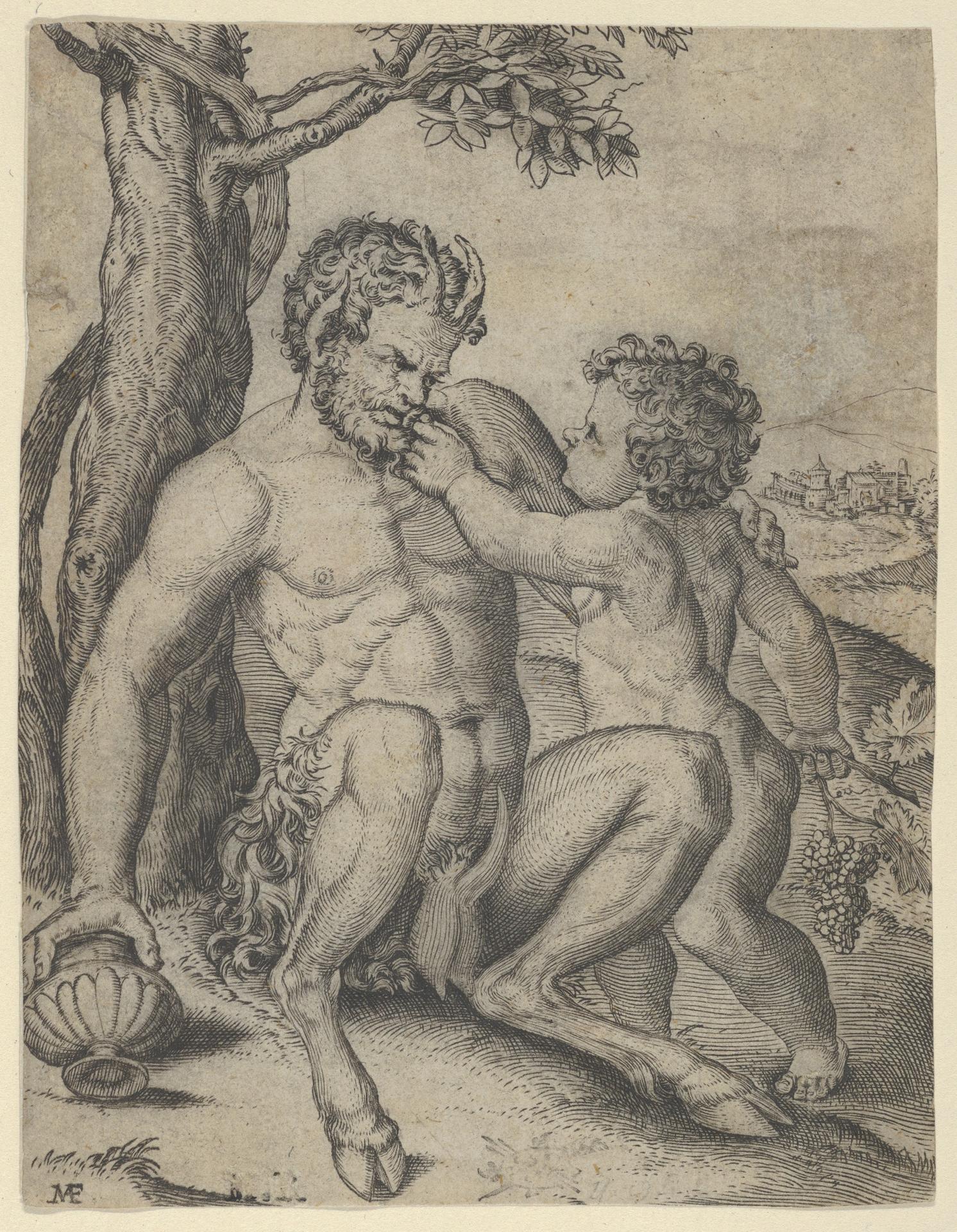
Satyr and Child
Original title: Satyr and Child
kurzbeschreibung
This engraving by Marcantonio Raimondi dates from around 1515–16. It depicts a seated satyr holding a child on his lap, set within a naturalistically rendered landscape. The print is an example of the carefully executed printmaking of the Italian Renaissance.
Description
The satyr has taken his place on a tree trunk; his naked, muscular body bears horns on his head. A naked child rests on his lap, and he raises the child's hand to his lips as if to silence him. Grapes and leaves fill the foreground, while behind them a landscape with suggested buildings opens up. Printed in black and white, the image employs detailed and extremely precise linework.
Context
Raimondi, an Italian engraver of the Renaissance, is known above all for his reproductive engravings after designs by artists such as Raphael. This print falls around 1515–16, when Raimondi was working in Rome and closely associated with Raphael's workshop. The pair of satyr and child draws on ancient mythological subjects that were popular in the Renaissance. Small-format engravings of this kind were prized as collectors' items and also served as study material.
Impact
The high-contrast black-and-white scheme and the carefully controlled line give the print great graphic clarity. Between the satyr's calm posture and the child's intimate gesture, a quiet, almost tender mood arises. The precision of detail and the classical choice of subject make the work appear skilful and internally balanced.
Technique
For printing, the design was engraved into a copper plate and then pulled—the process of engraving. Fine, precise lines and differentiated hatching characterize Raimondi's hand. The print measures 12.3 × 9.5 cm and is in black and white.
AI-generated description text
Source: Metropolitan Museum of Art · Public Domain (CC0 1.0)