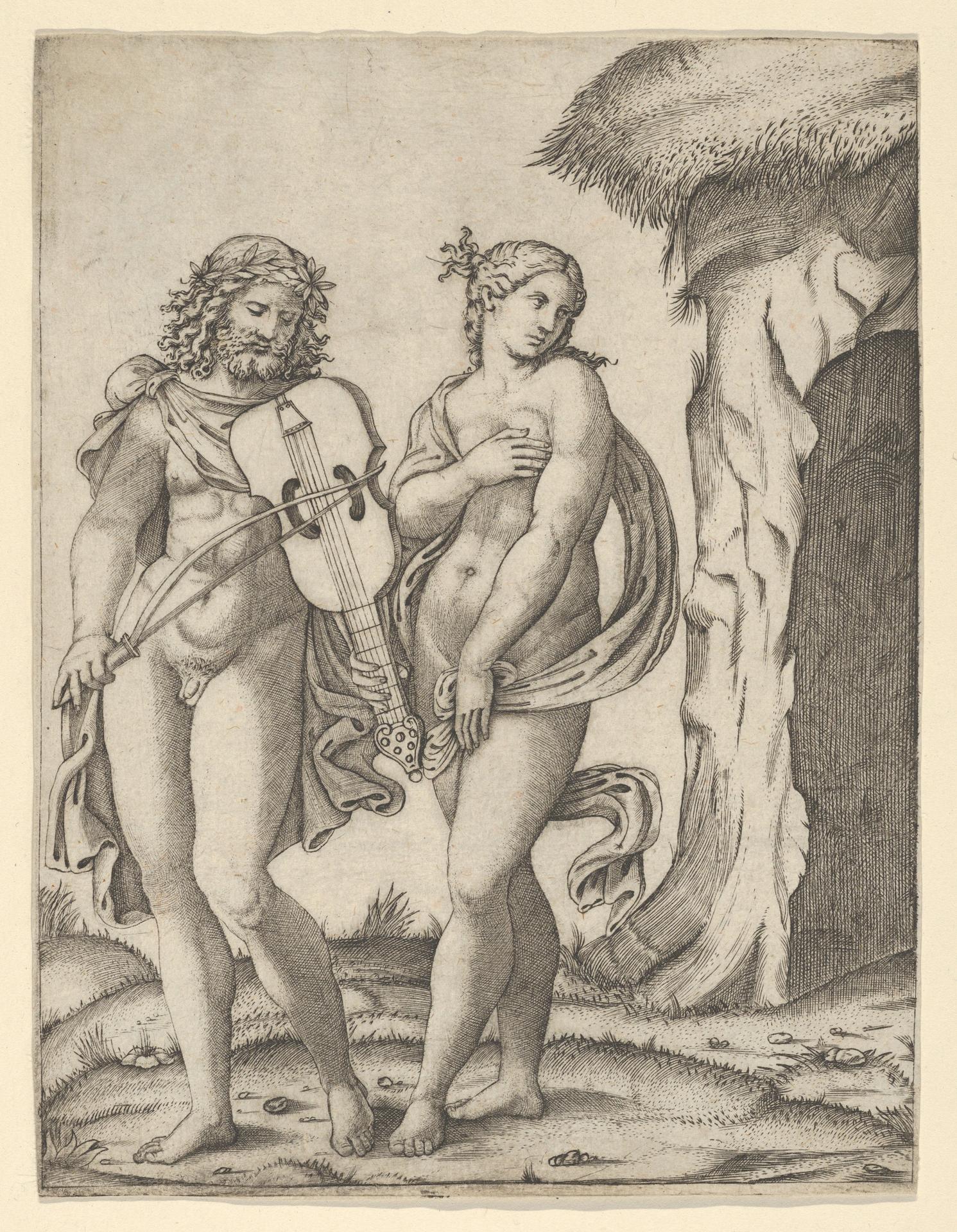
Orpheus standing at left playing the violin, Eurydice at right covering herself
Original title: Orpheus standing at left playing the violin, Eurydice at right covering herself
kurzbeschreibung
Unlike the usual Orpheus prints, this engraving by Marcantonio Raimondi from around 1509 places the singer on the left with a violin, while Eurydice on the right draws a cloth around herself. The subject measures 17.6 × 13.3 cm and belongs to the medium of engraving.
Description
Two figures face one another: on the left Orpheus with curly hair and a flower in it, barefoot, a sash across his shoulder, the violin held by a ribbon; on the right Eurydice, also with curls and a flower, barefoot, a cloth around her waist, her arms crossed, holding the fabric in front of her. A tree trunk and a piece of roof close off the space, while grass and stones form the ground. Even light falls across everything, with no strong shadows or highlights.
Context
Raimondi, an Italian engraver of the Renaissance, became known above all for reproductive prints after designs by artists such as Raphael. Around 1509 he was working in Rome and at the same time engaging with antique motifs and the art of his own day. That Orpheus here plays a violin departs from the tradition that otherwise assigns him a lyre; the instrument was still relatively new at the time.
Impact
The mirrored arrangement of the two figures and their calm, classicizing bearing give the sheet its balance. Because it is printed only in black, the quality of line and wealth of detail come to the fore, lending the view a distinguished graphic presence.
Technique
The work was done in engraving: lines are cut into a copper plate, the plate is inked and pulled on paper. Raimondi used fine, precisely placed lines to capture the texture of hair, fabric and landscape, which accounts for the high standard of his prints.
AI-generated description text
Source: Metropolitan Museum of Art · Public Domain (CC0 1.0)