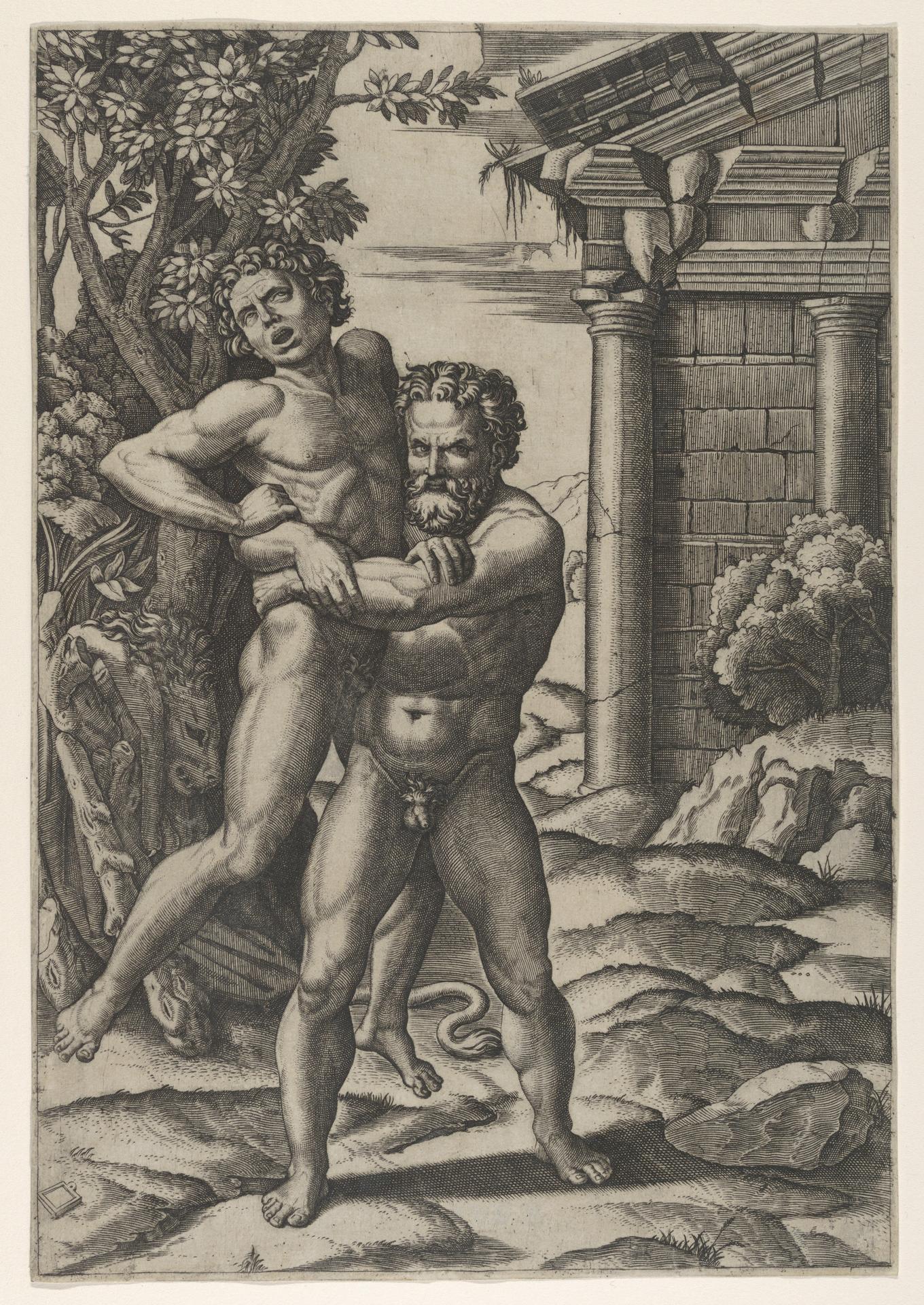
Hercules holding Antaeus by the waist and lifting him off his feet
Original title: Hercules holding Antaeus by the waist and lifting him off his feet
kurzbeschreibung
Around 1520–22 Marcantonio Raimondi translated the wrestling match between Hercules and the giant Antaeus into engraving. The hero grips his opponent by the neck and tears him up off the ground while Antaeus cries out. The result is a tightly worked print on a theme from classical legend.
Description
With the burin Raimondi keeps Hercules firmly in Antaeus's hold: one wrestler seizes and hoists his rival, the other roars. Both bodies are powerfully built, yet the heads differ — a carefully trimmed beard and hair on one, short curling locks on the other. Ancient columns rise behind the fighters, with trees and rocks between them. Dark passages sit beside light areas, and a dense web of lines and hatching gives structure to bodies and surroundings alike.
Context
Raimondi, a printmaker of the Italian Renaissance, became known above all for his engravings after Raphael. This sheet belongs to his Roman years and was made around 1520–22. The struggle of Hercules against Antaeus was a favourite subject already in antiquity and again in the Renaissance; it was often read as an emblem of virtue overcoming brute strength.
Impact
The strained bodies and Antaeus's desperate cry carry an immediate sense of movement. Fine hatching and the play of light and dark give the action spatial depth. The ancient columns behind help the print keep its classical tone.
Technique
As an etching, the image is produced by biting the drawing into a metal plate. Raimondi worked with thin lines and crossing hatching to bring out muscles and shadow. How surely he guided the burin shows in the clear execution and the good quality of the impression.
AI-generated description text
Source: Metropolitan Museum of Art · Public Domain (CC0 1.0)