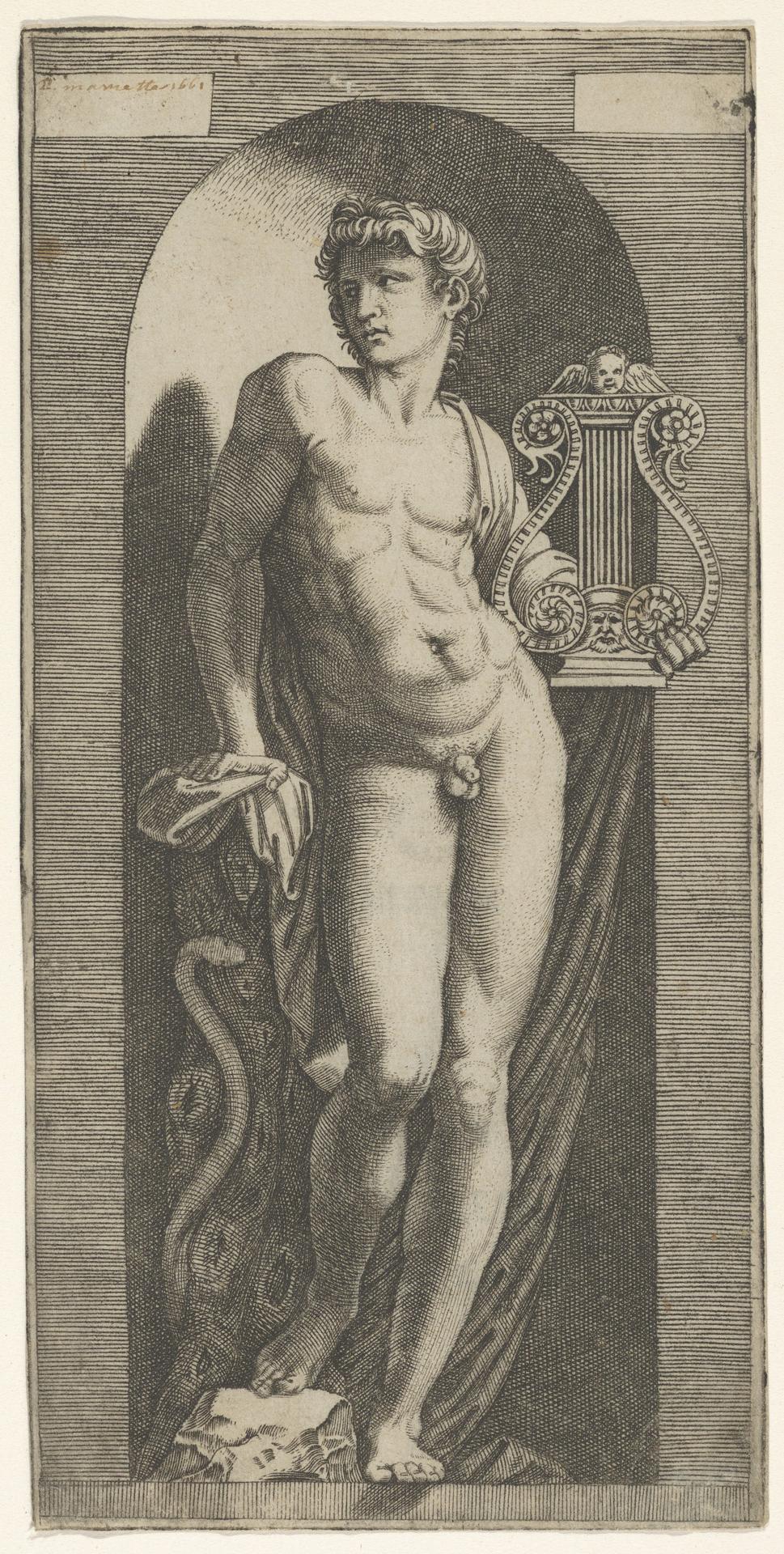
Apollo in a Niche
Original title: A statue of Apollo, naked standing in a niche, holding a lyre in his left hand and leaning on a tree trunk
kurzbeschreibung
Around 1512–15, Marcantonio Raimondi produced this engraving of a nude statue of Apollo set within a niche. The god holds a lyre in his left hand while leaning with his right on a tree trunk. It is an example of the printed reproduction of antique sculpture in the Renaissance.
Description
Apollo stands frontally in a semicircular niche, which a dark background and a frame make prominent. The muscular, athletic body is rendered with a calm, pensive expression. On the left, a snake coils around the tree trunk; on the right, part of a lyre ornament with a small angel is visible. The layout feels symmetrical: Apollo occupies the center, and the two side elements are subordinate to him. The image is monochrome, with light and shadow created by fine lines and hatching.
Context
Marcantonio Raimondi, an Italian engraver of the Renaissance, became known for his reproductions after works by Raphael and antique sculptures. The print was made at a time of great interest in antiquity in Italy. Raimondi worked in Rome, where he had access to ancient monuments and sculptures. The motif follows the classical ideal of antiquity that was revived in the Renaissance.
Impact
The clear linework and symmetrical arrangement give the print a calm, elevated mood. The nude, idealized body creates an aesthetic effect that recalls antique statues and emphasizes the beauty of the human form. Fine shading gives the figure a sculptural presence that remains palpable despite the small format.
Technique
This work was made as an etching, an intaglio process in which the drawing is etched into a metal plate. Raimondi used fine lines and cross-hatching to create modeling and shadow. The print is executed in the manner of copper engraving, which allows for high precision and detail.
AI-generated description text
Source: Metropolitan Museum of Art · Public Domain (CC0 1.0)