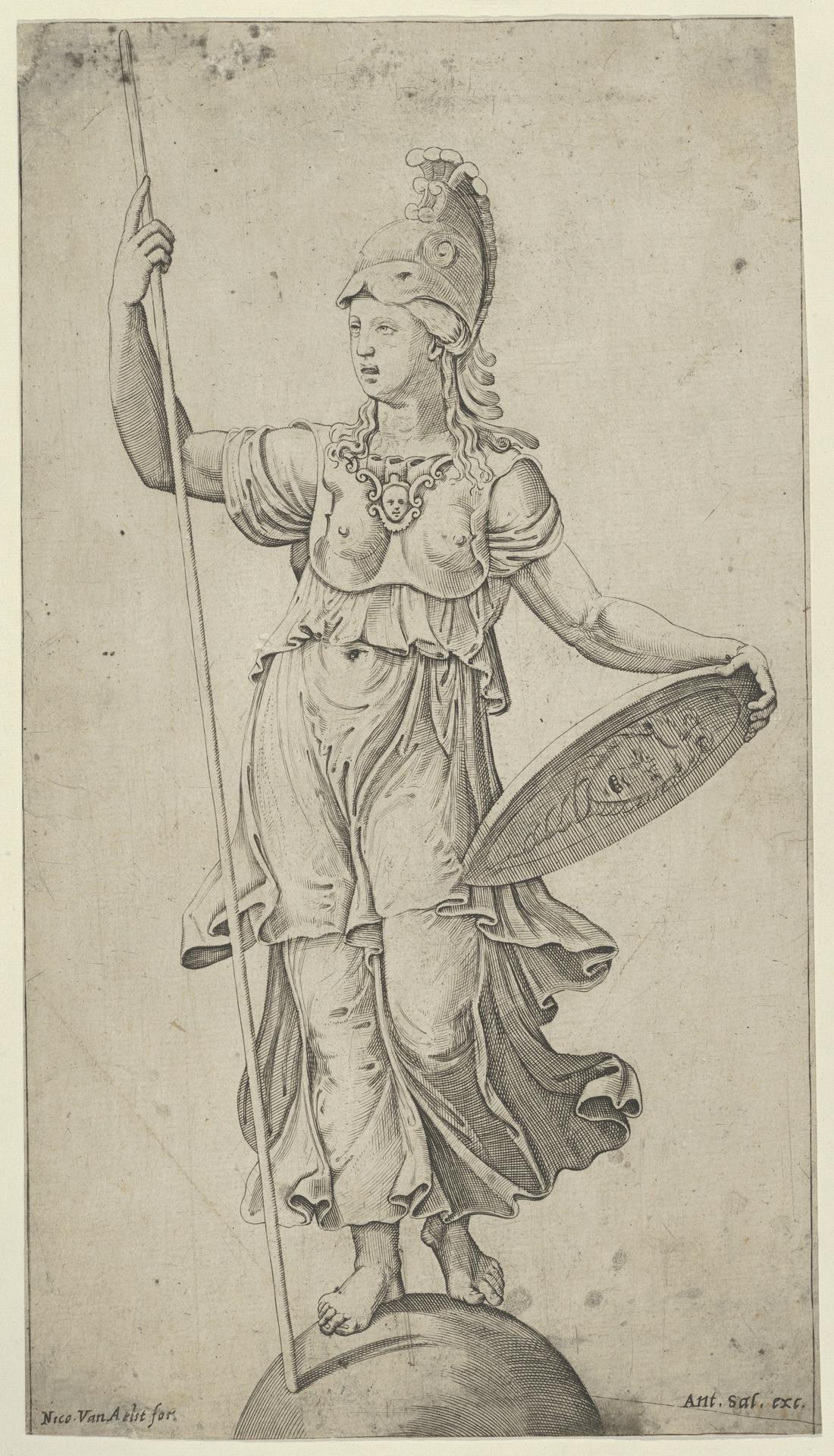
Pallas Athena standing on a globe, holding a spear in her left hand and her shield in her right
Original title: Pallas Athena standing on a globe, holding a spear in her left hand and her shield in her right
kurzbeschreibung
Athena, also called Pallas Athene, stands in full armour on a sphere; her left hand holds a lance, her right a round shield. This engraving by an unknown Italian artist was made between about 1520 and 1540, placing it in the printmaking of the Renaissance.
Description
Upright and facing forward, the goddess looks out of the picture with her feet set on a sphere. Helmet and armour with a breastplate, on which a coat of arms or emblem can be seen, surround the figure; the lance rises on the left, the round shield rests on the right. Fine lines and hatching bring out the textures and details of the armour. As is usual for an engraving, the sheet remains monochrome.
Context
This print was made in sixteenth-century Italy, when antiquity was eagerly revived. Athena was worshipped as a goddess of wisdom and war as well as a patron of the arts. Her standing on a sphere suggests dominion over the world and fate. The creator is not recorded, which was the rule for many utilitarian prints of those years.
Impact
The symmetrical layout and frontal orientation give the goddess something dignified and aloof. Thanks to the precise linework, the armour and surfaces appear almost metallic and rich in detail. The upright posture and direct gaze place the viewer in a distant, reverent sphere.
Technique
In engraving, lines are incised into a metal plate and then printed on paper. This process allows fine, exact lines and hatching with which armour and texture can be rendered. The monochrome printing ink corresponds to the usual practice of this technique.
AI-generated description text
Source: Metropolitan Museum of Art · Public Domain (CC0 1.0)