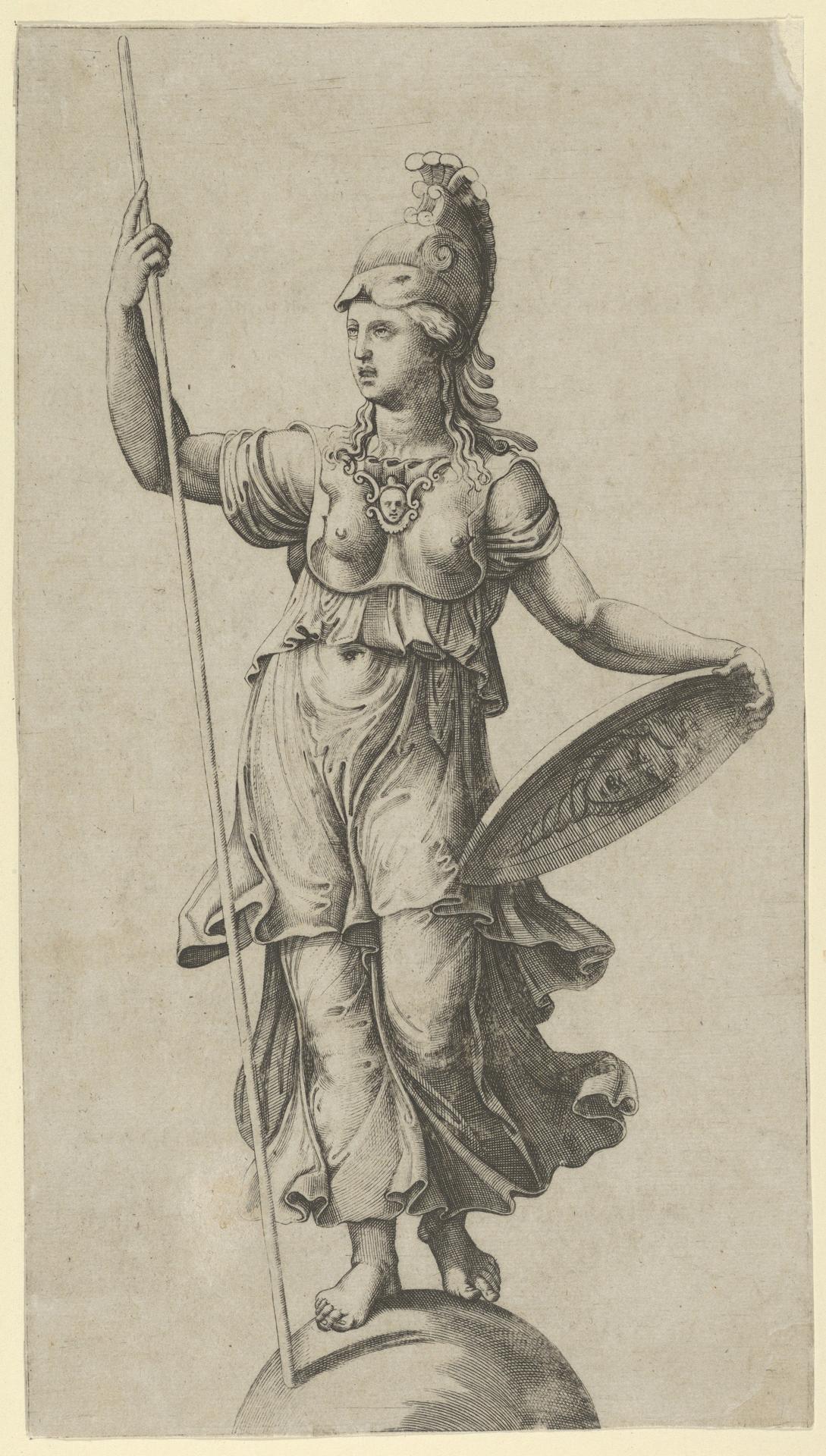
Pallas Athena Standing on a Globe
Original title: Pallas Athena standing on a globe, holding a spear in her left hand and her shield in her right
kurzbeschreibung
Unlike related prints that show Athene in profile or in combat, this engraving by an unknown Italian engraver of the early 16th century places the goddess in full armour frontally on a sphere. Spear, shield and helmet make visible both her warlike and her wise side.
Description
The figure stands upright on a ball shaped as a globe. A helmet covers her head, and the armour, with a small shield on the breast, is richly articulated. Her left hand holds a lance, while her right arm encloses a shield. Folds and shadows of the armour stand out clearly and make its roundness tangible. The background remains sparse and directs the gaze entirely to the figure in the middle.
Context
The sheet was made in Italy between 1520 and 1527, in the milieu of Renaissance-shaped art production. Anonymous engravers often worked for humanists and nobles who valued ancient deities as emblems of virtue and prudence. Athene as protectress and goddess of wisdom particularly suited this taste. Because engravings could be printed in large numbers, such images quickly spread throughout Europe.
Impact
The upright posture and sharp contours give the figure something dignified and watchful. Carefully placed shading makes her stand out plastically and reinforces her presence. Together they create an impression of strength and intellectual superiority that lingers in the viewer's mind.
Technique
Work was done in copper: the lines were engraved into the plate and then pulled onto paper. This process allows fine, precise strokes with which armour and folds are rendered in detail. Parallel and crossed lines create shadows that simulate volume and depth.
AI-generated description text
Source: Metropolitan Museum of Art · Public Domain (CC0 1.0)