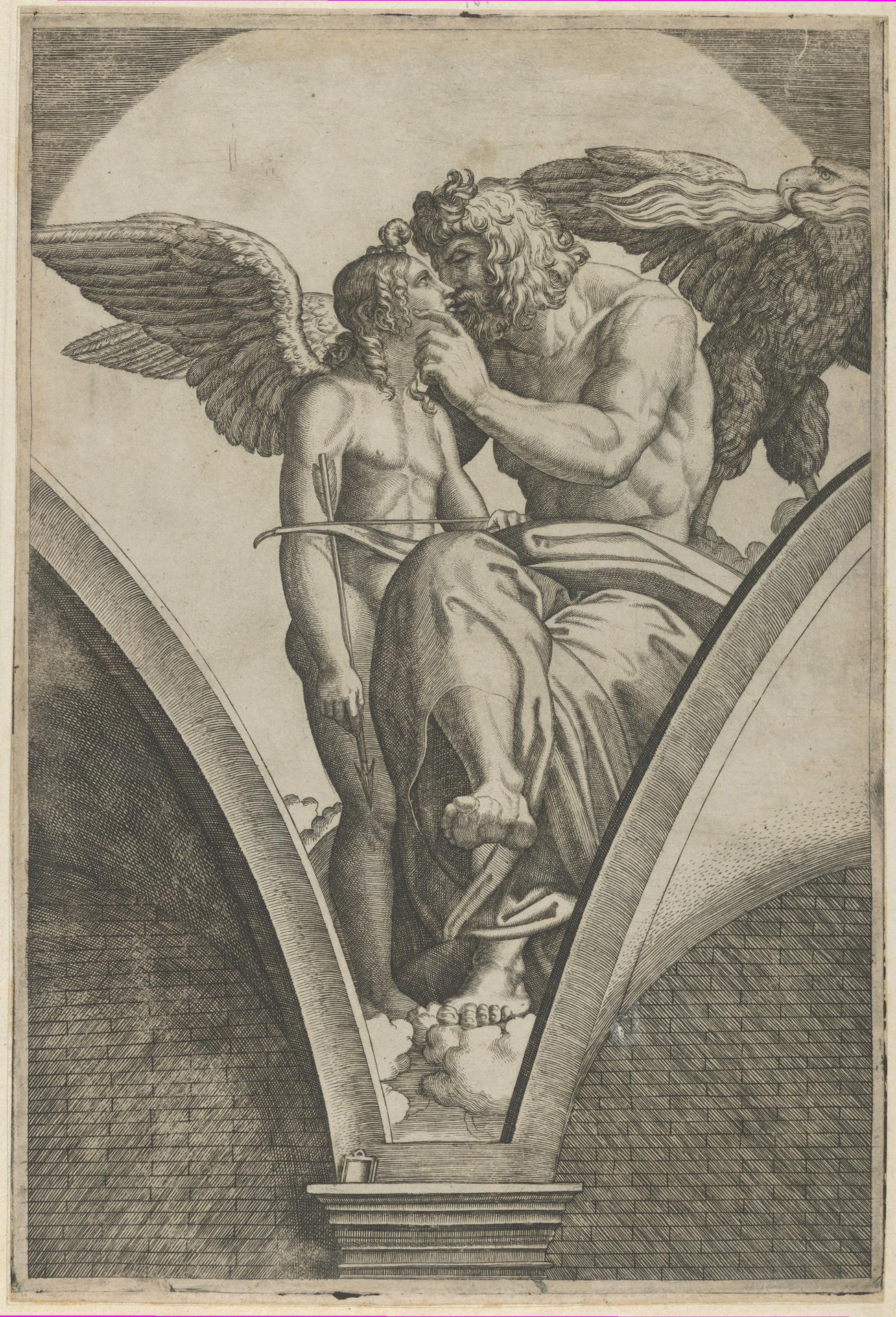
Jupiter embracing Cupid after Raphael's fresco in the Chigi Gallery of the Villa Farnesina in Rome
Original title: Jupiter embracing Cupid after Raphael's fresco in the Chigi Gallery of the Villa Farnesina in Rome
kurzbeschreibung
Jupiter wraps his arm around the winged Cupid, and that gesture is fixed in Marcantonio Raimondi's engraving from around 1517–20. The source was a now-lost fresco by Raphael in the Villa Farnesina in Rome. The print is among the early examples of reproductive printmaking in the Renaissance.
Description
On the right sits the bearded, muscular Jupiter with wings, above which an eagle hovers; on the left is the small, likewise muscular Cupid with bow and arrow. Both figures rest on a base framed by an arch. A masonry wall with a semicircular window forms the backdrop, and bright light falls through it. The layout is symmetrical, and the lighting from above sharpens the contours.
Context
Raimondi engraved after Raphael's fresco in the Chigi Gallery, which no longer exists. The Villa Farnesina belonged to the banker Agostino Chigi, an important patron of the Renaissance. Raimondi was among the first artists to circulate prints after works by Raphael, helping to popularize his compositions. The engraving was made at a time when demand for reproductions of antique and contemporary masterpieces was steadily growing.
Impact
Classical symmetry and the monumental treatment of the figures give the sheet an air both lofty and intimate. Light and shadow create a dramatic depth that draws the viewer into the mythological narrative. The tension between powerful masculinity and tender affection shapes the work's aesthetic.
Technique
For the engraving, lines were cut into the plate with a burin. This method allows fine, precise hatching that renders the modeling of the bodies and the effects of light in detail. The monochrome print emphasizes the graphic quality of the linework.
AI-generated description text
Source: Metropolitan Museum of Art · Public Domain (CC0 1.0)