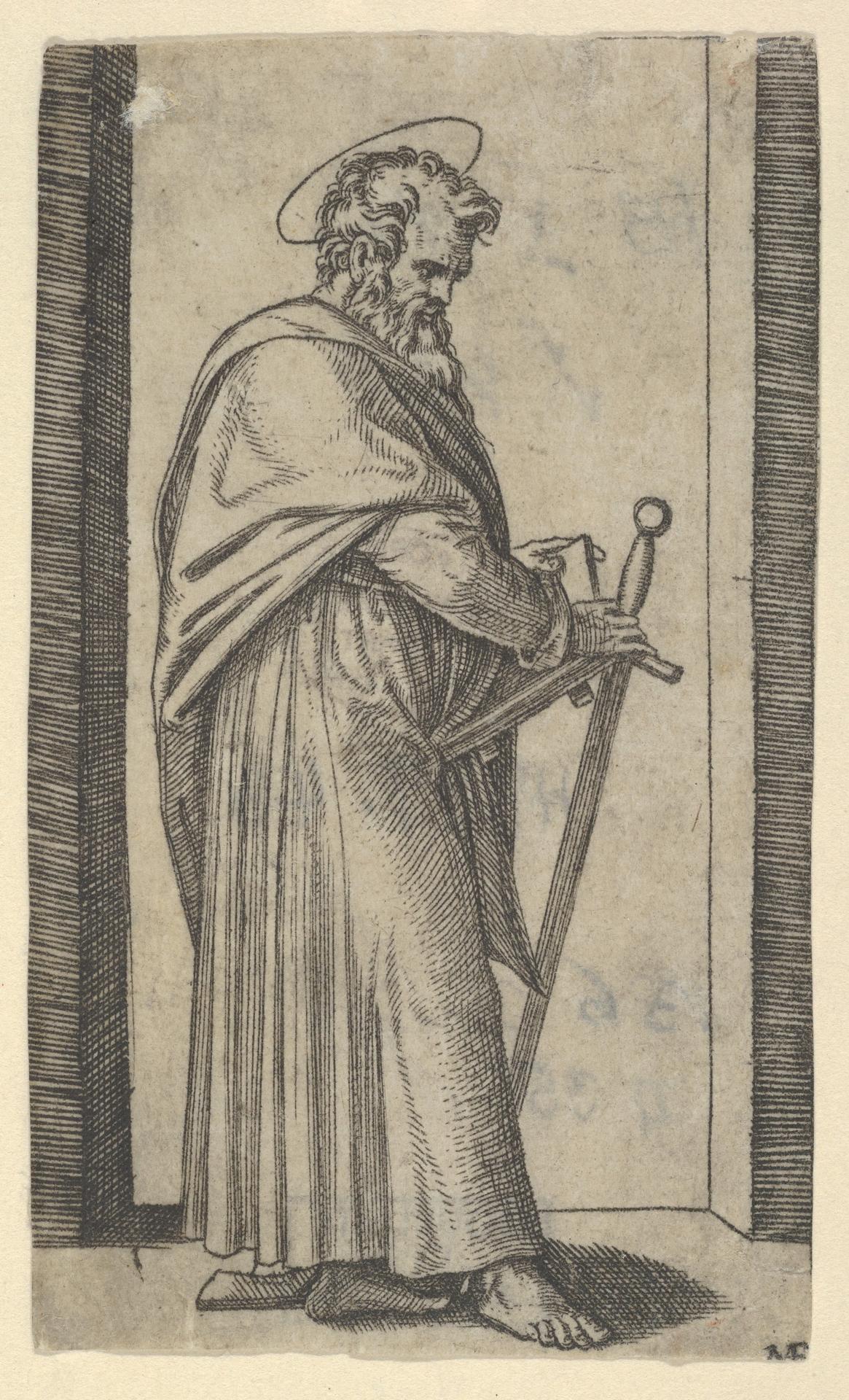
Saint Paul, sword in his right hand, from "Piccoli Santi" (Small Saints)
Original title: Saint Paul, sword in his right hand, from "Piccoli Santi" (Small Saints)
kurzbeschreibung
Unlike many images of Paul that place him in conversation or within a narrative scene, this one presents him alone. Marcantonio Raimondi's engraving, made between 1500 and 1527, shows Saint Paul full length, a sword in his right hand, a richly folded robe and a crown. The sheet belongs to the series "Piccoli Santi", a set of small-format devotional images.
Description
Paul faces the viewer squarely and fills the middle of the sheet, the sword in his right hand plainly visible. Many fold lines run through his robe, giving the fabric a sculptural presence. A crown rests on his head and signals his sanctity; his feet stay bare. Vertical strips behind him suggest an architectural structure or a frame. The layout is spare and devoted entirely to the figure of the saint.
Context
Marcantonio Raimondi, an Italian engraver of the Renaissance, became known above all for his reproductive prints after works by Raphael. The "Piccoli Santi" series came about during his Roman years and served as a model for devotional pictures. Small images of saints like this were widespread in the early sixteenth century and met both liturgical and private needs for piety. Through Raimondi's prints, Italian artistic forms spread across Europe.
Impact
Clear in its line and calm in the saint's posture, the sheet feels dignified and modest at once. Because the background stays reduced, the arrangement draws the eye straight to Paul's attributes and to his figure. The small format gives the print an intimate quality that suits devotion.
Technique
The lines were cut into a metal plate and then printed: an engraving. With fine, parallel hatching Raimondi modelled shadow and texture. The modest size of 8.0 x 4.7 cm demanded precise burin work, visible in the details of the robe and the facial features.
AI-generated description text
Source: Metropolitan Museum of Art · Public Domain (CC0 1.0)