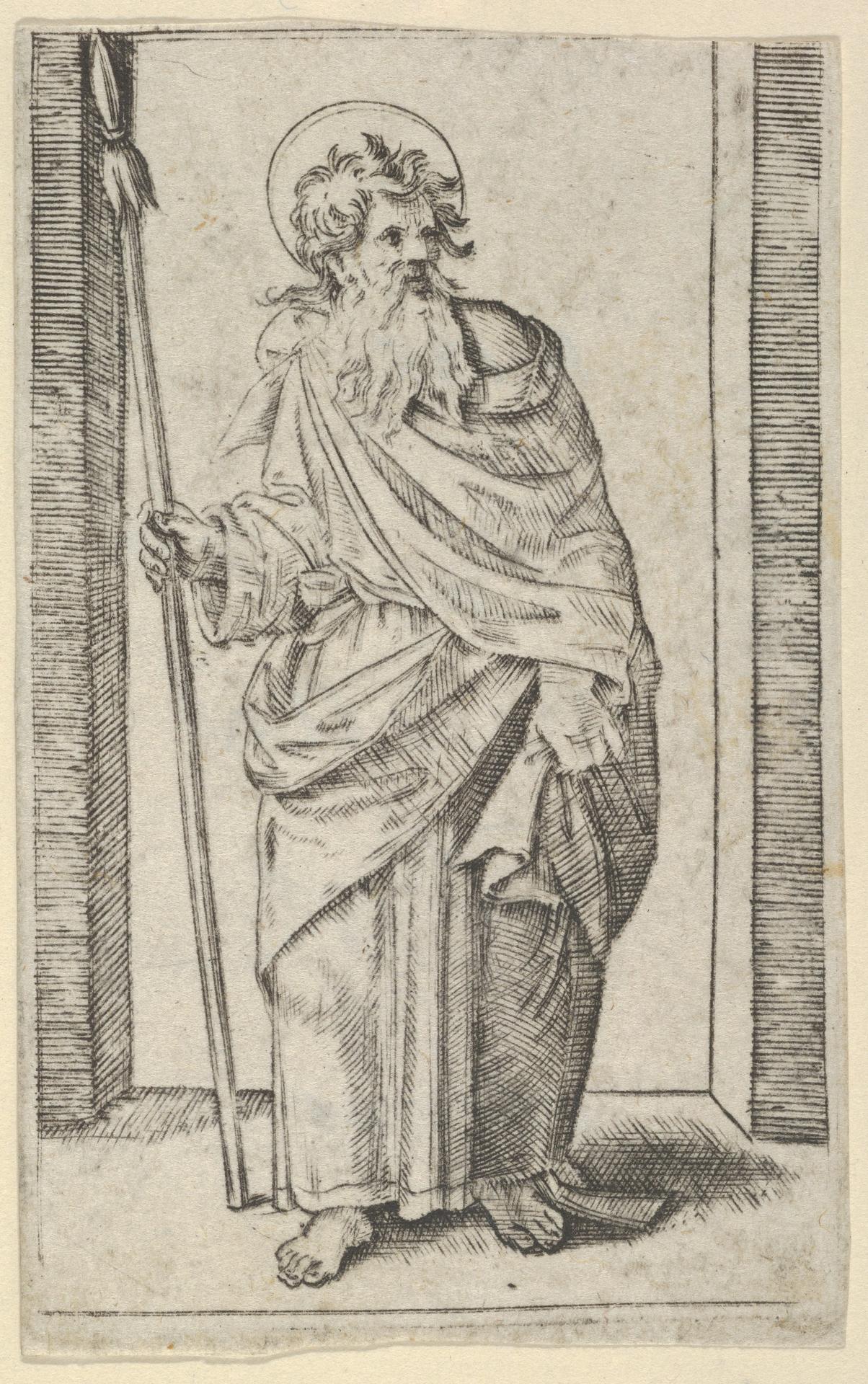
Saint Matthias, from "Piccoli Santi" (Small Saints)
Original title: Saint Matthias, from "Piccoli Santi" (Small Saints)
kurzbeschreibung
The apostle Matthias stands alone with a halo in this engraving by Marcantonio Raimondi, made between about 1500 and 1534. Executed in the medium of engraving, the sheet measures just 8.3 by 5.1 cm and belongs to a series of small-format depictions of saints.
Description
Matthias appears as a bearded man with long curly hair, a semicircular nimbus arching above his head. Over a folded garment he wears a simple, long-sleeved robe, and his feet remain bare. His right hand grips a long, tapering staff, likely the attribute of his martyrdom. The layout feels clear and balanced, with the apostle placed centrally within a plain frame. Worked in black and white, the carefully drawn lines stand out distinctly.
Context
Raimondi was among the most important engravers of the Italian Renaissance and became known above all for his reproductive prints after Raphael. The 'Piccoli Santi' series was produced in the first half of the 16th century and served both private use and the dissemination of religious images. Small-format saint depictions of this kind were common in the printmaking of the period and were used for devotion. Raimondi worked in Rome and Bologna and brought the technique of engraving to its perfection.
Impact
Quiet dignity and the balanced, central arrangement give the saint a monumental presence. The precisely guided lines create a contemplative mood that invites devotional use. Despite the small format, the figure remains elevated and composed.
Technique
For this print, the drawing was incised into a copper plate with a burin and then printed on paper. This method allows high precision and fidelity to detail, as can be seen in the fine structures of hair and drapery. The impression remained in black and white, as was usual for Renaissance printmaking.
AI-generated description text
Source: Metropolitan Museum of Art · Public Domain (CC0 1.0)