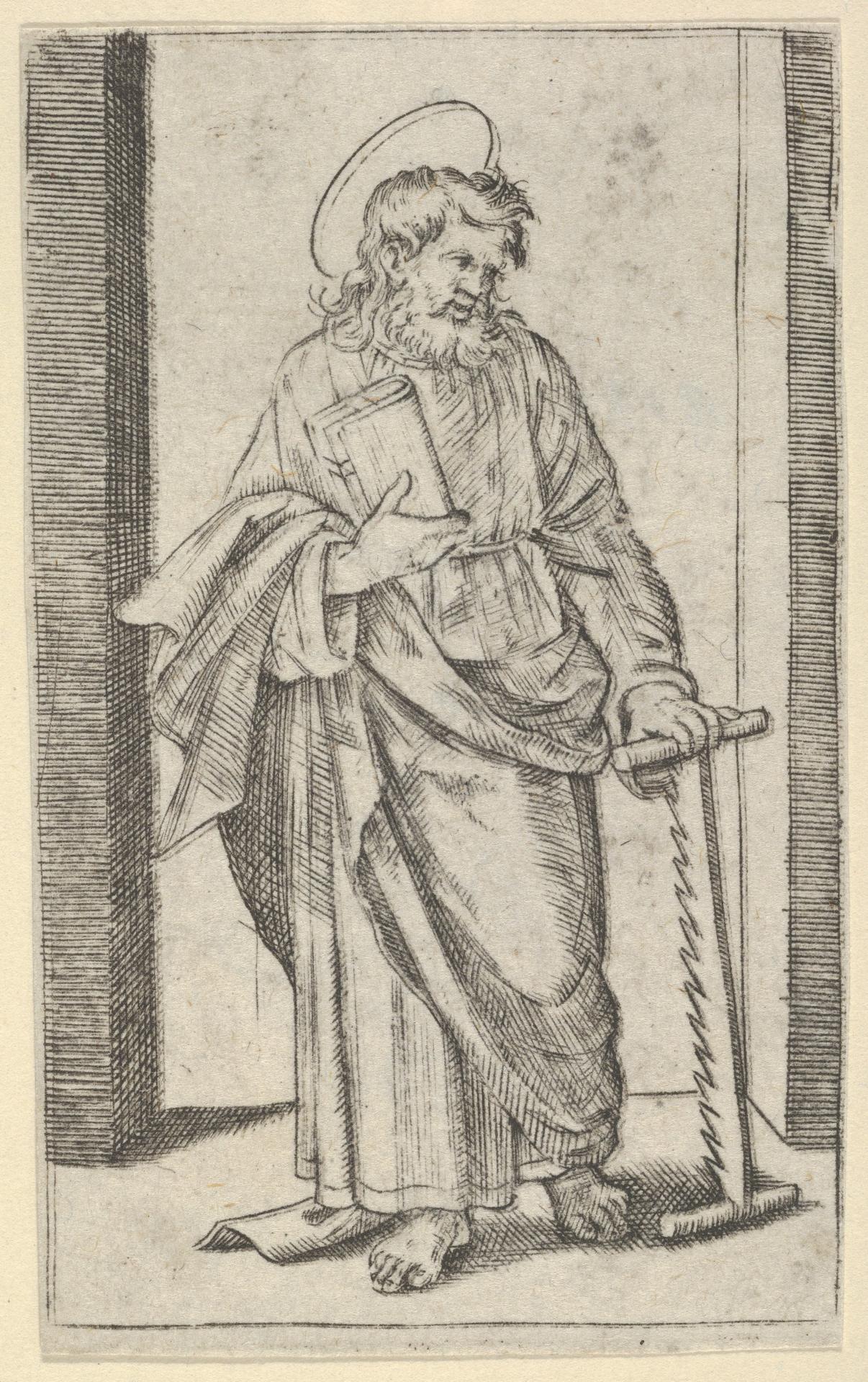
Saint Simon, a saw in his lowered left hand, from "Piccoli Santi" (Small Saints)
Original title: Saint Simon, a saw in his lowered left hand, from "Piccoli Santi" (Small Saints)
kurzbeschreibung
Marcantonio Raimondi made this engraving of Saint Simon holding a book in his right hand and a saw in his left. The print dates from around 1500–27 and measures 8.2 x 5.0 cm. It belongs to the 'Piccoli Santi', a series of small-format depictions of saints.
Description
Saint Simon stands upright, his gaze turned slightly to the left. He wears a mantle and a crown, as was common for Renaissance saints; his feet are bare. His right hand holds a book, his left a saw whose blade points toward the right hand. A plain border surrounds the figure. The image is black-and-white and monochrome, with fine lines and hatching defining garment and body.
Context
Raimondi, an Italian engraver of the Renaissance, is best known for his reproductive prints after works by artists such as Raphael. The 'Piccoli Santi' series was probably made in Rome in the first decades of the 16th century, where the artist was active. Small devotional images of this kind were widespread at the time and served private piety. The saw as Saint Simon's attribute alludes to his martyrdom.
Impact
A clear, calm arrangement and careful linework give the print a dignified presence. Its small format and monochrome execution make it feel intimate and invite concentrated looking. The dense hatching lends the saint plasticity without dissolving the flatness of the print.
Technique
For this engraving, lines were incised into a metal plate and then printed on paper. Fine hatching and precise lines are characteristic of Raimondi's working method. The reproduction remains black-and-white and monochrome, with even light and no strong shadows.
AI-generated description text
Source: Metropolitan Museum of Art · Public Domain (CC0 1.0)