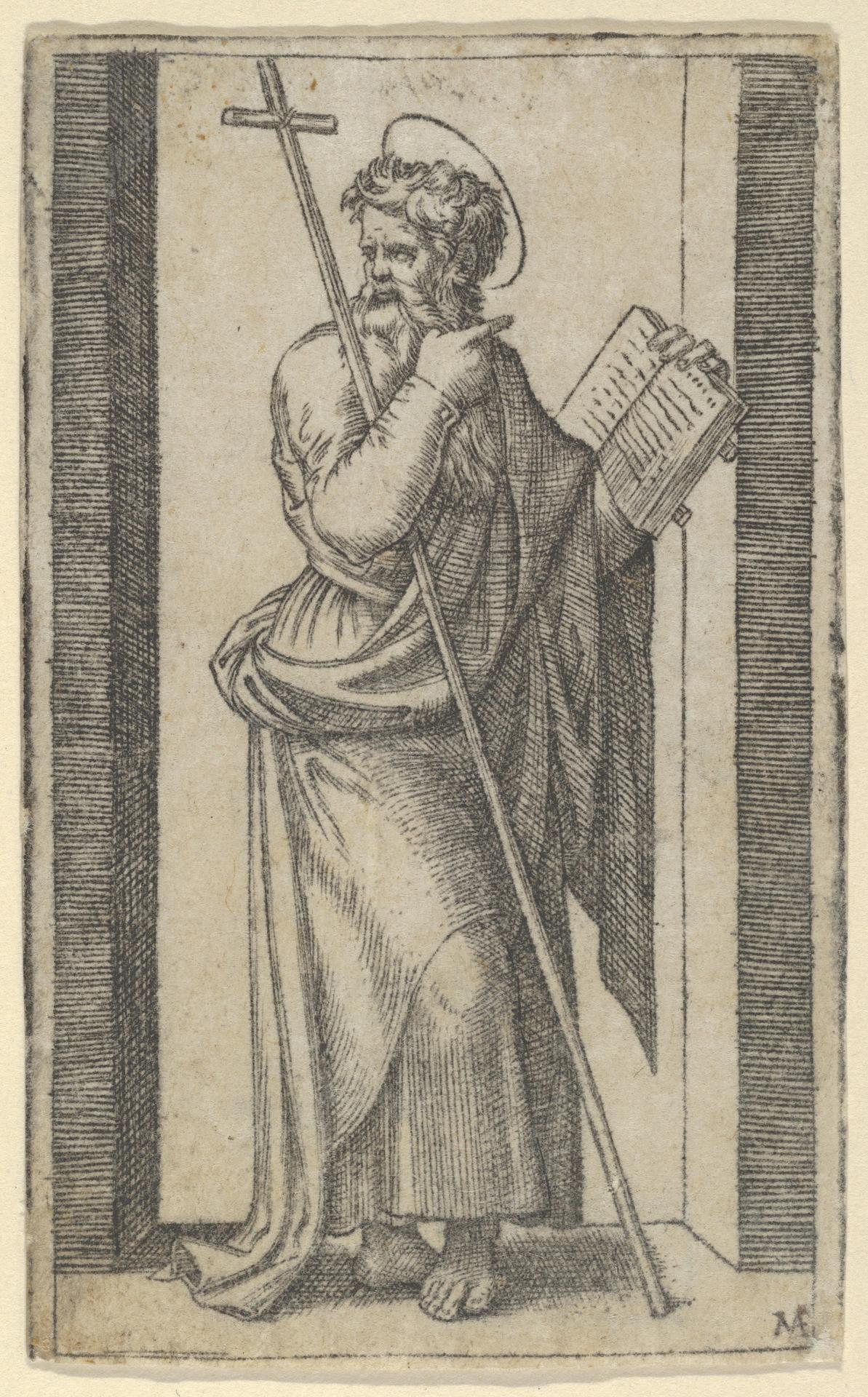
Saint Philip, book in his left hand, staff resting on his left arm, from "Piccoli Santi" (Small Saints)
Original title: Saint Philip, book in his left hand, staff resting on his left arm, from "Piccoli Santi" (Small Saints)
kurzbeschreibung
This engraving by Marcantonio Raimondi was made between about 1500 and 1527 as part of the 'Piccoli Santi' (Little Saints) series. It depicts the barefoot Saint Philip in a belted, long-sleeved garment; above his head appears a cross surrounded by a halo of rays. A book rests in his right hand, while his left points to the open page and a staff lies against his left arm.
Description
Philip stands full-length, his feet bare, his robe long-sleeved and tied at the waist. A cross hovers above him, framed by rays that signal his sanctity. The right hand holds a book, and the left points to its page; a staff rests against his left side. Vertical bands run through the background, suggesting columns, while the engraved lines and cast shadows give the sheet a sense of body.
Context
Raimondi, a Renaissance Italian engraver, is best known for reproductive prints after designs such as those by Raphael. The 'Piccoli Santi' form a series of small devotional images from around 1500–27, intended for private piety. In early sixteenth-century Italy such prints circulated widely and offered a broad public affordable religious pictures.
Impact
Clear lines and the saint's calm, dignified pose create a devotional mood. Because the background stays plain, the eye turns entirely to the figure, whose spiritual presence stands out all the more.
Technique
The lines were cut into a copper plate with a burin, a method that allows fine, precise lines and graded shading, qualities prized in the Renaissance. The sheet measures 8.2 x 4.8 cm, matching the usual format of small devotional prints.
AI-generated description text
Source: Metropolitan Museum of Art · Public Domain (CC0 1.0)