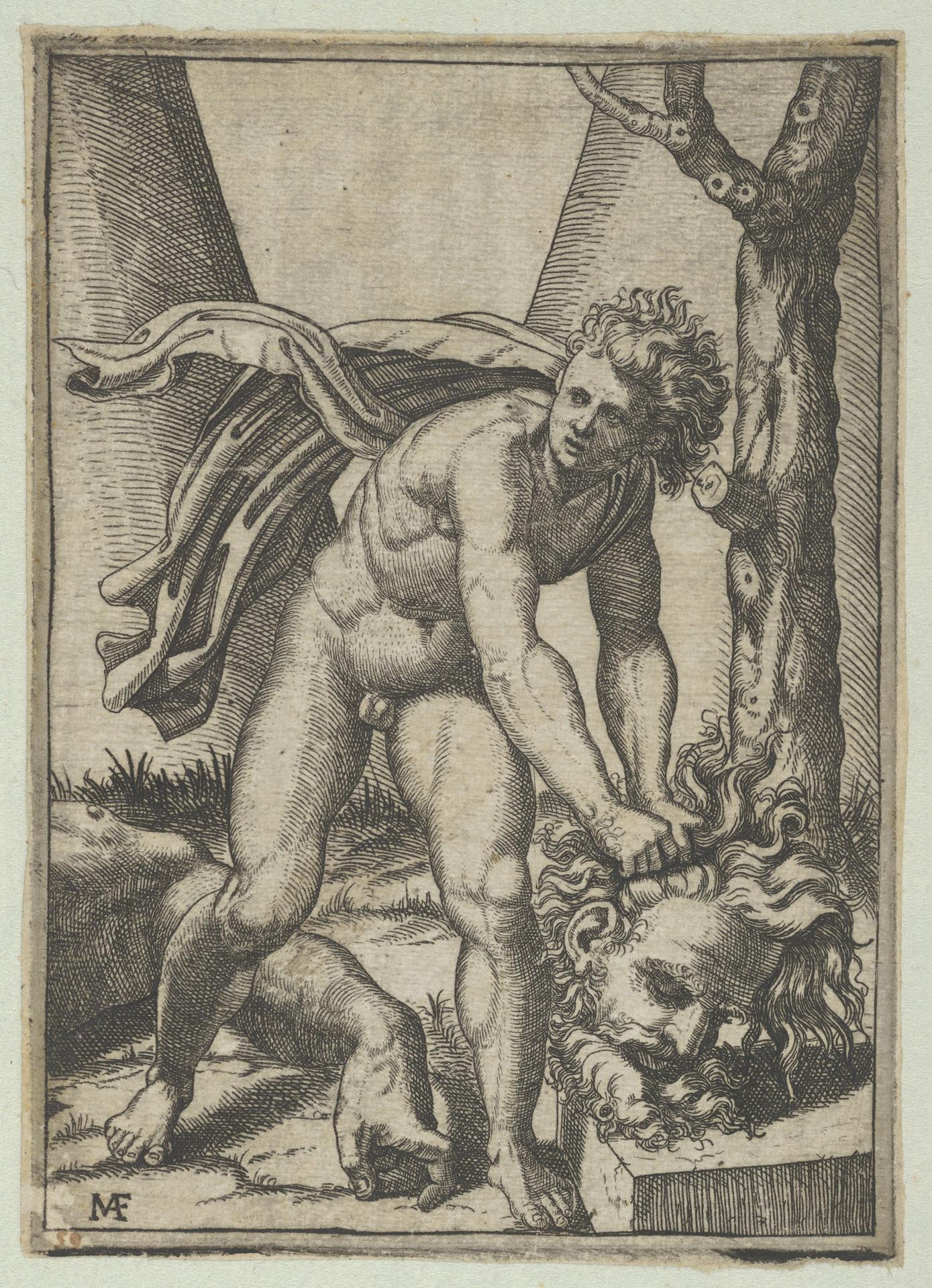
David with the Head of Goliath (ca. 1515–16, Met-Objekt 5700)
Original title: David with the head of Goliath
kurzbeschreibung
Marcantonio Raimondi made this print around 1515–16, presenting David with the severed head of Goliath. The biblical episode from the Old Testament is rendered as an etching with engraving. The young David is shown displaying the giant's head to the viewer.
Description
David stands at the center, looking to the right. A garment slips over his shoulder, and his hair is short and curly. His left arm is bent, and his hand holds the head of Goliath, which lies on the ground; the giant's long, curly hair and open mouth are clearly visible. Trees and grass suggest an outdoor setting. The layout remains clear and focuses entirely on the two figures.
Context
Raimondi, an Italian engraver of the Renaissance, became known above all for his reproductive engravings after designs by Raphael and other artists. This sheet dates from his Roman years, when he also turned to biblical subjects. David's triumph over Goliath was a popular motif in the Renaissance, standing for victory and divine providence.
Impact
The contrast between the upright David and the head lying on the ground shapes the tension of the print. The black and white of the print sharpens the contrasts and brings out the graphic structure. A sense of calm and finality pervades the moment, without the gestures losing any of their drama.
Technique
Here Raimondi combined etching with engraving. This interplay produces both soft, painterly lines and sharp, precise details, as can be seen in the rendering of hair and fabric. The black printing ink heightens the contrasts and the graphic quality of the sheet.
AI-generated description text
Source: Metropolitan Museum of Art · Public Domain (CC0 1.0)