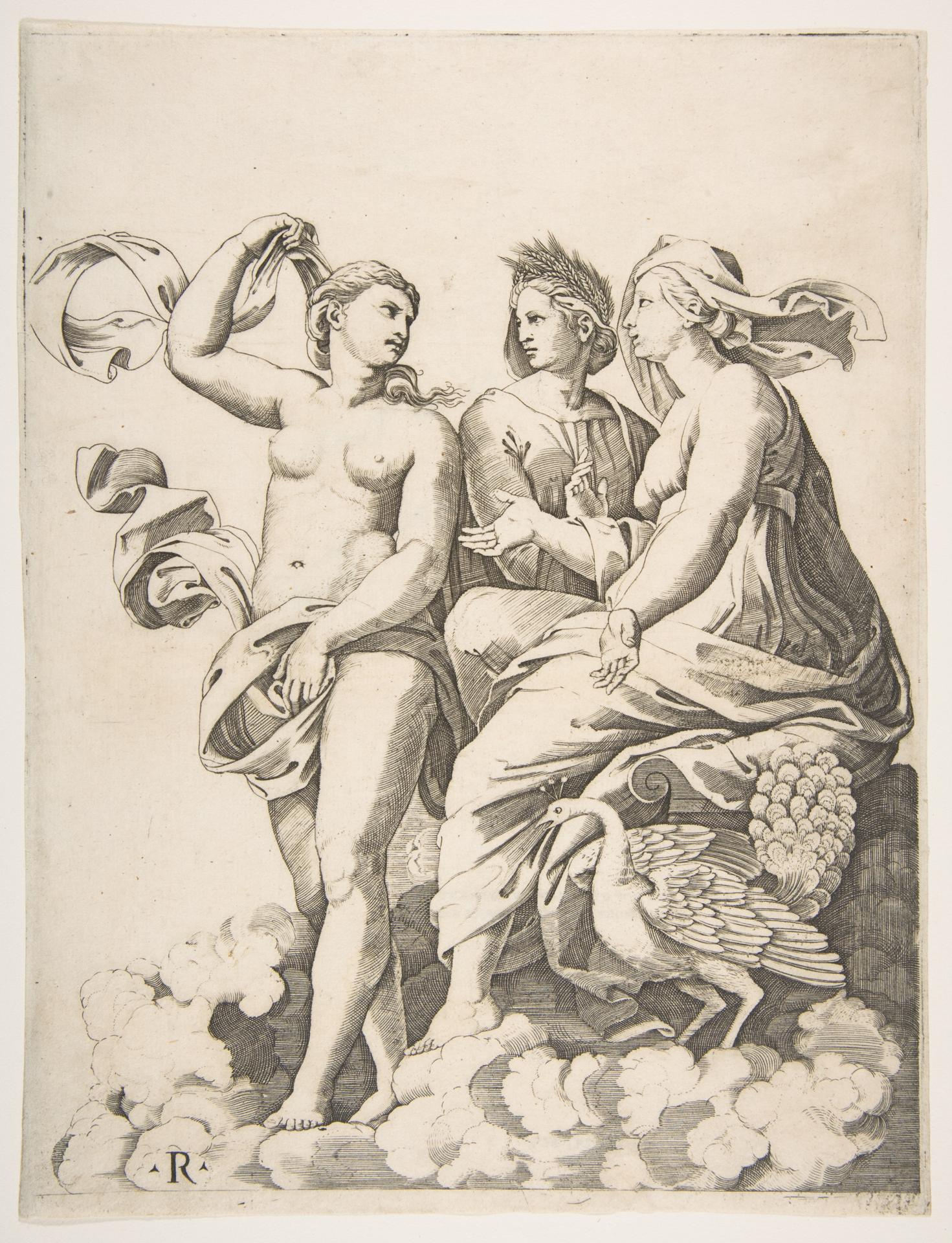
Juno, Ceres, and Psyche in the Clouds Conversing
Original title: Juno, Ceres, and Psyche in the clouds conversing, Juno seated with a peacock at her feet, Ceres wearing a garland of wheat and Psyche partially naked and holding a cloth
kurzbeschreibung
Marco Dente engraved this print between roughly 1515 and 1527. Three female figures converse among the clouds: Juno, a peacock at her feet, Ceres wearing a wreath of grain, and Psyche, half dressed, holding a length of cloth. The sheet ranks among the carefully finished examples of Renaissance printmaking.
Description
Three women sit facing one another in the clouds, spread across the image in a balanced arrangement. Psyche appears at the left, only partly clothed, a cloth in her hand. Ceres occupies the middle, robed and adorned with a wreath of grain and a crown. Juno stands at the right, fully dressed and likewise holding a cloth, with a peacock beside her on the ground. The forms follow classical Renaissance models, and even light draws out the contours. Because the print stays monochrome, the lines and the interplay of the figures stand out clearly.
Context
Dente was an Italian engraver of the Renaissance who worked in Marcantonio Raimondi's workshop. He became known above all for reproductive prints after antique and contemporary models. His career fell in a period when printmaking flourished in Italy and mythological subjects found a ready market among collectors. The motif of Juno, Ceres and Psyche draws on an ancient myth that was given fresh interpretation during the Renaissance.
Impact
Clear lines and a calm, well-poised layout draw the eye to the exchange between the three figures. The evenly spread light and the exact working of detail lend the sheet a noble, classical bearing characteristic of High Renaissance printmaking.
Technique
For this engraving the lines were cut into a copper plate and then pulled on paper. This method allows fine, precise strokes and a faithful rendering of figures and clouds. The single-colour ink emphasises the graphic effect, while shading comes about through parallel and crossing lines.
AI-generated description text
Source: Metropolitan Museum of Art · Public Domain (CC0 1.0)