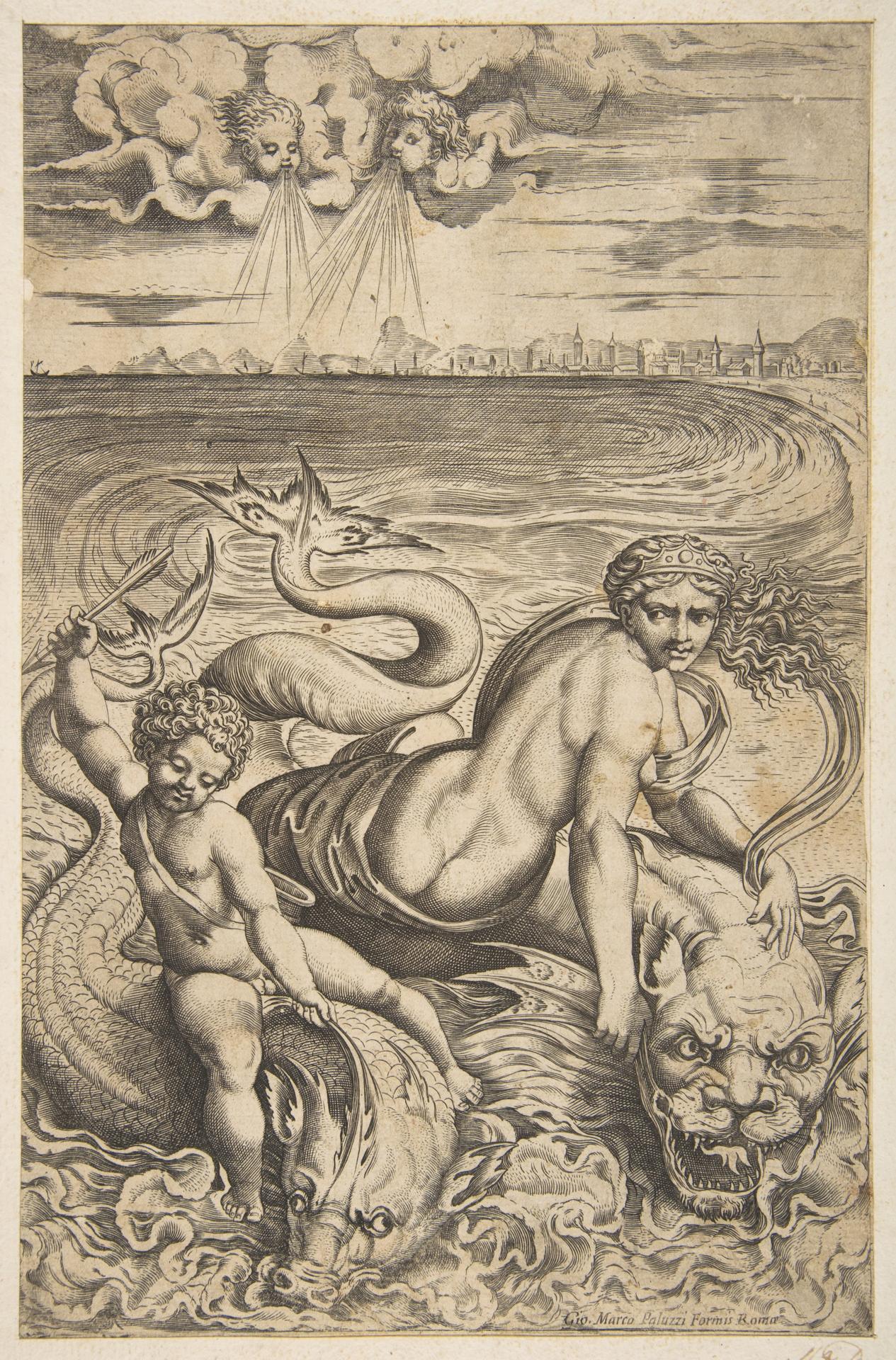
Venus and Cupid Riding on Sea Monsters (ca. 1515–27, Met-Objekt 5690)
Original title: Venus and Cupid riding two sea monsters, Cupid raises an arrow in his right hand, two heads representing wind in the clouds above
kurzbeschreibung
Around 1515–27, Marco Dente produced this engraving of Venus and Cupid riding two sea monsters. Cupid raises an arrow in his right hand, and above the scene two heads in the clouds suggest the winds. The work survives as a fine example of Italian Renaissance printmaking.
Description
Venus sits on the back of a large, agitated sea creature, while Cupid rides a smaller second monster. Cupid’s right hand lifts an arrow, ready to shoot. Above, in the clouds, two heads emit rays of light – likely wind gods. A coastal landscape with buildings and mountains closes the view at the rear. The arrangement feels dynamic, and the figures’ expressions are vivid.
Context
Marco Dente, an Italian Renaissance engraver, worked in the workshop of Marcantonio Raimondi. This print dates from the first half of the 16th century, when printmaking in Italy flourished. Collectors prized mythological subjects like this one, as they helped spread classical imagery. The Metropolitan Museum of Art makes the work available as public domain (CC0).
Impact
Your eye goes first to Cupid’s raised hand and the arrow that sets the direction. Line clearly separates light from shadow, giving the bodies volume. The dynamic layout and expressive faces create dramatic tension. The print feels at once concrete and poetic, as is characteristic of Renaissance art.
Technique
The engraving on paper is in black and white and uses fine hatching. Gradations of gray produce effects of light and space. The process allows high detail, evident in the sea creatures and the landscape.
AI-generated description text
Source: Metropolitan Museum of Art · Public Domain (CC0 1.0)