The Singer in Green
Original title: The Singer in Green
kurzbeschreibung
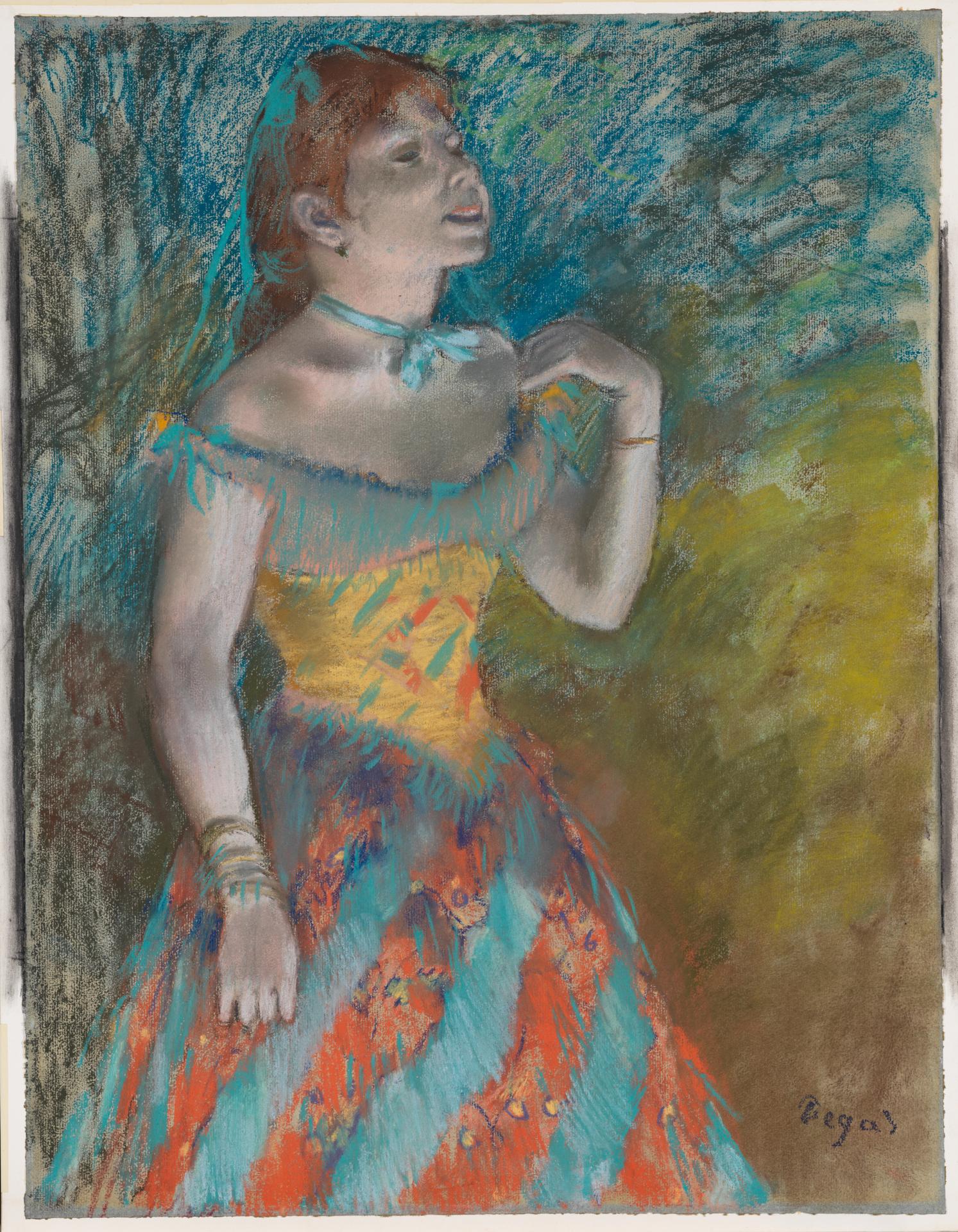
Around 1884, Edgar Degas made the pastel drawing 'The Singer in Green.' It features a red-haired singer in a brightly colored dress, captured in a lively pose. The sheet belongs to Degas's studies in which he explored movement and stage performances.
Description
The singer's light dress is composed mainly of reds and blues, with yellow and blue accents. With her head raised, she lifts one hand while the other rests on her knee—a stance that creates tension and dynamism. The background remains abstract, blending blue with greenish tones, giving an impression of motion and interplay of color. Diffuse light softens the colors. Typical of Degas, the emphasis lies on movement and color harmony.
Context
In the 1880s, Edgar Degas devoted himself increasingly to theater and opera. The Singer is part of a series of works that demonstrate his fascination with ballet and music. During this phase, he turned more and more to pastel, using it for studies of movement and light.
Impact
The lively pose and bold colors give the picture an immediate expressiveness. Diffuse light and abstract background elements create an atmosphere of closeness and movement that draws the viewer into the scene. The harmony of red, blue, and green lends the work a particular aesthetic depth.
Technique
The sheet is executed in pastel on light blue laid paper, which enhances the luminosity of the colors. Degas used pastel to achieve fine transitions and a soft texture. Precise strokes and flat areas of color show his mastery of this technique.
AI-generated description text
Source: Metropolitan Museum of Art · Public Domain (CC0 1.0)