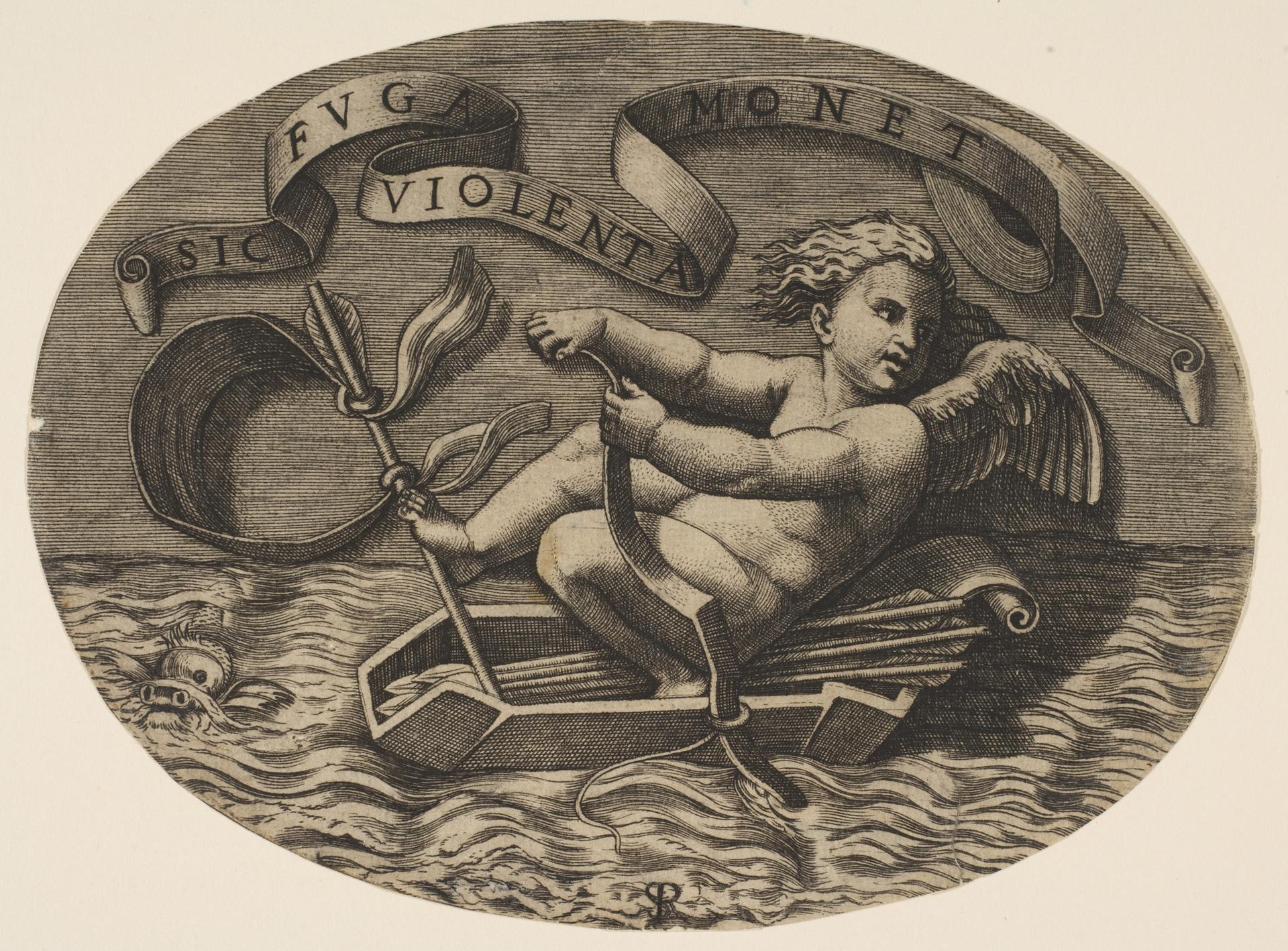
Eros escaping by sea using his bow to propel a boat made from his quiver with an arrow as the mast and his blindfold as the sail, a banderole above
Original title: Eros escaping by sea using his bow to propel a boat made from his quiver with an arrow as the mast and his blindfold as the sail, a banderole above
kurzbeschreibung
Unlike the usual depictions of Eros, this engraving by Marco Dente (ca. 1515–27) does not show the winged god of love aiming his bow and arrow; instead, he is in flight. In a boat made from his own quiver, he escapes across the sea. His bow serves as propulsion, an arrow becomes the mast, and his blindfold is turned into a sail. The print is regarded as a carefully executed example of Italian Renaissance graphic art.
Description
An oval vessel formed from Eros's quiver carries the god over the waves. Seated inside, he holds an arrow in one hand and steers the boat with the other. A blindfold covers his face and simultaneously acts as a sail. Below the boat, waves and a human head emerging from the water can be seen. Three bands with Latin inscriptions — 'FUGA MONET', 'SIC VIOLENTA', and 'VIOLENTA' — hover above the scene.
Context
The Italian engraver Marco Dente, active in the first half of the 16th century, was a pupil of Marcantonio Raimondi and produced numerous reproductive engravings after antique and contemporary models. For this work, he drew on the mythological figure of Eros, widespread in antiquity and the Renaissance. The Latin inscriptions suggest an allegorical reading that links the flight and the violence of love.
Impact
Clear lines and precise details define the print, pointing to the engraving technique of the Renaissance. The layout feels calm yet animated, lending the motif a timeless elegance. The use of the blindfold as a sail gives the scene a poetic and at the same time ironic touch.
Technique
In this engraving, the motif is incised into a copper plate and then printed on paper. Fine lines and hatching create a monochrome but detailed reproduction. The careful execution of figure and background speaks for the high craftsmanship of the artist.
AI-generated description text
Source: Metropolitan Museum of Art · Public Domain (CC0 1.0)