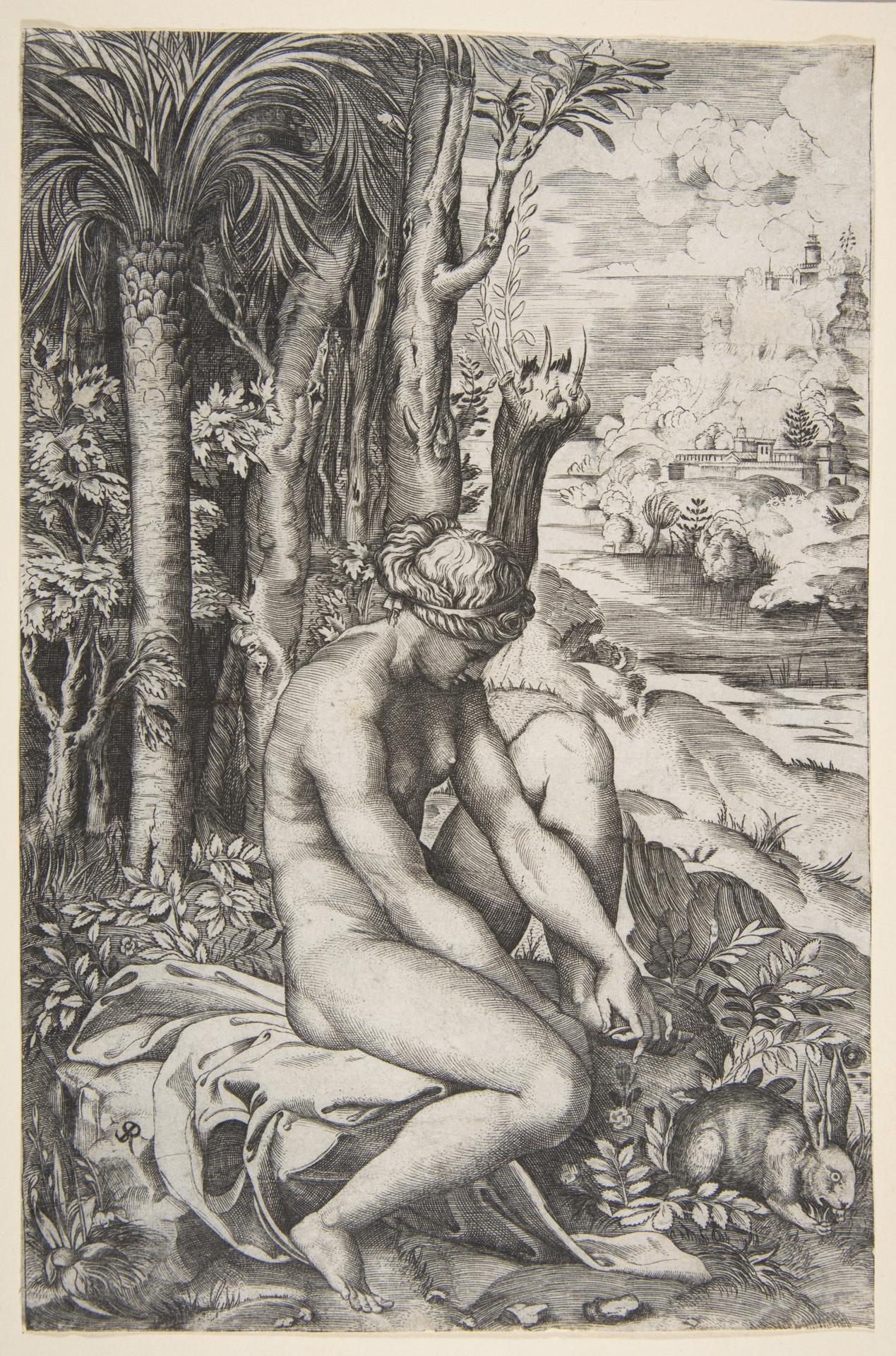
Venus removing a thorn from her left foot while seated on a cloth next to trees, a hare lower right
Original title: Venus removing a thorn from her left foot while seated on a cloth next to trees, a hare lower right
kurzbeschreibung
Marco Dente's engraving of around 1515–27 places a naked Venus on a spread cloth, where she bends to pull a thorn from her left foot. The upright plate measures 26,5 × 17,4 cm and sets the mythological subject within an idyllic stretch of countryside.
Description
Venus crouches on fabric laid over the ground, her body bare and her head wrapped in a cloth. Leaning slightly forward, she works the thorn loose from her left foot with both hands. A hare appears at the lower right, a small sign of the natural setting. Trees, palms, a river, a bridge and a building close off the view. The arrangement feels balanced, and clear lines with hatching build up light and shade.
Context
The Italian engraver Marco Dente, a pupil of Marcantonio Raimondi, worked in Rome in the first half of the sixteenth century, translating antique and Renaissance models into prints. The thorn-pulling Venus draws on a well-known ancient tale that was taken up often in the Renaissance. The sheet was probably made as part of a series of mythological subjects for collectors and lovers of art.
Impact
The calm, harmonious layout invites quiet looking. Delicate lines and soft hatching give the nude Venus an almost sculptural presence, while the landscape behind her carries a poetic mood. Mythological figure and natural surroundings together produce a timeless, idealised atmosphere.
Technique
For this engraving the lines were cut into a copper plate and then printed on paper. The method allows precise detail and a wide range of tones through hatching of varying density. The sheet is trimmed, as the note 'Sheet (Trimmed)' indicates, which points to later handling or framing.
AI-generated description text
Source: Metropolitan Museum of Art · Public Domain (CC0 1.0)