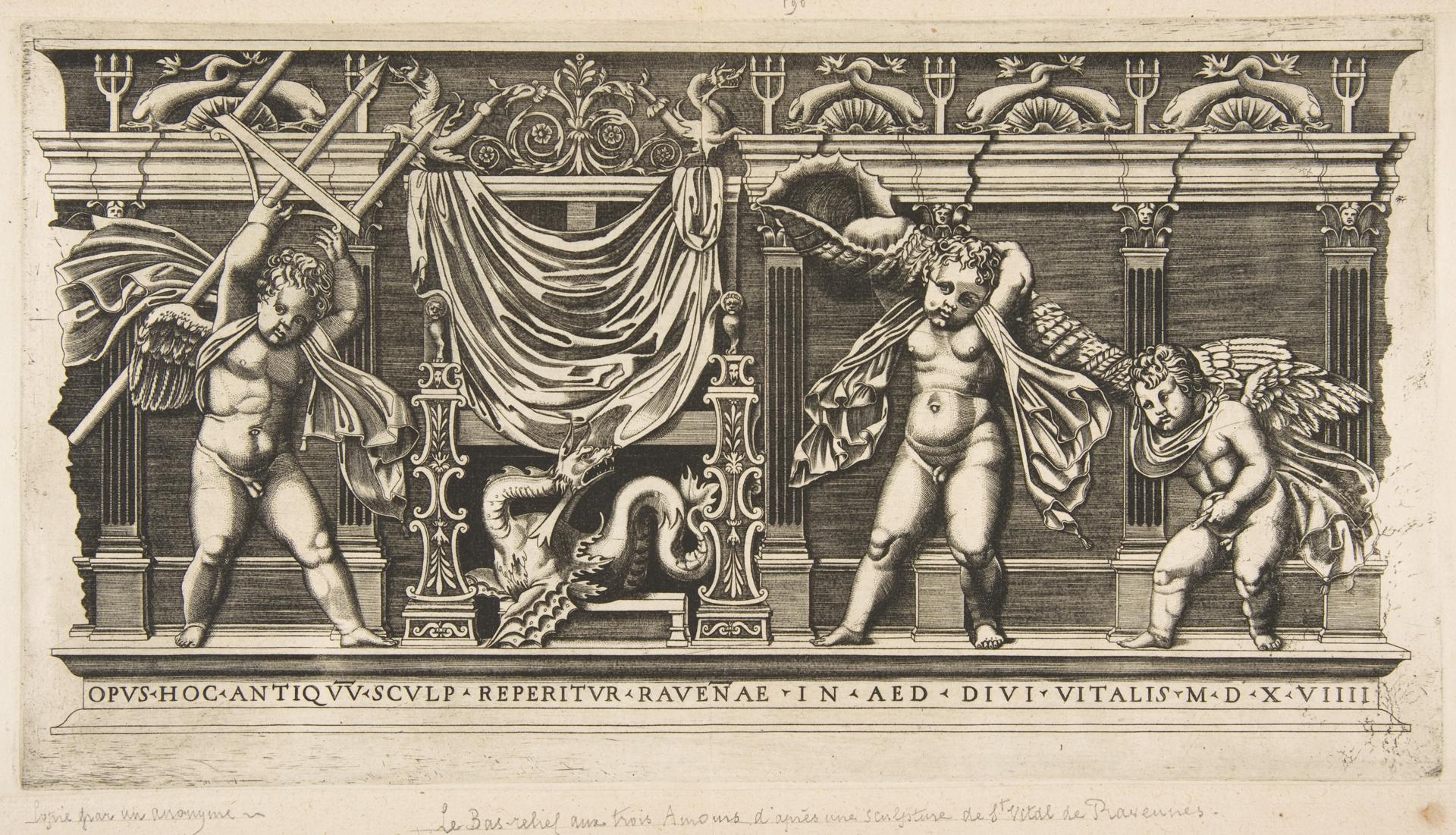
Three cupids in front of a facade with pilasters, one holding a trident and another a large shell
Original title: Three cupids in front of a facade with pilasters, one holding a trident and another a large shell
kurzbeschreibung
An anonymous Italian engraver working somewhere between the sixteenth and early seventeenth century placed three winged putti in front of an ornamented facade. One carries a trident, another a large shell, and the third crouches with lowered gaze. The motif is printed in black and white on paper.
Description
Three naked, winged boys are staggered before a wall articulated by pilasters. At the left a putto holds the trident; in the middle a large shell is raised aloft; at the right the third sits with his head bowed. Ornaments including a dragon and a sword decorate the facade, while tridents and shells hover above. A band of Latin inscription closes the bottom edge.
Context
The print was made in Italy between roughly 1515 and 1600, a period when antique imagery and mythological subjects were everywhere in art. Trident and shell point to sea deities such as Neptune and Venus, suggesting an allegorical or decorative purpose. The inscription along the lower margin names an ancient relief as the model. Prints of this kind served artists as patterns or collectors as sought-after sheets.
Impact
The even spacing of the putti and the clean linework give the sheet a calm, balanced character. Childlike lightness meets an antique vocabulary of signs, so the view retains something timeless and at the same time refined.
Technique
Lines were cut into a copper plate and then pulled onto paper. This method above all allows the finest strokes and precise hatching, which give the putti's bodies and the facade's ornaments their plastic relief.
AI-generated description text
Source: Metropolitan Museum of Art · Public Domain (CC0 1.0)