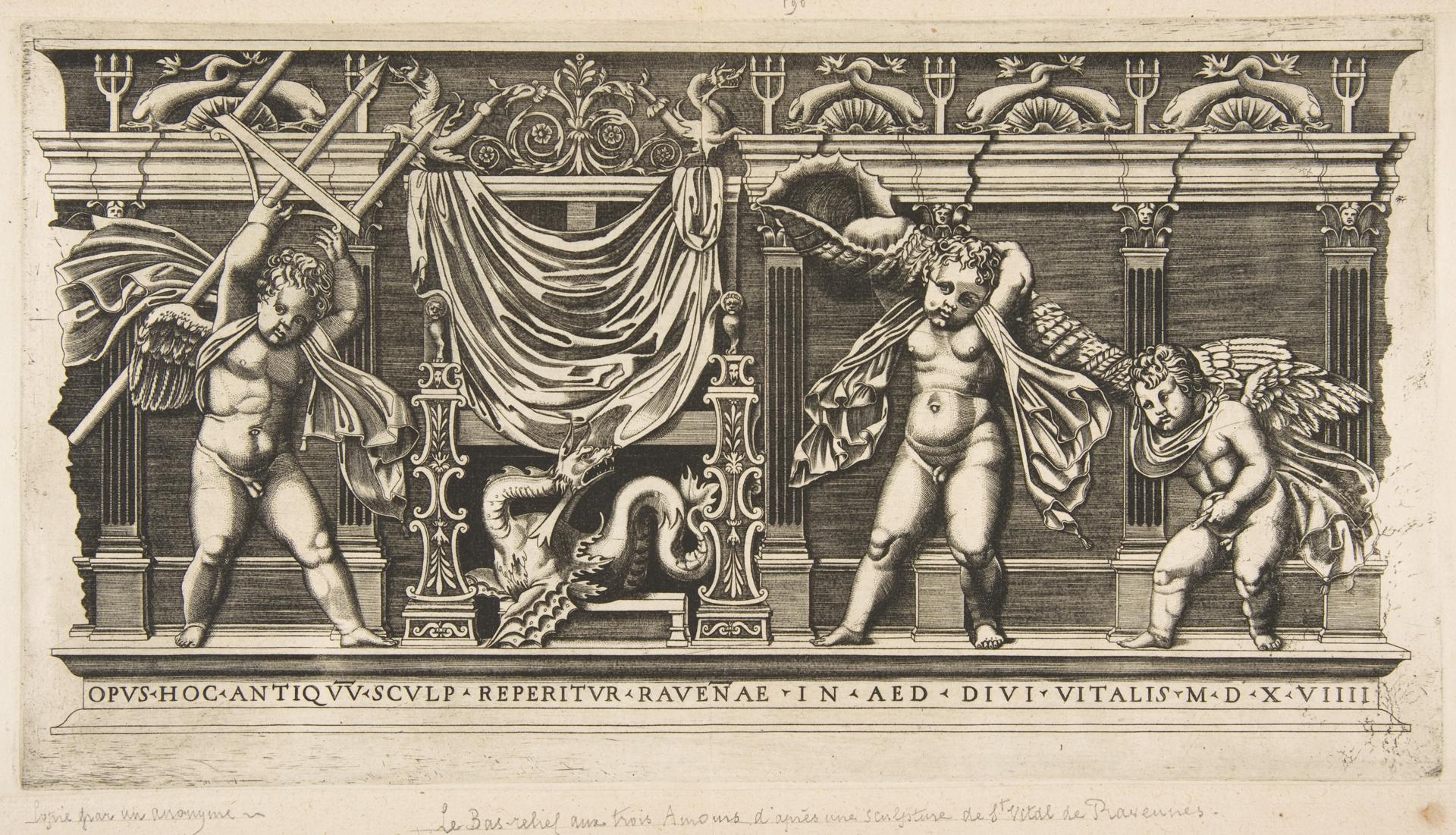
Three Cupids in Front of a Facade with Pilasters, One Holding a Trident and Another a Large Shell
Original title: Three cupids in front of a facade with pilasters, one holding a trident and another a large shell
kurzbeschreibung
An anonymous Italian engraver active between about 1515 and 1600 produced this print, which sets three naked putti against an architectural facade. Antique ornament meets a group of figures bearing a shell and a trident.
Description
Three barefoot, unclothed putti occupy the foreground: the one at left grasps a trident, the middle figure a large shell, and the right-hand putto covers himself with a cloth. Behind them rises a carefully worked facade with pilasters, a dragon motif at its centre. A curtain is draped above the group, held by two further putti. A border decorated with symbolic elements such as tridents and shells frames the whole scene. Along the lower edge runs a Latin inscription band reading 'OPVS HOC ANTIQVVM SCULP REPERTVR RAVENAE IN AED DIVI VITALIS M D X V IIII'.
Context
The engraving was made in Italy between 1515 and 1600 and is attributed to an unknown artist. The inscription cites as its antique model a relief found in Ravenna, in the church of San Vitale. Reproductions of such ancient reliefs were widespread in the sixteenth century, serving to record and circulate classical motifs. Putti carrying attributes like a trident and a shell suggest an allegorical or mythological meaning, perhaps in the orbit of Venus or Neptune.
Impact
The symmetrical placing of the putti and the precise rendering of the architecture give the sheet a balanced, calm presence. Tension arises between the tender bodies and the severe facade. The ornamental border and the Latin inscription lend the view an antiquarian, scholarly character.
Technique
The image was made as an engraving: the drawing is cut into a copper plate and then printed on paper. Fine lines and hatching allow a detailed rendering of light and shadow, especially on the putti's bodies and in the architecture. The plate measures 19.2 × 35.6 cm, while the sheet at 19.5 × 46.7 cm is somewhat larger, pointing to a full margin.
AI-generated description text
Source: Metropolitan Museum of Art · Public Domain (CC0 1.0)