Eros Escaping by Sea
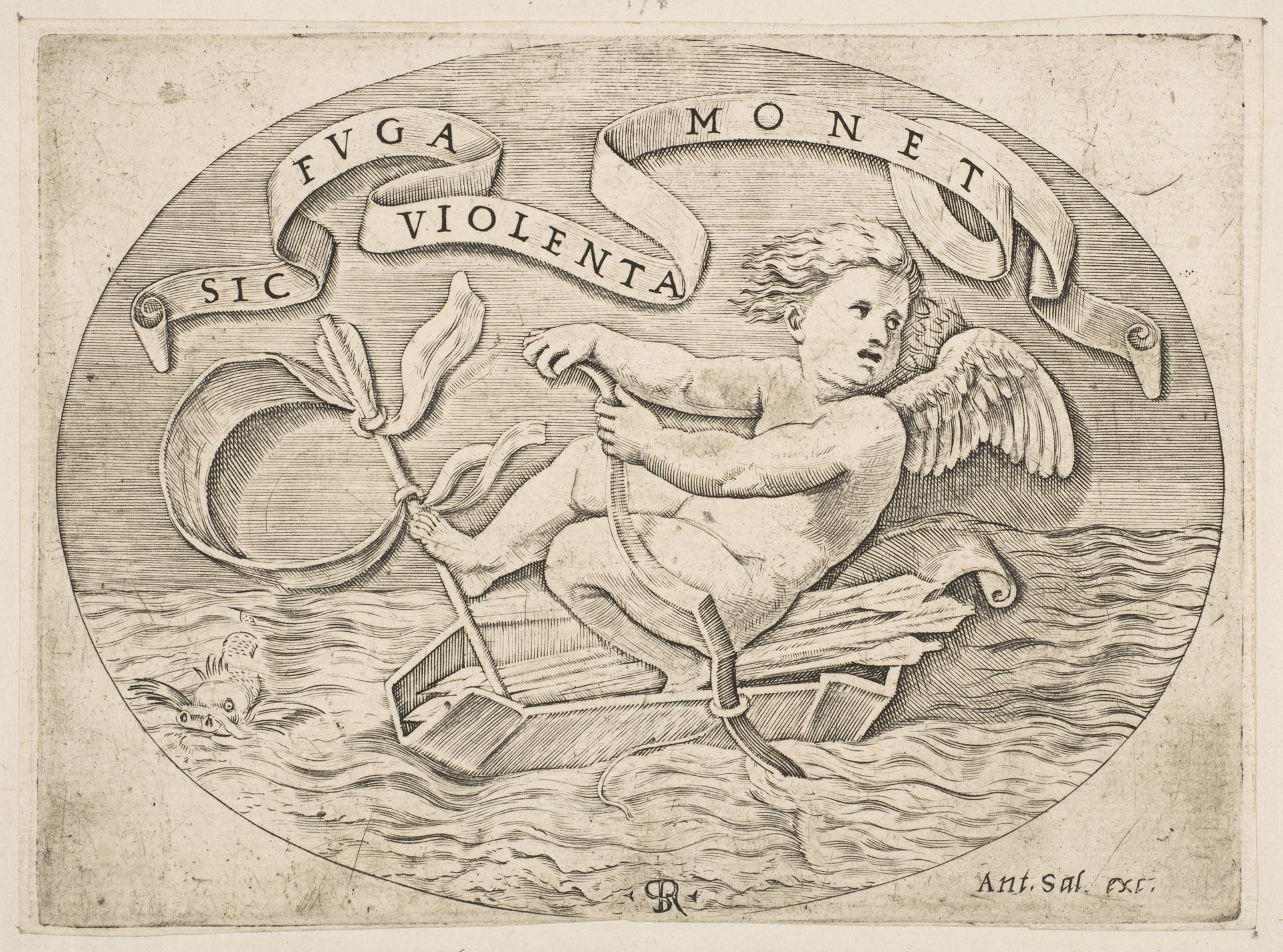
Original title: Eros Escaping by Sea; Cupid using his bow to propel a boat made from his quiver with an arrow as the mast and his blindfold as the sail, a banderole above
kurzbeschreibung
A winged Eros sits in a boat made from his own quiver, using an arrow as a mast with his blindfold stretched as a sail. Marco Dente engraved this scene around 1515–27. Above the boat, two floating bands bear the words 'FUGA MONET' and 'SIC VIOLENTA'. The finely worked engraving comes from the Renaissance.
Description
Eros grips a bow and sits in a small boat shaped like a quiver. An arrow rises as a mast, and the god's blindfold is rigged to it as a sail. His face shows a focused, slightly worried expression as he drives the boat forward. Wavy lines suggest the sea. Two bands with the Latin inscriptions 'FUGA MONET' and 'SIC VIOLENTA' hover above the boat. At bottom left is the monogram 'BR'; at bottom right, the signature 'Ant. Sal. exs.'
Context
Marco Dente, an Italian engraver of the Renaissance, made this print in the first half of the 16th century. It likely derives from an ancient gem or relief, as was common at the time. The inscriptions and motif suggest an allegorical reading related to the flight of love or the violence of passion. Dente worked in Rome and belonged to the circle of Marcantonio Raimondi, the most important engraver of the High Renaissance.
Impact
The precise rendering of the mythological scene and the fine linework shape the impression. From the gentle movement of the sail and Eros's concentrated pose arises a mood that is both dynamic and reflective. The viewer is invited to ponder the symbolic meaning of flight and violence in love.
Technique
For this engraving, the lines were cut into a copper plate with a burin. This allows fine, exact lines and high detail, visible for instance in the waves and the facial features. The sheet measures about 12.9 × 17.3 cm, the plate 12.5 × 16.9 cm.
AI-generated description text
Source: Metropolitan Museum of Art · Public Domain (CC0 1.0)