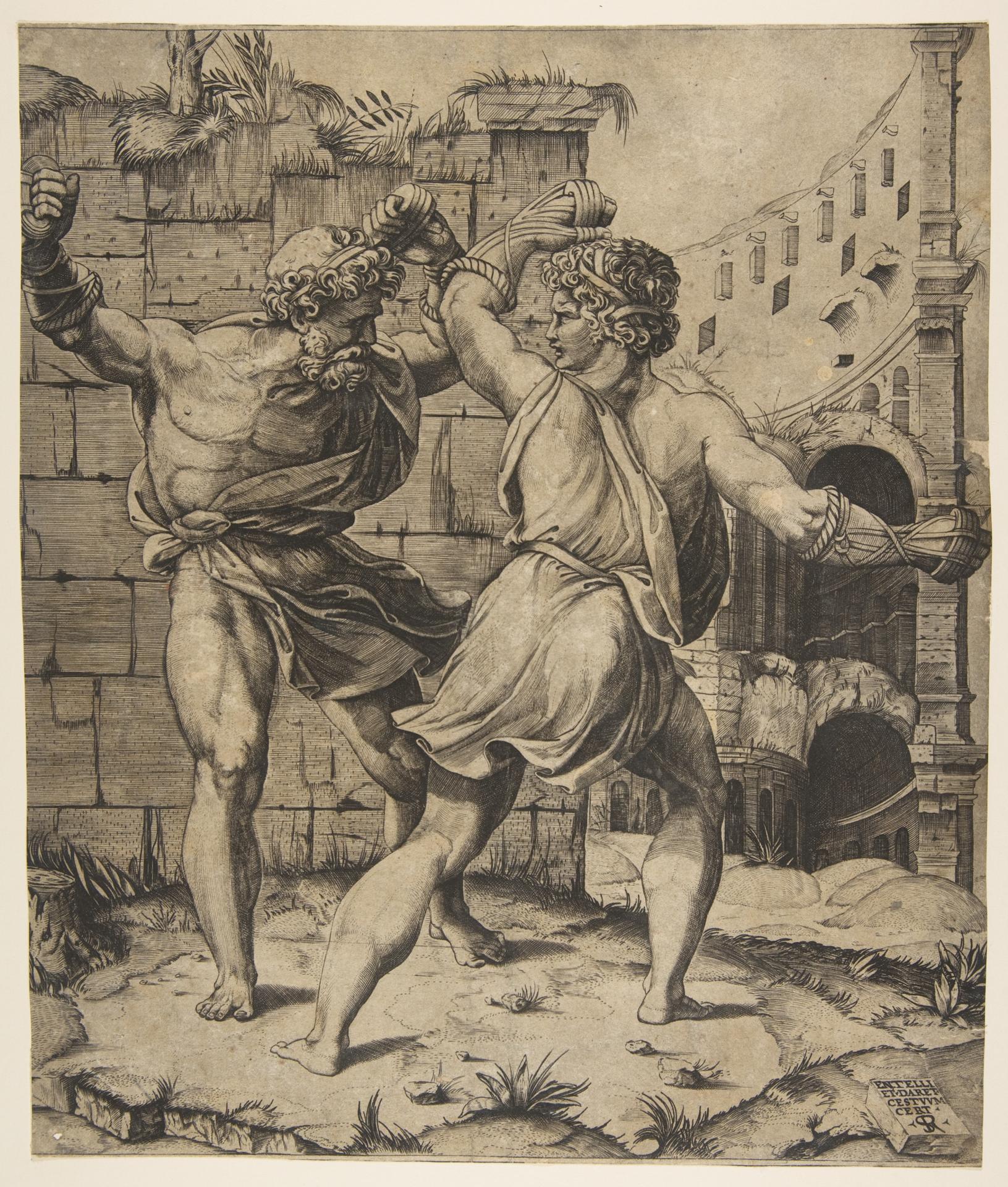
Entellus and Dares fighting in front of classical ruins
Original title: Entellus and Dares fighting in front of classical ruins
kurzbeschreibung
Marco Dente’s engraving from around 1520–25 presents the fistfight between Entellus and Dares from Virgil’s Aeneid. Before ancient masonry, two powerful figures grapple with each other; the sheet is executed as an engraving on paper.
Description
Two athletic fighters dominate the image: on the left stands Entellus, bearded, with short curly hair and a loincloth, in a defensive stance with raised arms. On the right Dares acts, similarly coiffed, wearing a head covering, poised to attack, arm raised, leg extended. Muscles and lines of movement are precisely worked out and heighten the tension of the wrestling. Behind them rise stone ruins, partly overgrown with plants, creating a monumental, historical mood. The layout feels asymmetrical; the palette remains monochrome in shades of gray with even light and no shadows.
Context
The Italian Renaissance engraver Marco Dente made this sheet in the 1520s in Rome, where he was closely associated with the workshop of Marcantonio Raimondi. The model was an episode from Virgil’s Aeneid (Book V): the aged Entellus defeats the younger Dares in a fistfight. The setting among ancient ruins points to the interest in Roman architecture and antiquity widespread in the High Renaissance. Dente’s death in 1527 during the Sack of Rome brought his career to an abrupt end.
Impact
The fighters’ vigorous dynamism and physical force come to the fore, supported by precise muscle drawing and lines of movement. The ruins in the background lend the fight a sublime, timeless dimension and reinforce the heroic mood. The gray tonality and even light create a calm, almost classical aesthetic that directs attention to the formal qualities.
Technique
For this engraving, lines were incised into a metal plate and then printed on paper. Fine hatching and precise lines produce graduated gray tones and model both the musculature and the surfaces of the ruins. The process allowed high detail accuracy and was valued in the Renaissance for reproducing classical motifs.
AI-generated description text
Source: Metropolitan Museum of Art · Public Domain (CC0 1.0)