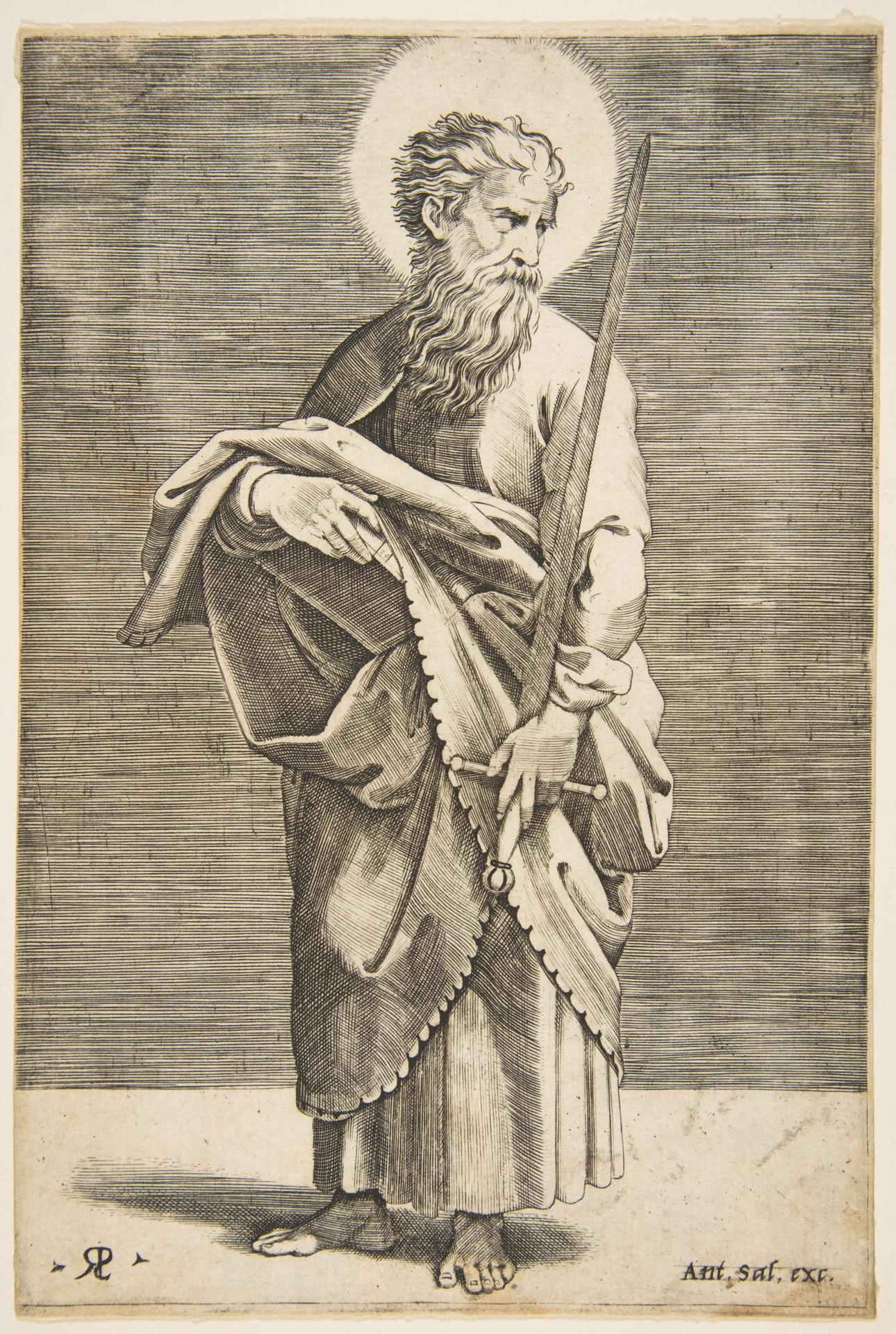
Saint Paul looking to the right and holding a sword and a book
Original title: Saint Paul looking to the right and holding a sword and a book
kurzbeschreibung
Marco Dente engraved this image of Saint Paul around 1515–27. The figure faces right, wears a cloak, and holds a staff topped with a sword in his right hand and a book in his left. A plain background with horizontal stripes and the halo reinforce the sacred character.
Description
Saint Paul stands as the central figure, his head turned to the right. A deeply folded cloak, modeled with precise lines, wraps around him; his right hand grasps a long staff that ends in a sword above, while his left holds a closed book. A bright circle surrounds his head as a halo. The background remains plain, showing horizontal stripes that suggest a simple architectural or landscape structure. A monogram appears at the lower left, and the inscription 'Ant. Sal. exc.' at the lower right.
Context
This print was made in the first half of the sixteenth century by Marco Dente, an Italian engraver of the Renaissance. Dente worked in Rome as an assistant to Marcantonio Raimondi, one of the leading reproductive engravers of the time. The depiction of the saint belongs to a series of similar prints that helped spread religious images throughout Europe. The inscription 'Ant. Sal. exc.' names the publisher Antonio Salamanca, who issued prints in Rome.
Impact
Clear lines and a balanced layout give the saint a dignified presence. The strong contrast of shading makes the figure stand out plastically from the plain background. Paul's calm, thoughtful posture conveys spiritual seriousness.
Technique
As an engraving, the image was cut into a copper plate, the lines filled with printer's ink, and then printed. This process allows fine, precise strokes and a wide range of tonal values, as seen in the detailed rendering of the cloak and face. The monochrome execution is typical of this printing technique, which made large editions possible.
AI-generated description text
Source: Metropolitan Museum of Art · Public Domain (CC0 1.0)