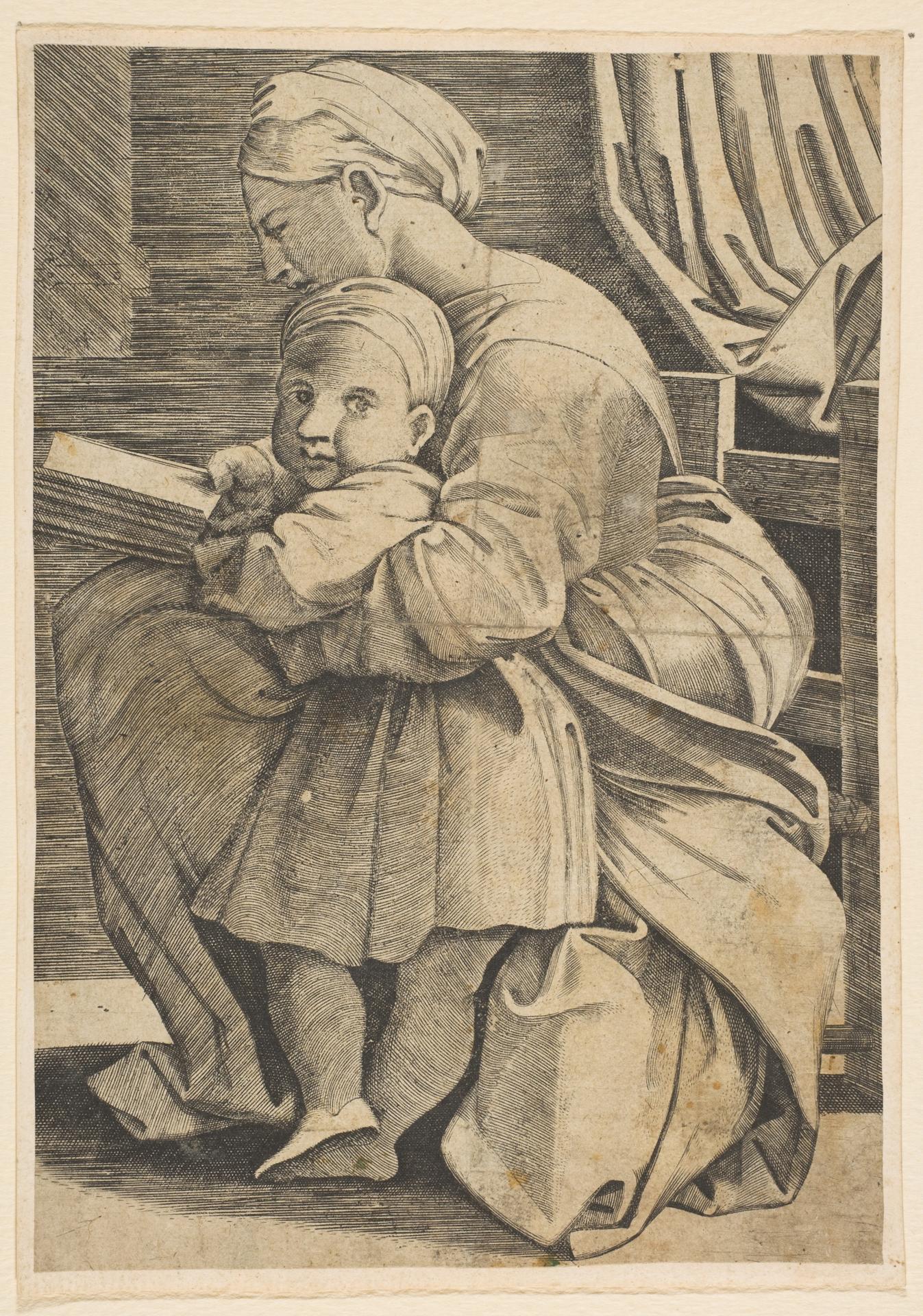
The Virgin reading with the infant Christ
Original title: The Virgin reading with the infant Christ; woman seated in profile facing left and reading with an arm around a child who looks out toward the viewer
kurzbeschreibung
Mary sits in profile, reading from a book while her arm encircles the Christ Child, who looks directly out at the viewer. This sheet comes from an unknown Italian artist of the 16th to early 17th century and survives as a finely worked black-and-white print.
Description
A woman in side profile has taken a seat on a chair and holds an open book before her. A head covering conceals her head, and fine lines give three-dimensional folds to her long-sleeved garment. Her arm lies protectively around a child, who also wears a head covering and gazes straight at the beholder. Vertical stripes in the background suggest a window or a wall. The layout remains entirely in black and white; varied hatching creates textures and shadows.
Context
This sheet was made in Italy between about 1515 and 1600; the artist remains unknown. As a devotional image it belongs to a genre widespread in the 16th century that supported private piety. Showing Mary with the Christ Child while reading points to the importance of scripture in Christian faith. Such prints often came onto the market in larger editions and served devotion in private households or monasteries.
Impact
The familiar closeness of the two figures radiates calm, and the child's direct gaze draws the viewer in immediately. Delicately placed lines and the quiet arrangement contribute to a devotional mood that invites lingering.
Technique
An engraving is made by incising lines into a metal plate and then printing them onto paper. Parallel hatching and cross-hatching, finely executed, allow fabric folds and facial features to be rendered precisely. Clear contours and a restrained tonal range correspond to the printmaking of that era.
AI-generated description text
Source: Metropolitan Museum of Art · Public Domain (CC0 1.0)