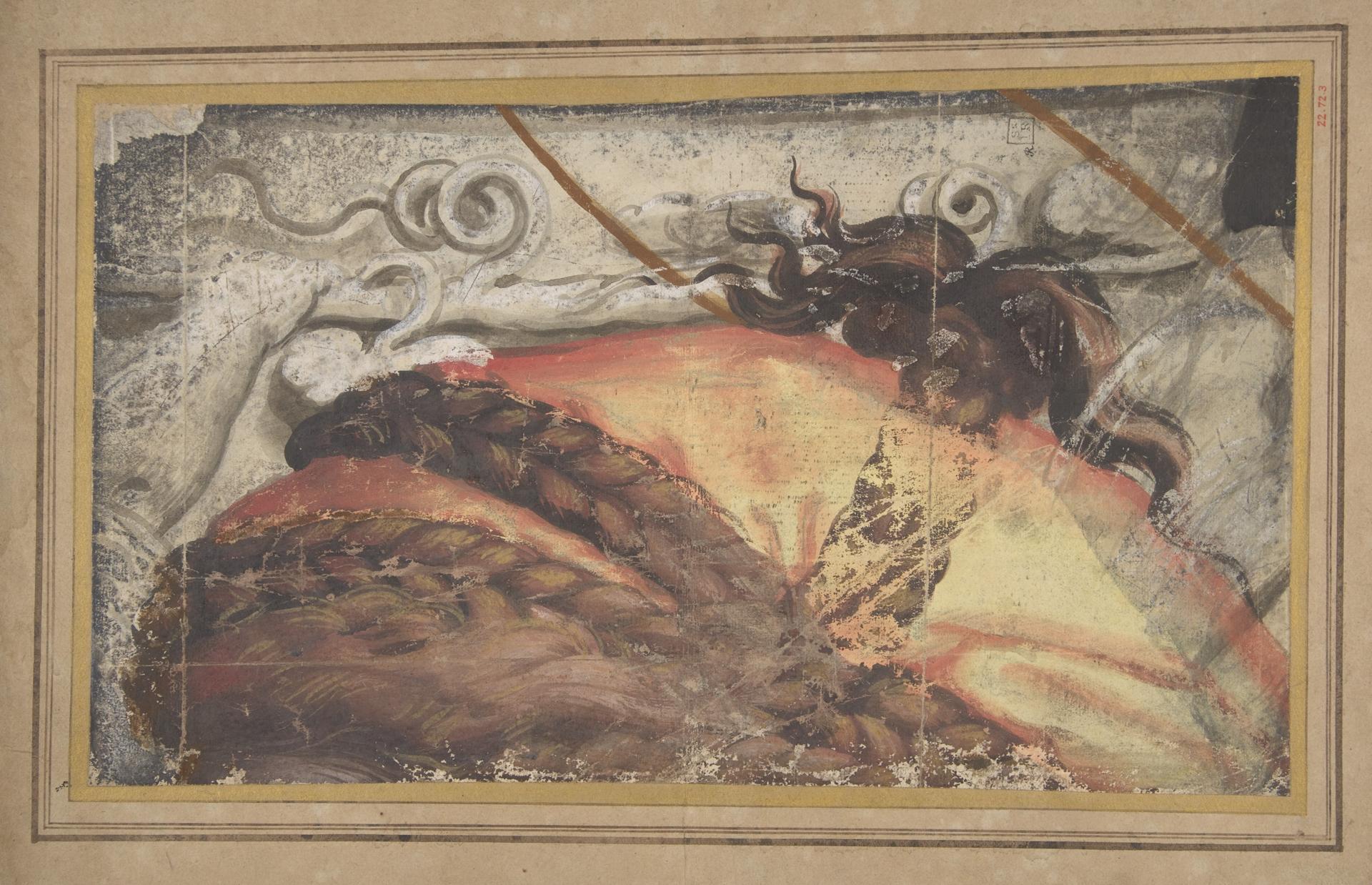
Tapestry Cartoon Fragment: The Top of Woman's Head with Hair Braided over a Cloth Headdress
Original title: Tapestry Cartoon Fragment: The Top of Woman's Head with Hair Braided over a Cloth Headdress
kurzbeschreibung
A fragment connected with the tapestry cartoons: attributed to Raphael (Raffaello Sanzio or Santi), made between 1500 and 1550. It shows the upper part of a woman's head, her hair braided and lying over a cloth headscarf. Brush and gouache in yellow, orange, brown, gray, and white stand out over traces of black chalk.
Description
The eye is caught first by the braided hair, which lies over the cloth headscarf and fills the upper section of the woman's head. Clouds and a patch of sky form the background. The layout feels irregularly placed and is directed entirely toward the head and the masses of hair. Yellow, orange, brown, gray, and white tones dominate the color scheme. A gold frame structure encloses the sheet.
Context
The sheet belongs to a series of cartoons that Raphael designed for the tapestries of the Sistine Chapel; the commission was placed between 1515 and 1516. Such cartoons served as models for the Brussels weavers, who translated the tapestries at high resolution. The span 1500–1550 covers both Raphael's creative period and the later use and reproduction of the designs. Stylistic features and the provenance of the sheet support the attribution to Raphael.
Impact
The meticulous execution of the hair immediately draws the gaze, its graded tonal values giving the head physical presence. Above the head, clouds hover and convey a quiet, heavenly mood that underscores the figure's dignity. Because the arrangement is not symmetrical, the eye wanders to the details, and the sheet retains something spontaneous, sketch-like.
Technique
The sheet was executed with brush and gouache in yellow, orange, brown, gray, and white, which lie over traces of black chalk. Gouache, an opaque watercolor, allows strong areas of color. The black chalk beneath the paint points to a preparatory drawing with which the layout of the image was sketched.
AI-generated description text
Source: Metropolitan Museum of Art · Public Domain (CC0 1.0)