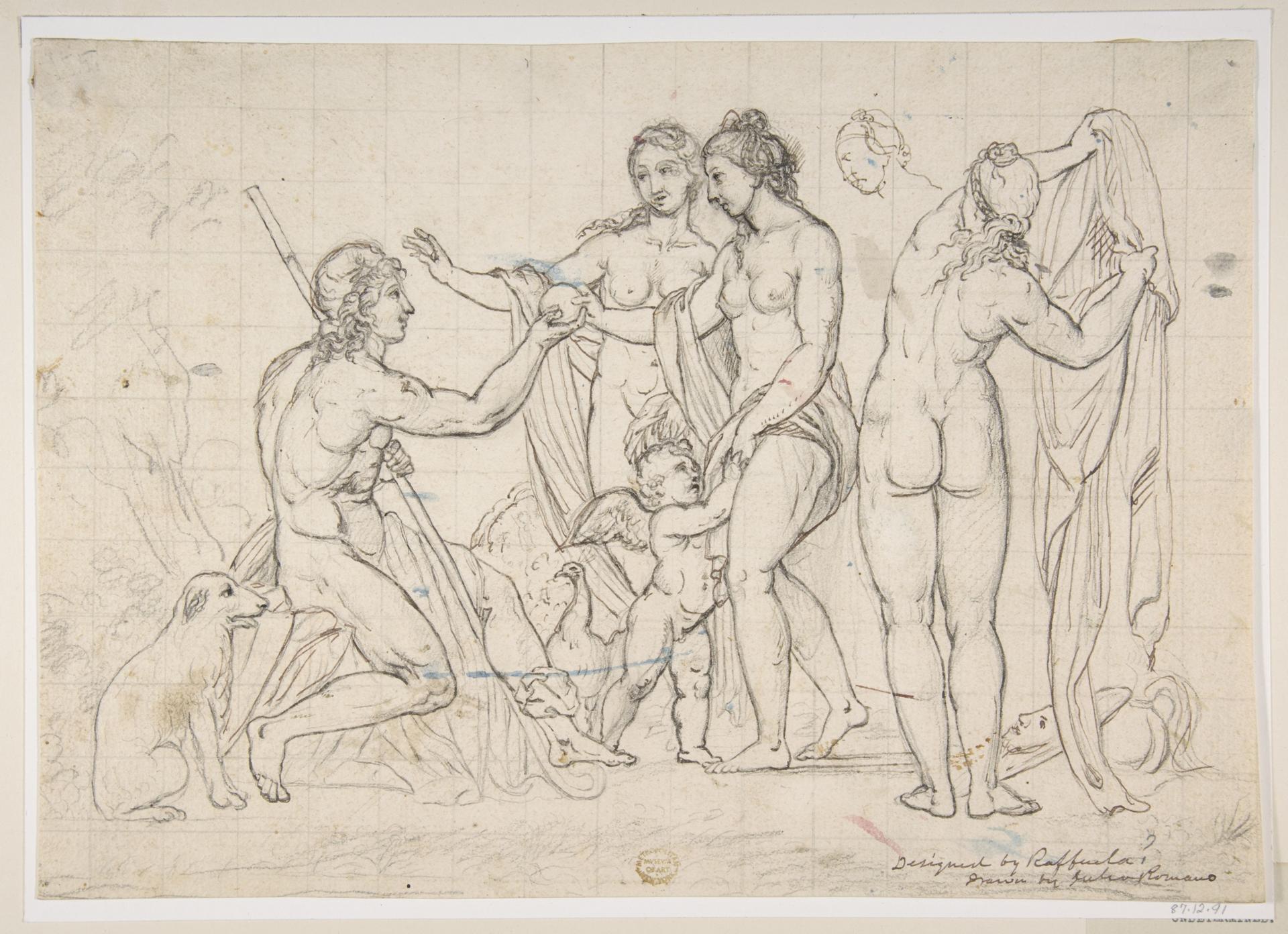
Judgment of Paris, after Raphael
Original title: Judgment of Paris, after Raphael
kurzbeschreibung
Drawn between 1520 and 1600, this sheet of the Judgment of Paris goes back to a design by Raphael (Raffaello Sanzio or Santi). The drawing is executed in pen and dark brown ink over black chalk, with a chalk grid covering the entire composition. It depicts the myth in which Paris chooses the most beautiful among the goddesses.
Description
Four female figures group together in varying poses; one wears a crown, another holds a bowl, a third supports a child. On the left stands a male figure with arrow and shield, a dog sitting beside him. The bodies are formed in the antique style of the Renaissance. Grays dominate the palette, and light spreads evenly across the plain sheet, drawing the eye to the figures. The arrangement is detailed and carefully thought out, giving the scene a lively interplay.
Context
Raphael died in 1520; the drawing is dated to the decades between 1520 and 1600 and follows one of his designs. He probably made this lost design for a painting or a print of the Judgment of Paris. The subject was highly popular in the Renaissance and often served as an example for representing female beauty and mythological themes. The sheet may have been used as a model for reproductions or as a study sheet.
Impact
The layout feels calm and balanced; the figures stand out clearly. Through the fine penwork and the restriction to grays, the sheet gains a restrained elegance that directs attention to gestures and the interaction of the figures.
Technique
Pen and dark brown ink were applied over an underdrawing in black chalk. A grid of black chalk lies over the whole and served to transfer the arrangement. Such grids were standard practice in the Renaissance for scaling designs up to larger formats.
AI-generated description text
Source: Metropolitan Museum of Art · Public Domain (CC0 1.0)