Copies after Raphael's "The Finding of Moses"
Original title: Copies after Raphael's "The Finding of Moses"
kurzbeschreibung
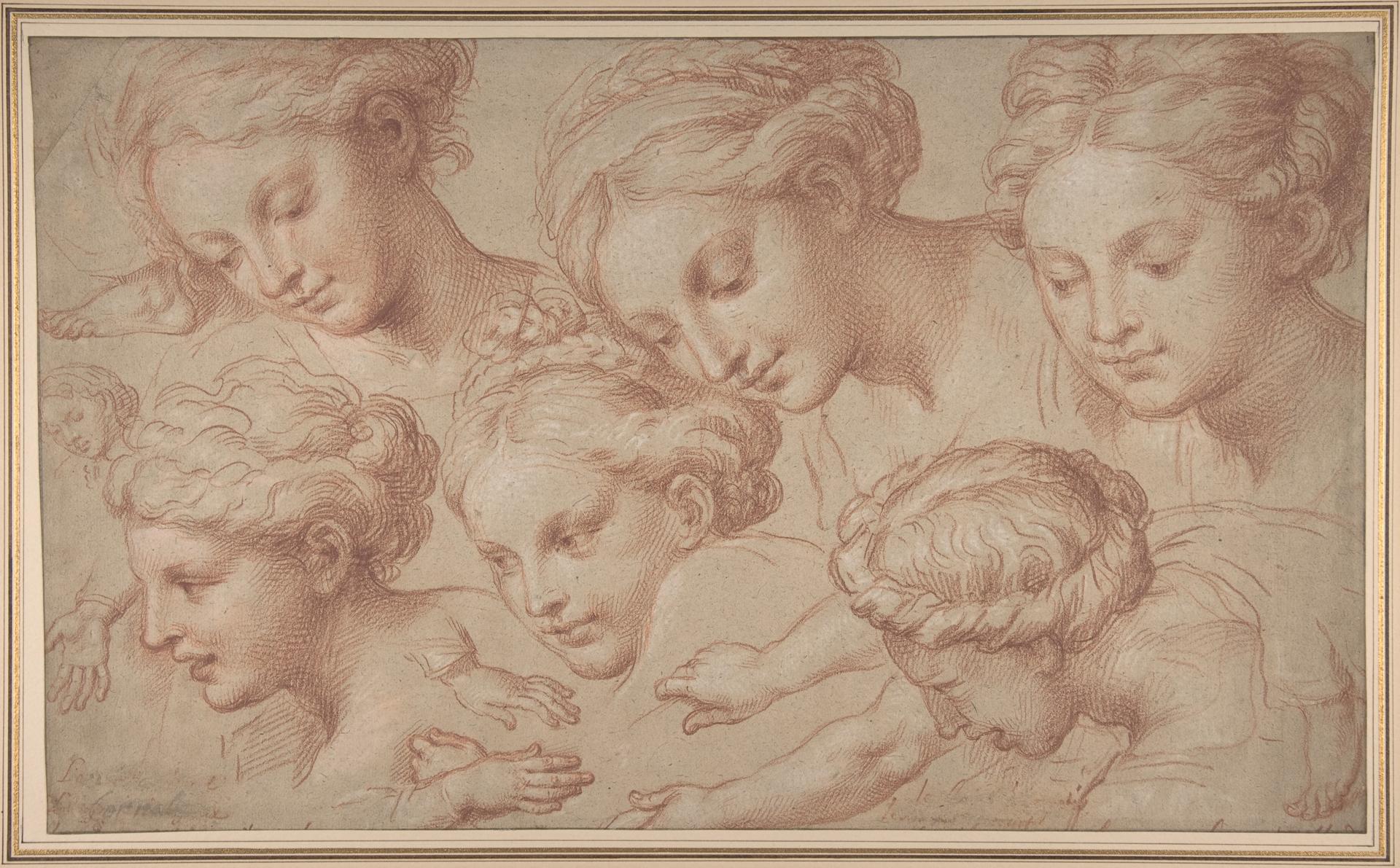
In this drawing, Michel Corneille the Younger recorded studies after Raphael's painting The Finding of Moses. Unlike many of his contemporaries, who focused on entire figure groups, he zooms in on individual heads and shoulder sections. The sheet is executed in red and white chalk with accents of pink pastel; it measures 26.7 x 45.5 cm.
Description
Several heads and shoulders are gathered on the sheet in varying poses and directions of gaze. Studies of hair and facial expression are worked out in detail and clearly reveal Raphael's figure style. The layout thrives on the different lines of sight, while the colouring is determined by greys with red, white and pink accents. There is no narrative action, as these are pure studies.
Context
Michel Corneille the Younger (1642–1708) was a French painter and printmaker prized for his drawings after older masters. The source, Raphael's The Finding of Moses, was made around 1515 and is now in the Vatican Museums. Such copies served as exercises in the 17th century and helped disseminate the compositions of famous works. The sheet was made at a time when engagement with the Italian Renaissance was central for French artists.
Impact
What distinguishes this drawing is the precise and fine execution that lends the figure studies liveliness. The mix of red, white and pink gives the heads a warm, almost sculptural presence. The arrangement of the heads creates a calm yet animated overall effect.
Technique
The work is executed in red and white chalk on paper, supplemented by accents of pink pastel. This combination of chalks and pastel is typical of Baroque study drawings. The precise linework and careful hatching attest to high manual control.
AI-generated description text
Source: Metropolitan Museum of Art · Public Domain (CC0 1.0)