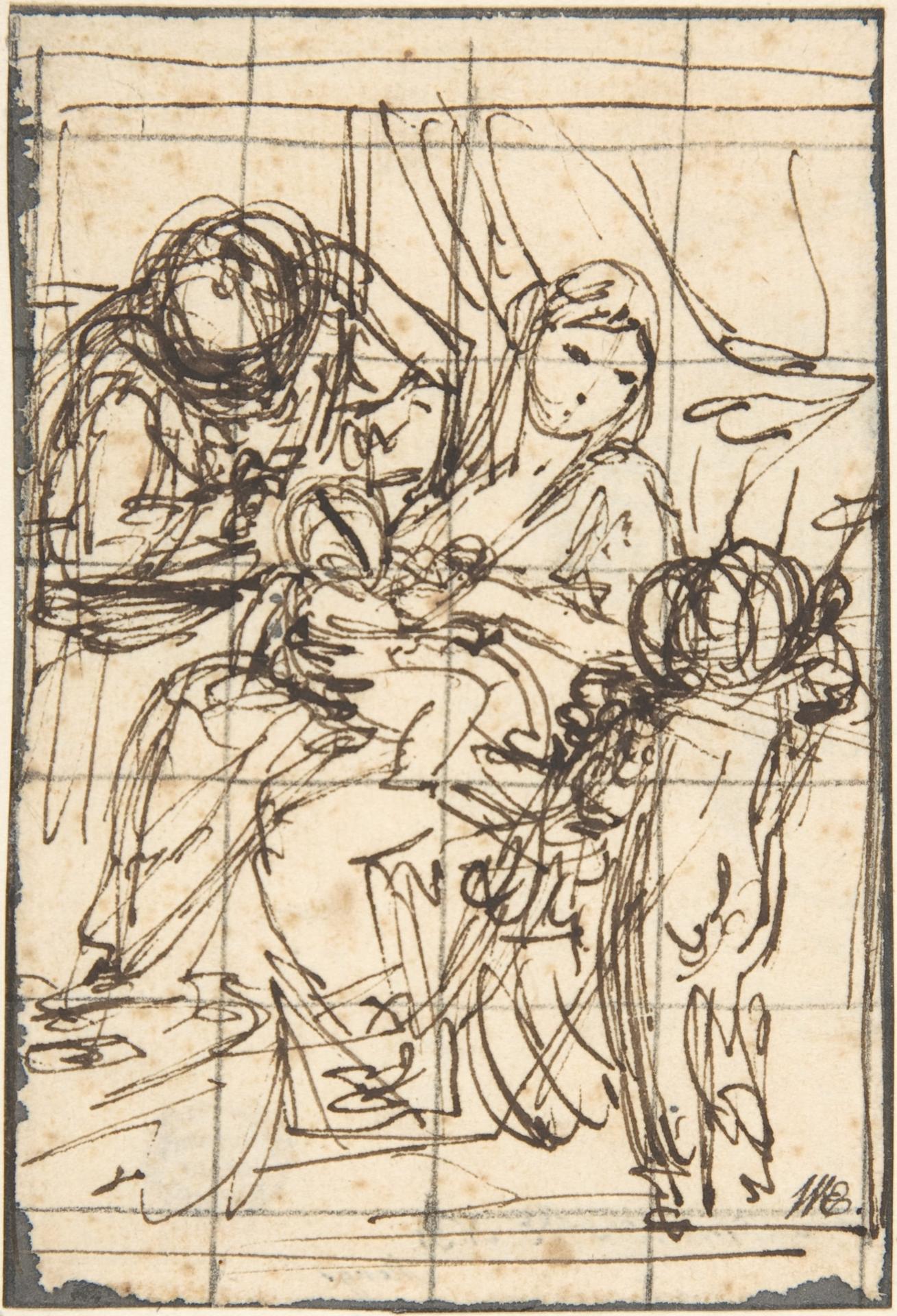
Holy Family with St. John the Baptist
Original title: Holy Family with St. John the Baptist
kurzbeschreibung
Anton Raphael Mengs made this drawing in the mid-18th century; it belongs to his graphic work and depicts the Holy Family with the Infant John. The sheet is executed in pen and brown ink, with a grid in black chalk drawn over the paper for transfer. At 11.3 x 7.7 cm, the format remains small, suggesting a study or a design.
Description
Mary sits on a chair and holds the Christ Child on her lap. Mary, Jesus and Joseph direct their gaze in a common direction, while John the Baptist looks to the left in the background. Flowing, stylized lines form the figures, and the background remains plain and without detail. A fine black chalk grid runs across the entire sheet, which served to transfer the motif. Brown on white paper, without visible shadows or light effects, defines the monochrome character of the drawing.
Context
Mengs (1728–1779) is one of the important painters of Neoclassicism and was active in Dresden, Rome and Madrid. The sheet was made in the mid-18th century, when he was intensively studying the Italian Renaissance and classical antiquity. The drawn grid indicates that the drawing was intended as a model for a larger painting or for a print. The motif of the Holy Family with John was widespread in Catholic art of the Baroque and Rococo periods.
Impact
Despite the small format, the sheet remains lively and animated because the flowing lines give the figures movement. The restriction to brown and white creates a calm, intimate mood and directs the gaze to the figures. The sketchy execution brings out the design character and shows the artist's confident hand.
Technique
The sheet is worked in pen and brown ink on paper, and the linework remains clear and precise. To transfer the motif to another medium, a grid of black chalk was laid over the drawing. This approach corresponds to typical design drawings of the 18th century, in which the pen drew fine contours and the chalk served for transfer.
AI-generated description text
Source: Metropolitan Museum of Art · Public Domain (CC0 1.0)