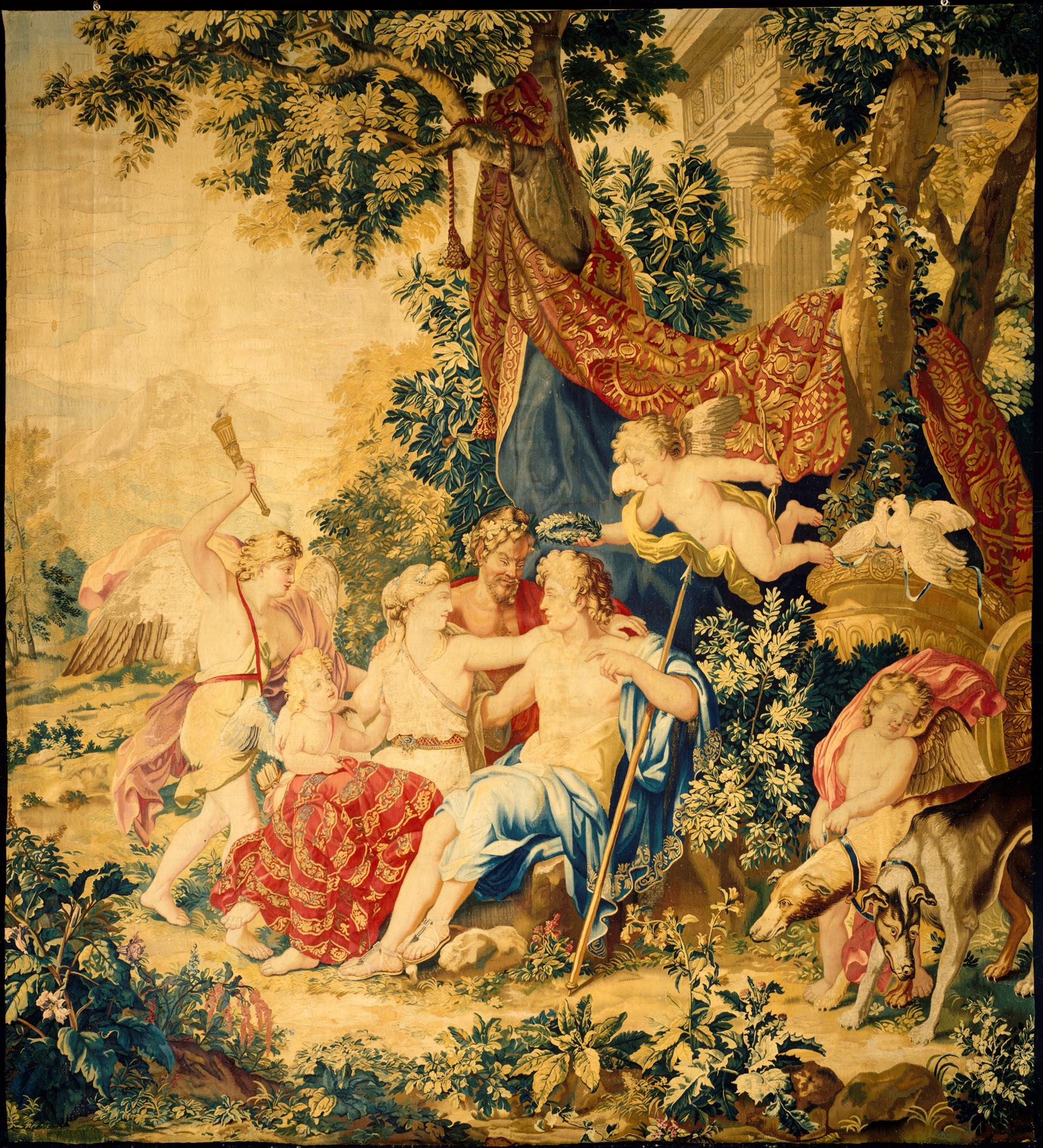
Venus and Adonis from a set of Mythological Subjects after Raphael
Original title: Venus and Adonis from a set of Mythological Subjects after Raphael
kurzbeschreibung
A tapestry woven between 1686 and 1690 from a design of 1686, showing Venus and Adonis. Wool, silk and silver thread make up the material, and the piece belongs to a series of mythological scenes after models by Raphael.
Description
A seated man first draws the eye, a crowned female figure resting her hand on his shoulder. To the side stands a woman with a lance, caught mid-motion. Above hovers an angel bearing a lance; on the right another angel and a dog can be made out. Trees and columns frame the garden-like setting, with further figures further back, among them a woman with a child. Golds, reds and blues set the tone.
Context
Raphael supplied the models for this tapestry series, which was carried out in a manufactory in the late seventeenth century. The commission formed part of a larger undertaking that brought classical mythology into courtly rooms of representation. The design date of 1686 falls in the reign of Pope Innocent XI, when demand for elaborate textiles with mythological subjects ran especially high.
Impact
Despite its size, the tapestry gives off a calm that draws the viewer into the scene. Silk and silver thread combine to a soft sheen that makes the figures stand out in relief. The clear arrangement of the figures guides the eye and supports the narrative content.
Technique
The tapestry was woven in a dense binding with 21 to 24 warps per inch. Wool, silk and silver thread allowed for fine detail and a subdued shimmer that heightens the colours. Such combinations of materials were usual for elaborate Baroque tapestries and demanded great artisanal precision.
AI-generated description text
Source: Metropolitan Museum of Art · Public Domain (CC0 1.0)