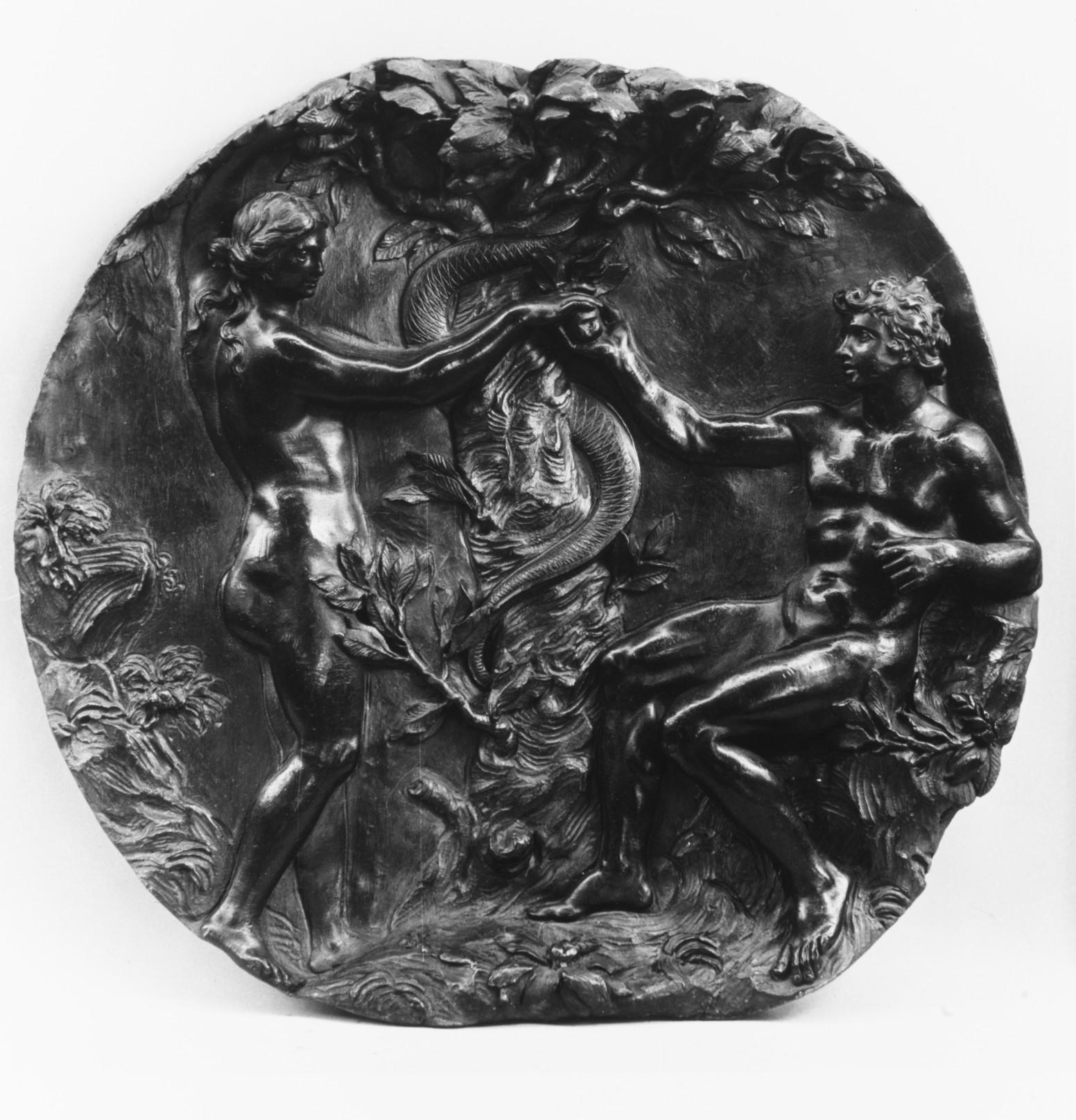
The Temptation of Adam and Eve
Original title: The Temptation of Adam and Eve
kurzbeschreibung
The biblical story of the temptation in Paradise, where Adam and Eve encounter the serpent, is captured on a round lead medal. The object is attributed to Raphael (Raffaello Sanzio or Santi) and dates to the early 18th century. It is made of cast and chased lead covered with black lacquer. The medal shows the scene with Adam, Eve and the serpent in the Garden of Eden.
Description
A serpent winds down from a tree and forms the centre of the round medal. On the left stands Eve, touching the serpent and giving the impression that she wants to seduce; on the right Adam sits on the ground, his gaze directed at the serpent. Other figures and plants are suggested, referring to the Garden of Eden. The relief brings out the figures and vegetation in three dimensions, while the lacquer layer gives the surface an even dark appearance. Balanced lighting ensures that the details of the image are clearly visible.
Context
Although the medal was made in the early 18th century—about two hundred years after Raphael's death in 1520—it bears his name. This attribution suggests that it is a copy or a workshop piece after a model by Raphael. Lead and black lacquer were common materials in the 18th century for medals and reliefs, which often served as decorative artworks or collector's items. The theme of the temptation of Adam and Eve was very popular in Christian art of that time.
Impact
The carefully executed relief work gives the biblical scene a dramatic note. The dark lacquer creates a serious, contemplative mood that draws attention to the theological significance of the Fall. Eve's animated pose and Adam's calm posture create an arrangement full of tension.
Technique
For the production, lead was cast and then chased with fine tools to bring out details. Afterwards the surface was coated with black lacquer, which gave the medal a uniform dark appearance and made the relief structure stand out particularly. This procedure was typical for decorative reliefs of the 18th century.
AI-generated description text
Source: Metropolitan Museum of Art · Public Domain (CC0 1.0)