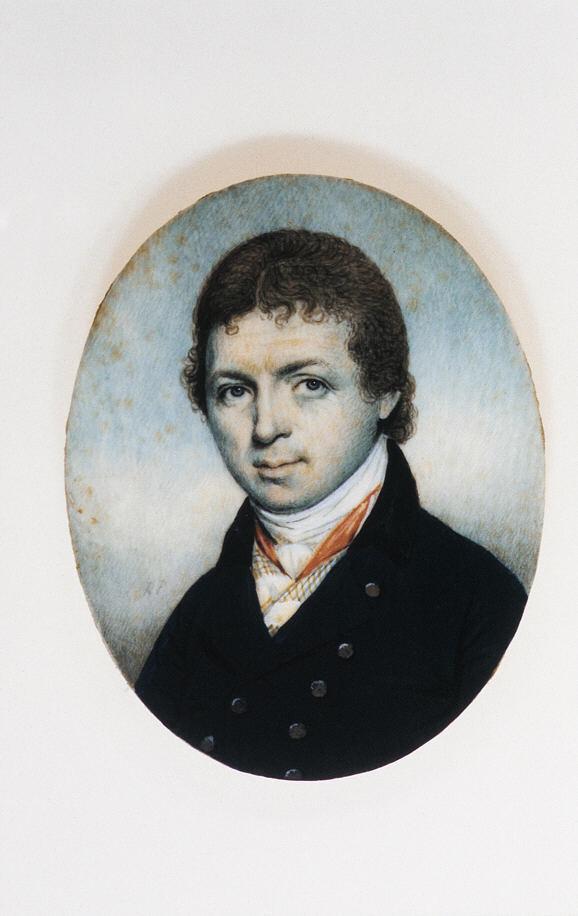
Portrait of a Gentleman (ca. 1800, Met-Objekt 5623)
Original title: Portrait of a Gentleman
kurzbeschreibung
Around 1800, Raphaelle Peale painted a miniature of a gentleman in watercolor on ivory. The sitter remains unnamed but appears in the dress of his time. Unlike many comparable portraits from those years, this example belongs to the widespread American portrait miniature tradition of the late 18th century.
Description
The oval format presents a man with dark curly hair whose gaze meets the viewer directly. Over a white shirt he wears a dark, buttoned jacket, while a bright orange neckcloth catches the eye. A plain bluish background sets the figure off and brings him forward. The palette stays restrained, and the execution is detailed without overemphasizing particulars.
Context
Raphaelle Peale (1774–1825) is known as an American painter primarily for still lifes, but he also devoted himself to portrait miniatures. Such works on ivory were highly popular around 1800, especially among the wealthy, as they were small and easy to carry. Peale came from the famous Peale artistic family—his father Charles Willson Peale was a respected portraitist. The making of this picture falls around 1800, when Peale was working in Philadelphia.
Impact
What sets this miniature apart from some related portraits is the careful execution and the man's calm, dignified presence. The muted tones and simple background create an atmosphere that feels both approachable and reserved.
Technique
The medium is watercolor on ivory—a method common for miniature portraits of this era. The delicate brushstrokes and precise rendering of details demand considerable craftsmanship. The ivory support makes the colors stand out with particular luminosity.
AI-generated description text
Source: Metropolitan Museum of Art · Public Domain (CC0 1.0)