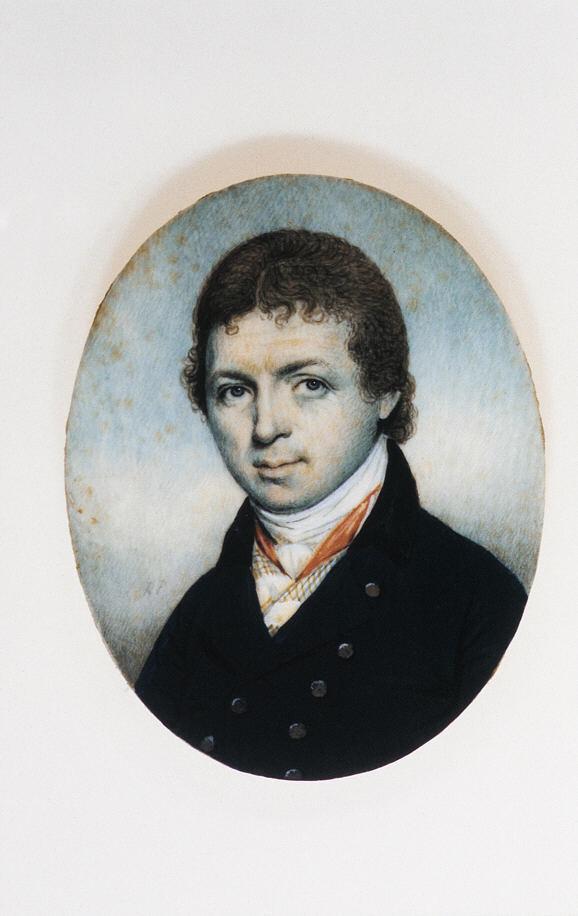
Portrait of a Gentleman (ca. 1800, Met-Objekt 5622)
Original title: Portrait of a Gentleman
kurzbeschreibung
Raphaelle Peale painted this oval miniature around 1800 in watercolour on ivory. It shows an unidentified gentleman dressed in the fashion of his day, notable above all for his red-and-white striped collar. In the late eighteenth century, miniature painting was greatly in demand for private portraits.
Description
The sitter's dark, wavy hair frames a face whose gaze rests quietly and thoughtfully on the viewer. Over a pale shirt with a striking red-and-white striped collar he wears a dark, buttoned garment. A plain pastel background throws the face and clothing into relief. Soft colours and even light bring out the fine, closely observed handling.
Context
Raphaelle Peale (1774–1825) was an American painter known for still lifes, though he also produced miniature portraits. The eldest son of Charles Willson Peale, a celebrated artist and naturalist, he grew up in a thoroughly artistic household. Around 1800, miniature portraits on ivory were prized in the United States and Europe as personal keepsakes or gifts. A format of roughly 7.3 x 5.9 cm called for precise brushwork, which Peale commanded with assurance.
Impact
The miniature draws attention through its delicate execution and the quiet, dignified presence of the sitter. His direct look and the pastel background give the portrait an intimate, personal note characteristic of the genre. Gentle colouring and even lighting produce a harmonious, restrained elegance.
Technique
The work is executed in watercolour on ivory, a standard technique for miniature portraits. Watercolours on ivory allow very fine, exact painting, since the smooth surface takes the colours well. The small size of the portrait demanded careful work with fine brushes and close control of each layer of paint.
AI-generated description text
Source: Metropolitan Museum of Art · Public Domain (CC0 1.0)