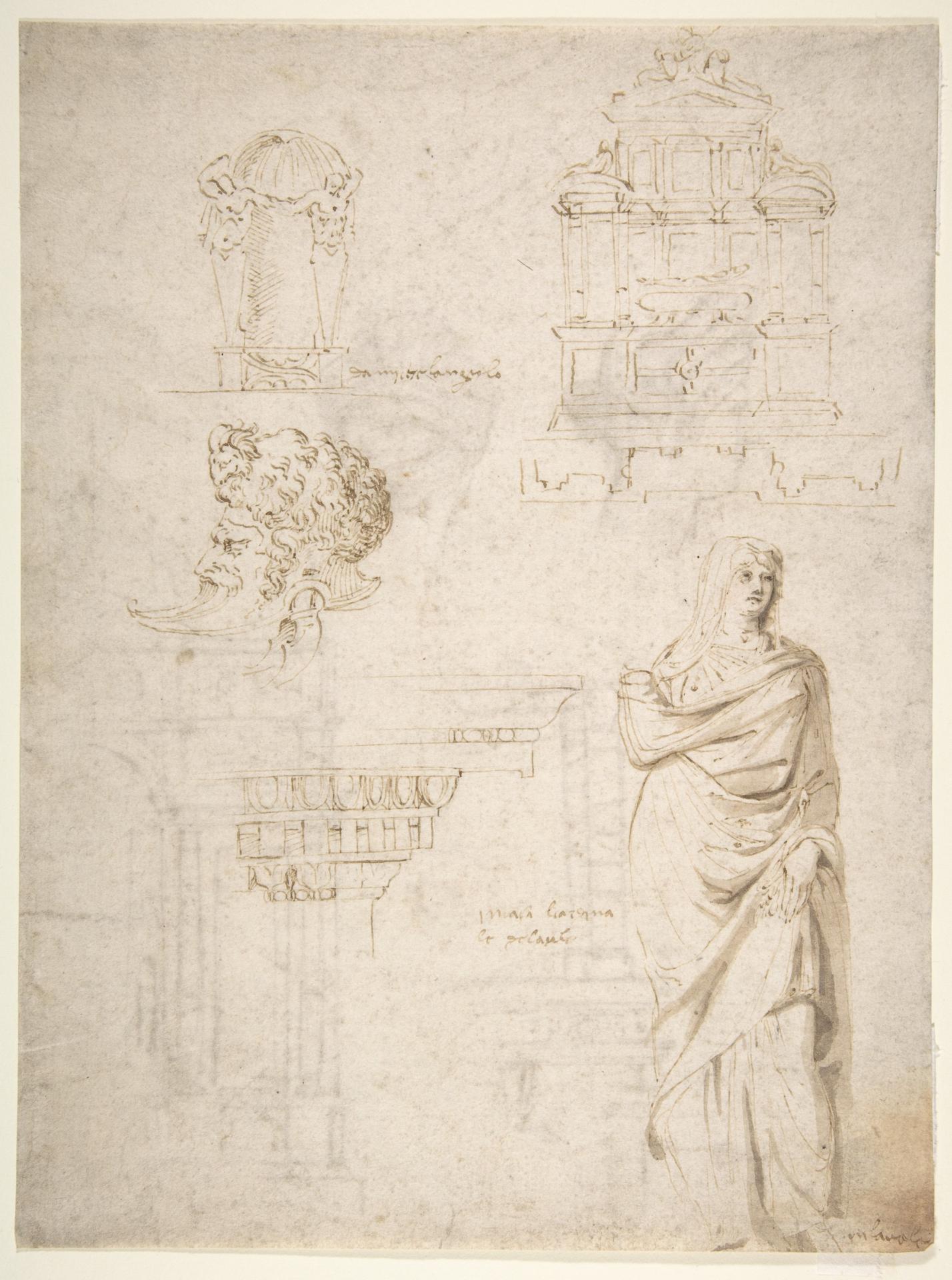
Sketches of a Funeral Monument, a Niche with Statues, a Helmet in the Shape of a Human Head, an Entablature and a Female Statue
Original title: Sketches of a Funeral Monument, a Niche with Statues, a Helmet in the Shape of a Human Head, an Entablature and a Female Statue
kurzbeschreibung
On a single sheet, Michelangelo Buonarroti (undated) gathers several unrelated studies: two variants of a tomb monument at the top, a helmet shaped as a human head at lower left, a cornice beside it, and a female figure at right. Everything is drawn with pen and brown ink, supplemented by brush wash over traces of leadpoint.
Description
Unlike sheets that work through a single motif, this one spreads a whole series of ideas across the surface. The upper part belongs to two tomb-monument designs with columns and other architectural elements, laid out in leadpoint. At lower left is a helmet as a head relief, also prepared with pencil, next to a sketch of a cornice. The female statue at lower right, draped in antique clothing and wearing a veil, is instead executed in ink and brown brush wash. The paper bears discoloration and signs of age.
Context
Designs for tombs run through Michelangelo's drawn work, especially around the Julius tomb, on which he worked from 1505. That architectural and figure studies stand side by side on one sheet matched the working practice of his workshop, where ideas were quickly recorded. A secure dating is missing; stylistically the sheet can be assigned to his Roman or Florentine phase. It later entered the collection of the Metropolitan Museum of Art, which makes it available as public domain.
Impact
One has the impression that Michelangelo put his thoughts directly onto paper without ordering them. Precise pencil lines and softer ink passages stand in lively contrast. The helmet and the female statue in particular reveal how much antique models occupied him and how confidently he captured forms with a few strokes.
Technique
The sheet is executed with pen and brown ink and brown brush wash applied over traces of leadpoint. Finer lines for the architectural parts and softer shading on the figures thus became possible. That the paper shows signs of age corresponds to the condition of comparable works of this period.
AI-generated description text
Source: Metropolitan Museum of Art · Public Domain (CC0 1.0)