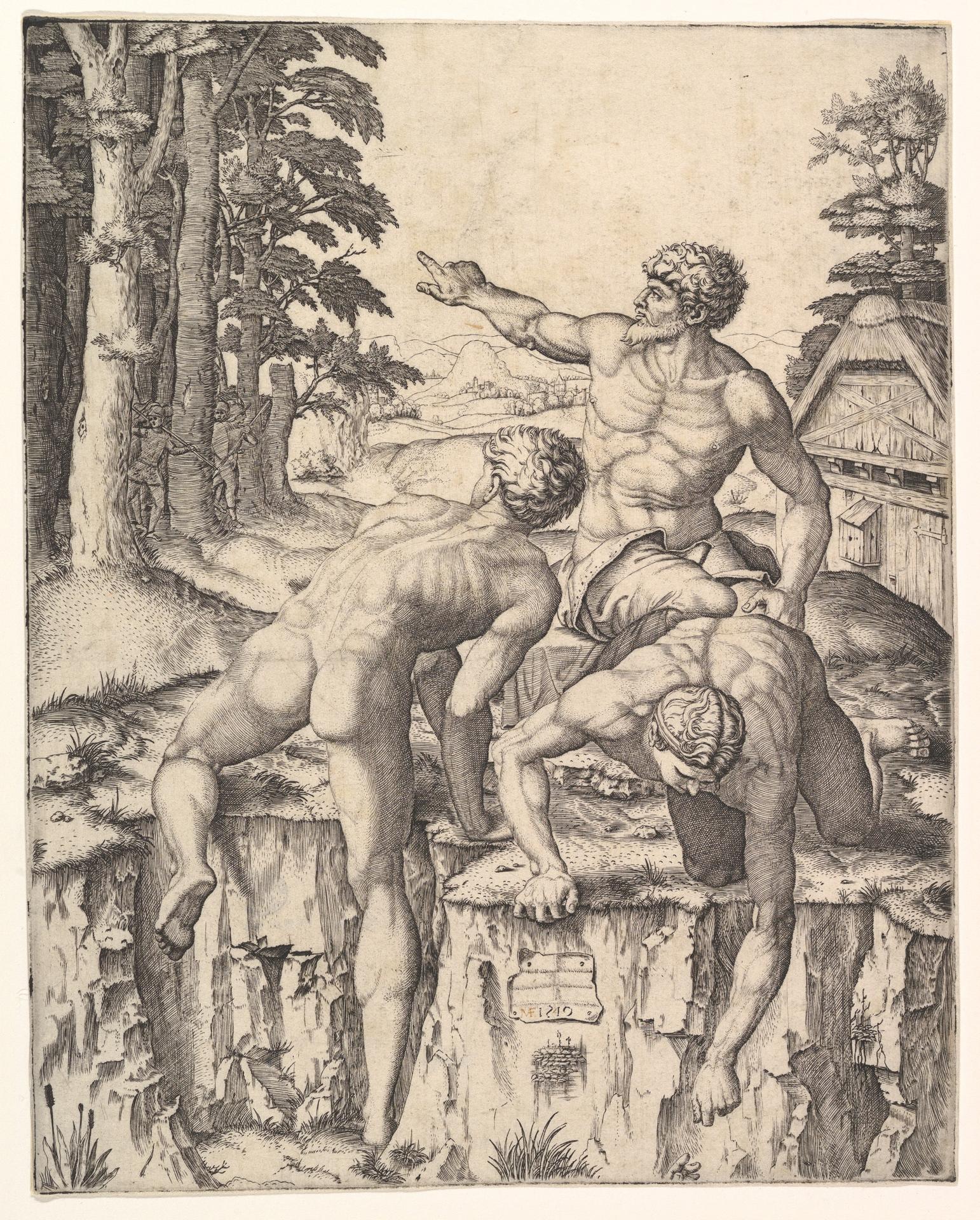
The Climbers (1510)
Original title: The Climbers: three naked men, one seen from behind climbing onto a river-bank, soldiers emerge from the forest in the background
kurzbeschreibung
Marcantonio Raimondi's engraving "The Climbers," dated 1510, belongs with his landscape and figure studies. Measuring 28.7 × 23 cm, the sheet presents three naked men scaling a rocky bank beside a river. One of the climbers is seen from behind, and soldiers are moving out of the woods in the distance.
Description
Three unclothed men work their way up a boulder in open country. Two are mid-ascent, while the third turns his back and presses upward as well. Behind them soldiers leave a dense forest, and mountains with a thatched village close off the landscape. The arrangement steps the figures from the foreground into the wooded depth.
Context
Raimondi, an Italian engraver of the Renaissance, is best known for his reproductive prints after Raphael. This sheet was made in Rome around 1510, during a period of intense activity. Nude figures set in landscapes were a common motif in the High Renaissance, often drawing on mythological or biblical subjects.
Impact
The climbers' movement and the soldiers emerging from the trees create a palpable tension. The nude bodies are modelled with strong contrasts and stand out clearly against the dark backdrop of the forest. From this the print gains a dramatic depth.
Technique
For an engraving, the lines are cut into a metal plate and then printed onto paper. Raimondi used fine hatching and cross-hatching to bring out shadow and volume. His precise linework is characteristic of his technique.
AI-generated description text
Source: Metropolitan Museum of Art · Public Domain (CC0 1.0)