The Milliner
Original title: The Milliner
kurzbeschreibung
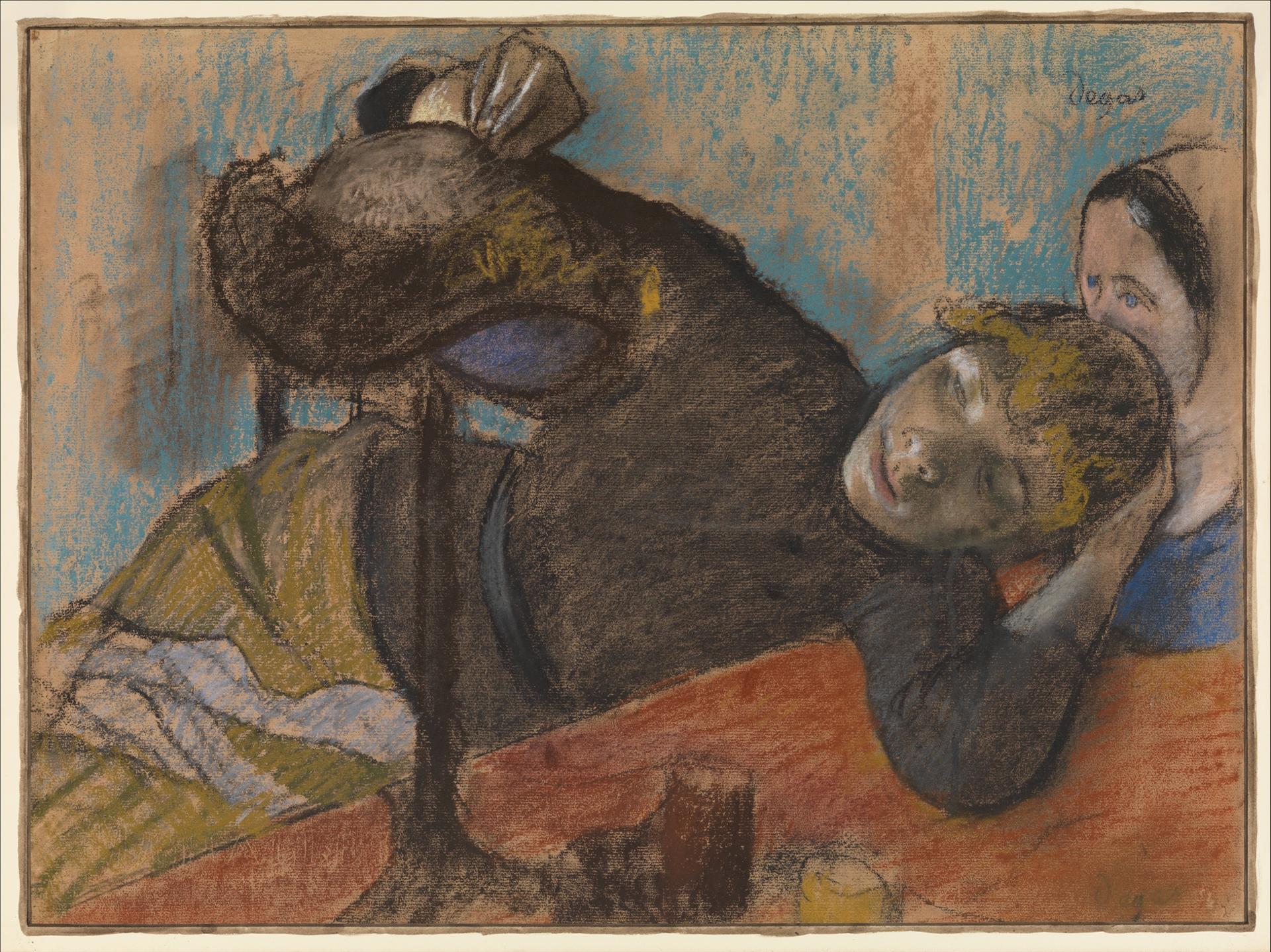
Around 1882, Edgar Degas made the pastel and charcoal drawing "Die Modistin" (The Milliner). It presents two figures in an intimate studio or workshop scene: one woman lies on a table, while another person holds a mask. The sheet was executed on warm gray wove paper that now appears buff.
Description
A woman in a green top lies on a table, her arms folded under her head, eyes closed, with a faint smile. Beside her, a second figure is partially visible, wearing a blue and red top and holding a mask before her face. The blue-toned background suggests a blurred wall or curtain. The colors remain muted, and the lines flow with rich detail, blending softly into one another, as is typical of Impressionism.
Context
During these years, Degas devoted himself intensively to Parisian daily life, especially scenes from workshops and shops. The milliner recurs in his work because he was interested in the labor and poses of women in such professions. The paper bears the watermark MICHALLET, indicating French manufacture. Later it was laid down on dark brown paper, whether for conservation reasons or for a deliberate presentation.
Impact
This scene feels quiet and intimate, almost like a private moment that grants the viewer a glimpse. Muted colors and soft contours create a melancholic mood that recalls fleeting observations of everyday life. The unusual arrangement of the figures—one lying down, the other masked—gives the image an enigmatic note.
Technique
Pastel and charcoal combine on warm gray wove paper that was later mounted on dark brown paper. With pastel, Degas achieved soft color transitions and a fine texture, while charcoal provided precise contours. The MICHALLET watermark attests to the paper's origin, which was suitable for pastel work.
AI-generated description text
Source: Metropolitan Museum of Art · Public Domain (CC0 1.0)