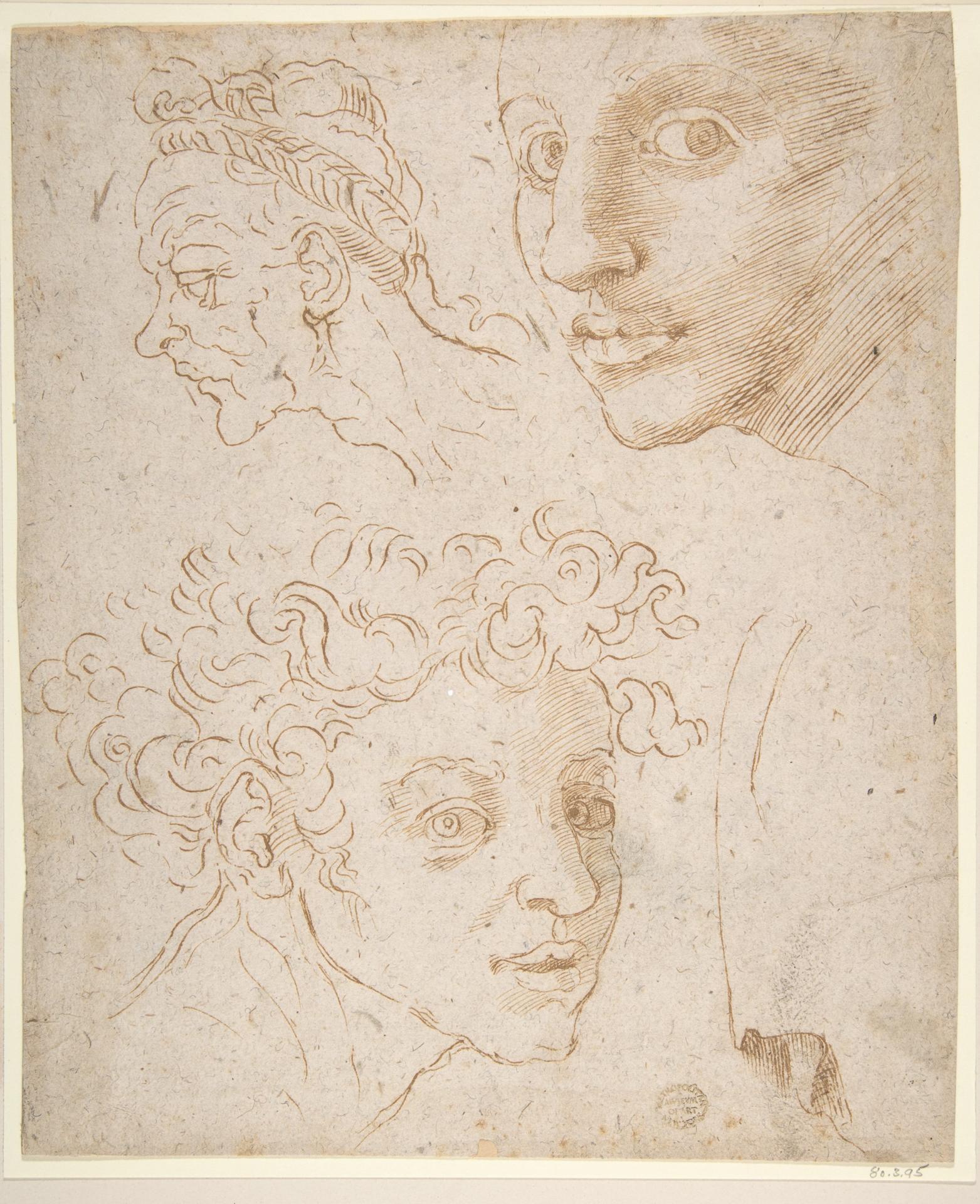
Three Heads after Michelangelo's Frescoes in the Sistine Chapel
Original title: Three Heads after Michelangelo's Frescoes in the Sistine Chapel
kurzbeschreibung
Unlike simple single copies after Michelangelo, this sheet gathers three male heads on one page. The anonymous Italian work of the 16th century is executed in pen and brown ink. Stylistically, the heads draw on the frescoes of the Sistine Chapel. As a study sheet, the drawing shows how artists of the period engaged with Michelangelo's figures.
Description
Three head portraits are distributed across the paper from different viewpoints, entirely in shades of brown. Hair and facial features emerge through densely set strokes, and each physiognomy remains clearly distinct from the others. Because all background elements are absent, the eye focuses solely on the sketched details. The slightly rough surface of the paper gives the ink a lively texture.
Context
The sheet was made in 16th-century Italy, during a phase of active engagement with Michelangelo's oeuvre. It belongs to a group of studies drawn after the frescoes of the Sistine Chapel. Artists used such copies as models for their own compositions and as practice in studying figures. That the author is not recorded fits the usual character of these exercise sheets, which often remained unsigned.
Impact
The concise limitation to the heads and the controlled linework give the sheet a collected, almost familiar presence. Thanks to the brown ink, the faces appear warm and sketchily animated, so that the closeness to the Michelangelesque model remains palpable.
Technique
The drawing is executed with pen in brown ink on paper. The carefully guided, delicate lines reveal a high level of craftsmanship typical of study sheets from this era. Since the paper is slightly rough, the flow of ink is affected, and the strokes acquire an organic texture.
AI-generated description text
Source: Metropolitan Museum of Art · Public Domain (CC0 1.0)