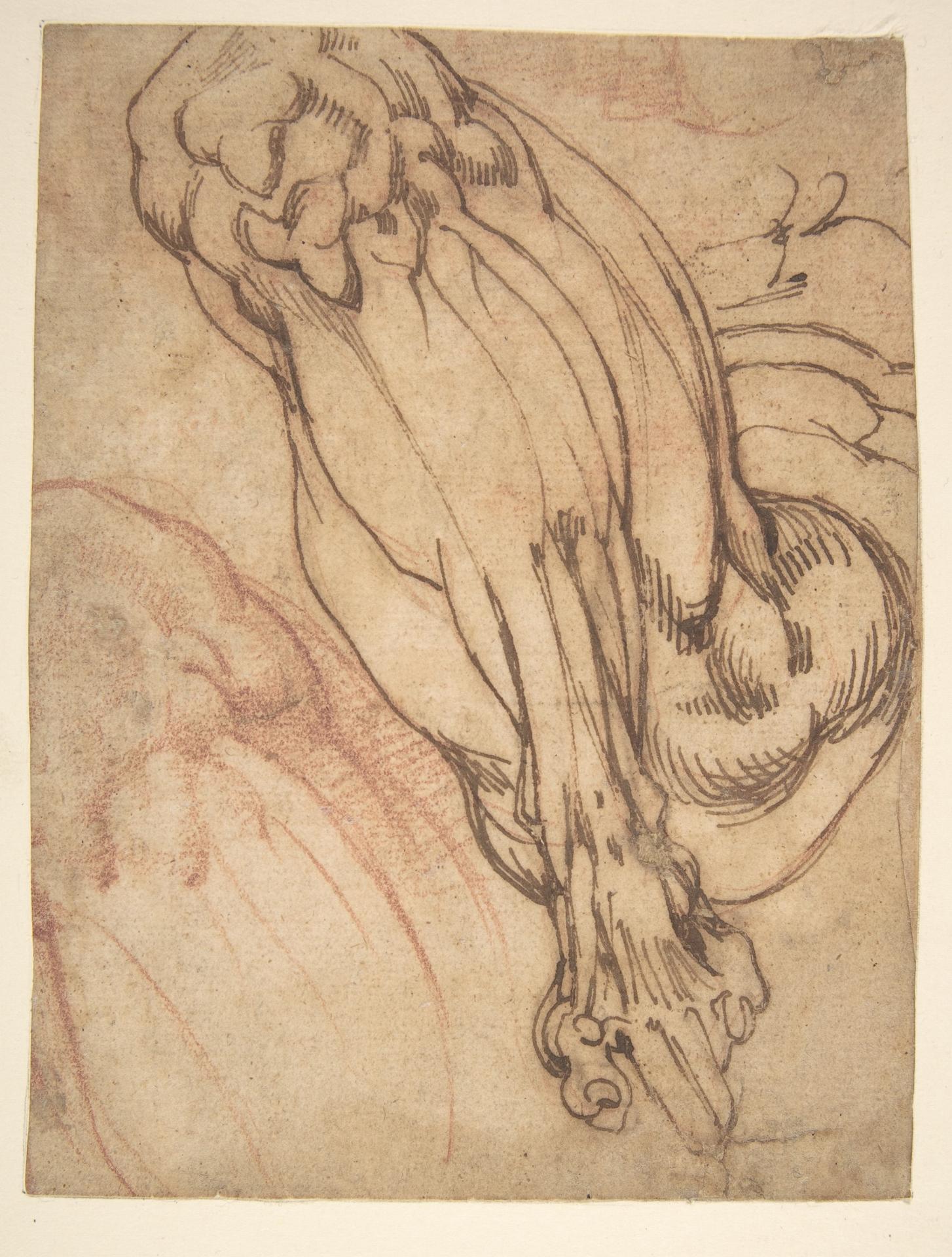
Anatomical Studies of a Leg (recto); Study of a Leg (verso)
Original title: Anatomical Studies of a Leg (recto); Study of a Leg (verso)
kurzbeschreibung
Michelangelo Buonarroti (1475–1564) presents an anatomical study of a leg, executed in pen and brown ink with red chalk. The sheet measures 17.1 by 13.2 cm and dates to the High Renaissance. It reveals a precise understanding of muscles and joints, characteristic of the artist's dual interest in art and anatomy.
Description
A left leg, slightly bent, fills the sheet from top to bottom. Muscles and joints are carefully worked out, the contours emphasized with brown ink and red chalk. Behind and beside the leg are faint strokes and lines, likely further anatomical notes. Brown dominates the color scheme, while red chalk accents provide shading and volume.
Context
This study probably belongs to Michelangelo's anatomical investigations, which he began around 1490 in Florence and later continued in Rome. Such sheets served as preparatory work for paintings and sculptures, for example figures with complex leg musculature as in the Sistine Chapel. The sheet is part of a group of anatomical drawings that document his thorough study of the human body.
Impact
Precise lines and delicate shading give the sheet a scientific and artistic character at once. Brown ink and red chalk lend the view something lively, almost tangible. Because the motif is limited to the leg and its muscular structure, a concentrated, objective aesthetic emerges.
Technique
On the recto, Michelangelo worked with pen and brown ink as well as red chalk; the verso shows only pen and brown ink. The pen allows fine, controlled lines; the red chalk serves softer shading and accents. The relatively small paper suggests a sketchbook study, executed with quick, confident strokes.
AI-generated description text
Source: Metropolitan Museum of Art · Public Domain (CC0 1.0)