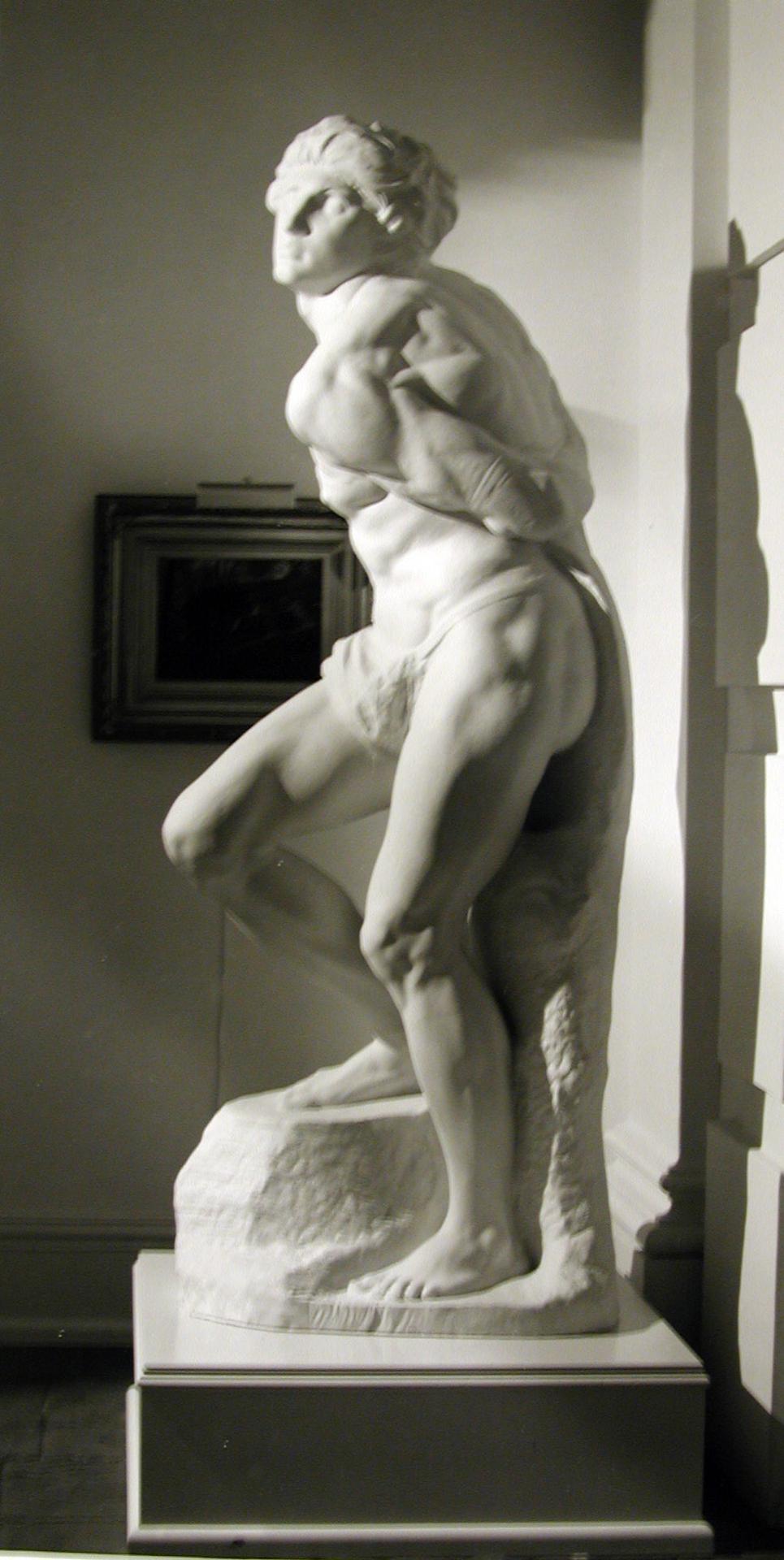
Rebellious Captive
Original title: Rebellious Captive
kurzbeschreibung
Michelangelo Buonarroti made the Rebellious Captive between 1505 and 1545 as part of his never-completed tomb for Julius II. The figure of a male warrior in a defiant pose survives here as a plaster cast that documents the original.
Description
A barefoot warrior, dressed only in a simple loincloth, looks upward with a determined expression. One arm is raised in a sweeping motion while the other pushes the torso slightly forward. He stands on a rocky base. Muscles and folds of the body are worked out in detail, and the realistic handling stresses the figure's physical presence.
Context
The sculpture belongs to a series of captive figures Michelangelo planned for the tomb of Pope Julius II. That project stretched over several decades and was repeatedly redesigned. The Rebellious Captive itself was left unfinished, a trait shared by many of Michelangelo's late works. This plaster cast was made in the 19th or 20th century to circulate and document the original.
Impact
The warrior's posture creates an immediate tension and movement that holds the viewer's attention. The unfinished surface and the expressive stance give the piece a raw emotional force characteristic of Michelangelo's late phase.
Technique
The cast is plaster, a material often used to reproduce originals. The surface still shows traces of modeling, and details such as muscles and folds are formed in relief. Plaster allows a faithful reproduction of the original, though it lacks the material impact of marble or stone.
AI-generated description text
Source: Metropolitan Museum of Art · Public Domain (CC0 1.0)