Samson and the Philistines
Original title: Samson and the Philistines
kurzbeschreibung
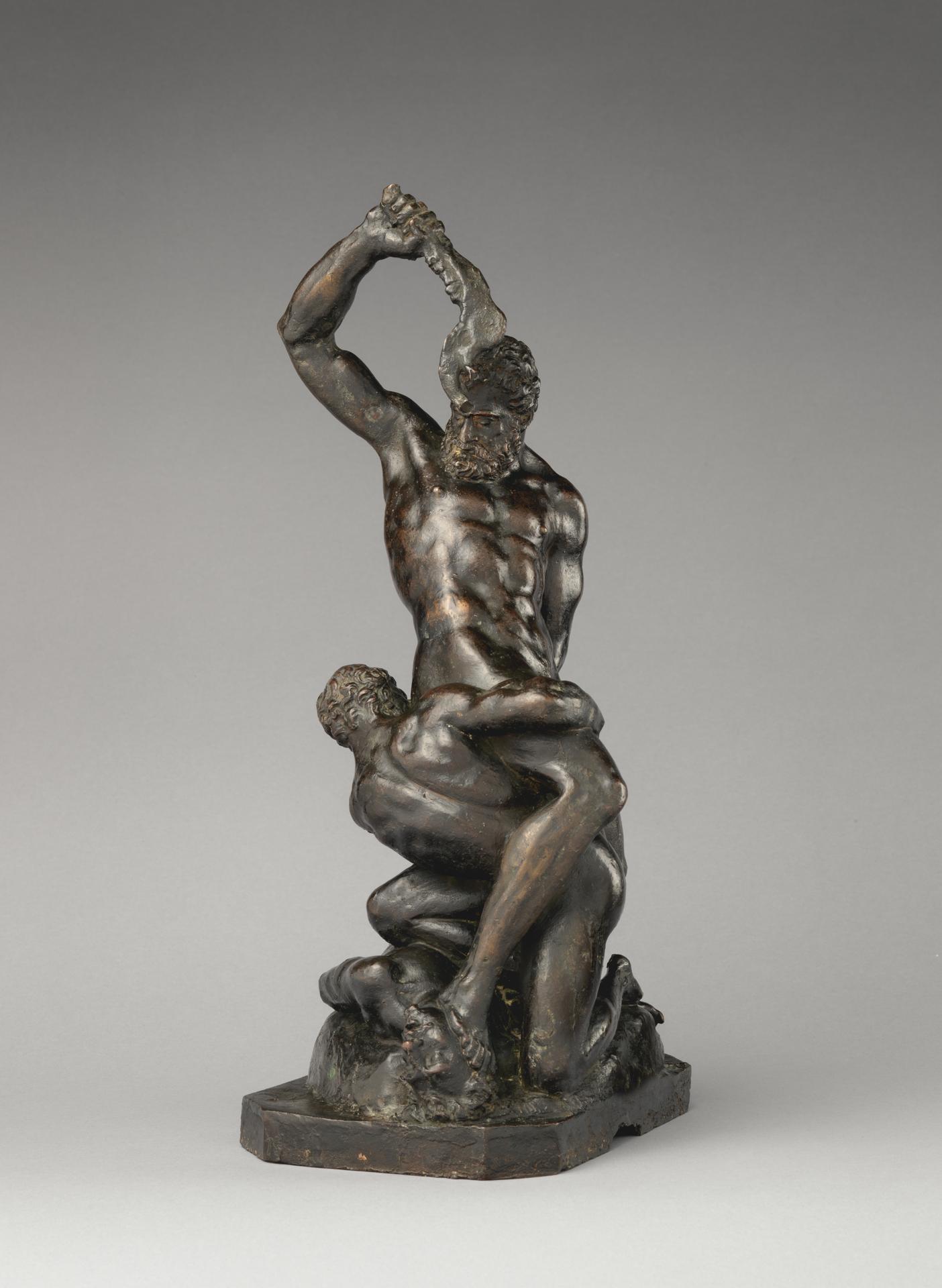
A bearded, powerful Samson stands over a Philistine lying on the ground – this Old Testament confrontation was cast in bronze by Michelangelo Buonarroti around 1550. The victorious hero and his defeated opponent meet in a sculpture that makes the strength and supremacy of Renaissance sculpture physically palpable.
Description
Samson presents himself with raised arms and a muscular, bearded body; at his feet crouches a Philistine, bent and defeated, making Samson's superiority clear. The bronze surface brings tendons, muscles, and folds of drapery into relief, translating the tension of the moment into material. The color ranges from deep brown to almost black, emphasizing the depth and structure of the surface. A plain background and a square base frame the two figures and direct the gaze entirely to their encounter.
Context
This bronze was made around 1550, during a phase in which Michelangelo turned more strongly to sculpture. The motif of Samson and the Philistines was very popular in the Renaissance because it was seen as an allegory of the victory of faith over its adversaries. At the time, the artist was working in Rome and had already produced widely known works with the Pietà and the David. Who commissioned the work is not recorded; however, the dynamic arrangement of the figures points to his late style.
Impact
Powerful bodies and the contrasts of the dark bronze surface shape the first impression. Samson's upright posture stands against the bent figure of the Philistine, creating a palpable dramatic tension. The physical force and emotional density of the scene hold the viewer's gaze.
Technique
The casting was done in bronze, a material Michelangelo valued for its durability and the possibility of fine detailing. On the surface, muscles and folds of drapery are carefully modeled and worked out through precise chasing. The cast allowed a delicate articulation that would be difficult to achieve in stone.
AI-generated description text
Source: Metropolitan Museum of Art · Public Domain (CC0 1.0)