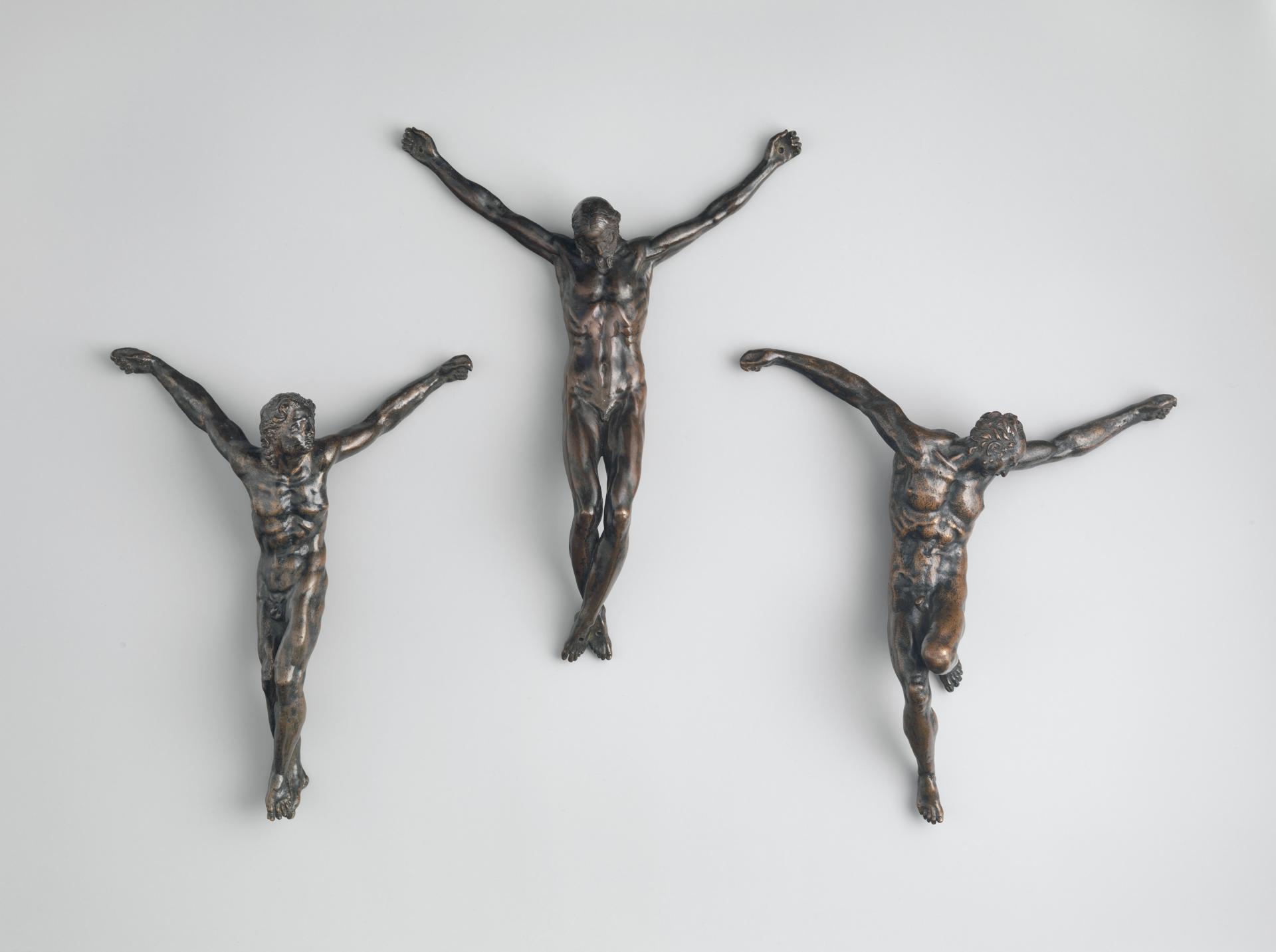
Christ and the Two Thieves Crucified
Original title: Christ and the Two Thieves Crucified
kurzbeschreibung
Unlike many Crucifixion scenes of the period, which tend to isolate Christ as the sole focus, this bronze group by Michelangelo Buonarroti, made around 1560–70, brings Christ and the two thieves together as a three-part whole. The crucified figures appear stretched out with their arms raised, heightening their suffering. They belong to an installation that includes a base and crosses.
Description
The bronze figures are arranged symmetrically: Christ in the middle, the two thieves flanking him. They stand upright, arms stretched upward, feet fixed to hooks. Muscles and facial features are worked in detail and reflect the pain of crucifixion. The neutral background lets the figures stand out, while the dark patina gives the work an aged depth.
Context
This group belongs to Michelangelo's late work, around 1560 to 1570, when religious themes and the representation of suffering became increasingly important to him. It is one of the few surviving bronzes by the artist; the attribution rests on documents and stylistic study. Probably made for a private patron, it is now in the collection of the Metropolitan Museum of Art.
Impact
The group is immediately compelling through its symmetrical placement and expressive poses. The dark patina and finely worked details give the figures a serious, meditative presence that draws the viewer into the Passion story.
Technique
Bronze, a material Michelangelo used rarely, served here for casting the Crucifixion group. The anatomy is precisely modeled; the bronze cast, with its fine details and patina, reinforces this. That Christ and the thieves were made separately and only later mounted on a base with crosses shows the elaborate craftsmanship involved.
AI-generated description text
Source: Metropolitan Museum of Art · Public Domain (CC0 1.0)