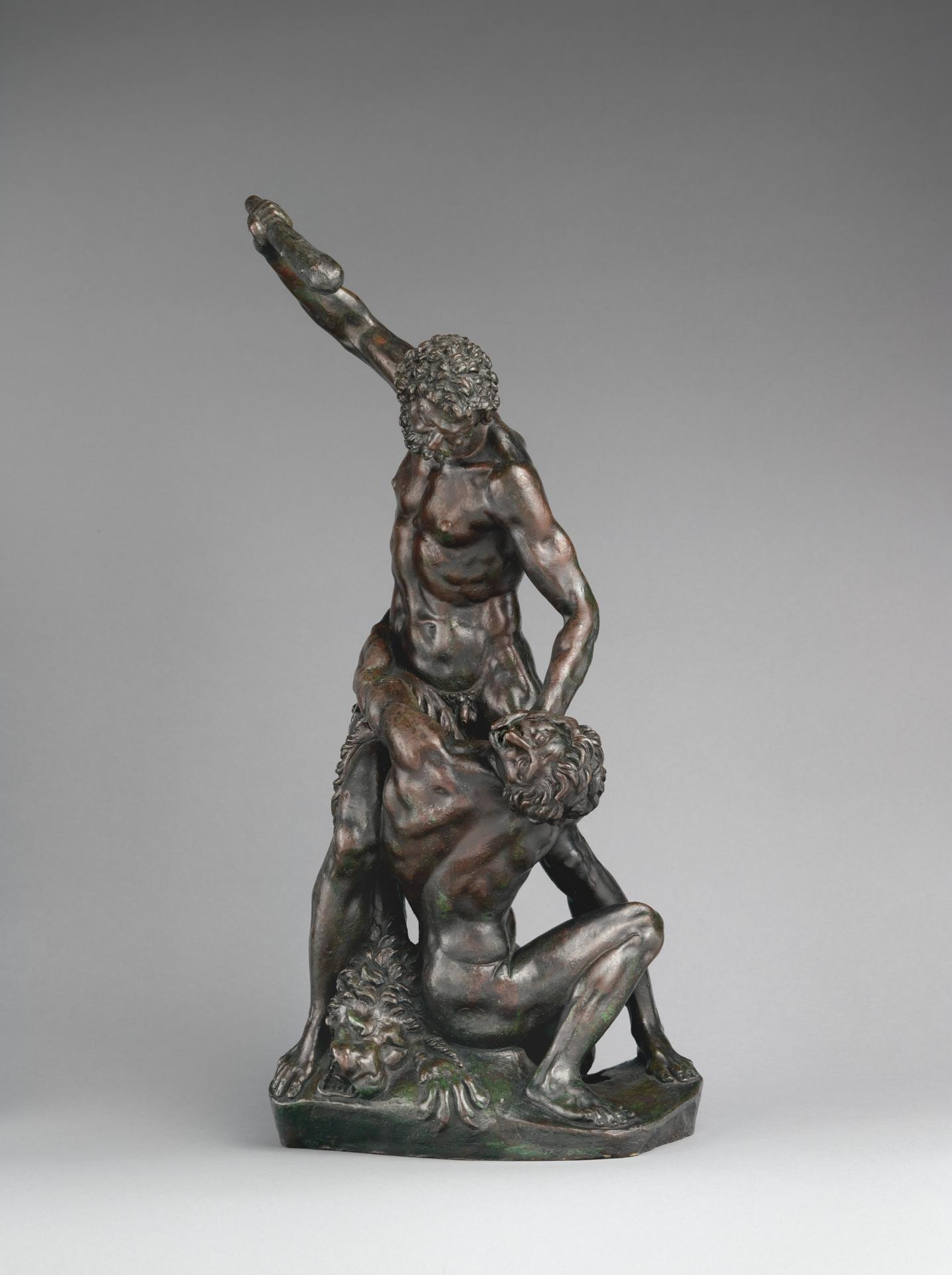
Hercules and Cacus (19th century?)
Original title: Hercules and Cacus
kurzbeschreibung
The mythological duel between Hercules and the giant Cacus is the subject of this bronze statue, attributed to Michelangelo Buonarroti but likely made in the 19th century. The group presents the struggle of the two figures in a dynamic arrangement.
Description
Two male figures are visible: in front, a kneeling, defeated figure; behind, a standing, powerful man with raised arm. His second hand rests on the body of the kneeling figure; both have curly hair. Floral ornaments decorate the base. A patina with greenish and brownish nuances covers the bronze.
Context
The subject comes from Greco-Roman mythology and stands for the victory of virtue over vice. Michelangelo made a much-noted marble version of this group in the early 16th century, which was installed in Florence. The bronze work shown here is of later date, probably made in the 19th century, and draws on Michelangelo's design.
Impact
The dynamic composition conveys immediate tension; the fight feels dramatically concentrated. Hercules appears overpowering, emphasizing his superiority, while Cacus's kneeling posture makes his defeat palpable. Thanks to the patina, the statue has something timeless and classical about it.
Technique
The statue was cast in bronze, a process that allows fine details and ensures durability. On the surface, oxidation has formed a natural patina with greenish and brownish tones. The decorative forms of the base suggest careful finishing.
AI-generated description text
Source: Metropolitan Museum of Art · Public Domain (CC0 1.0)