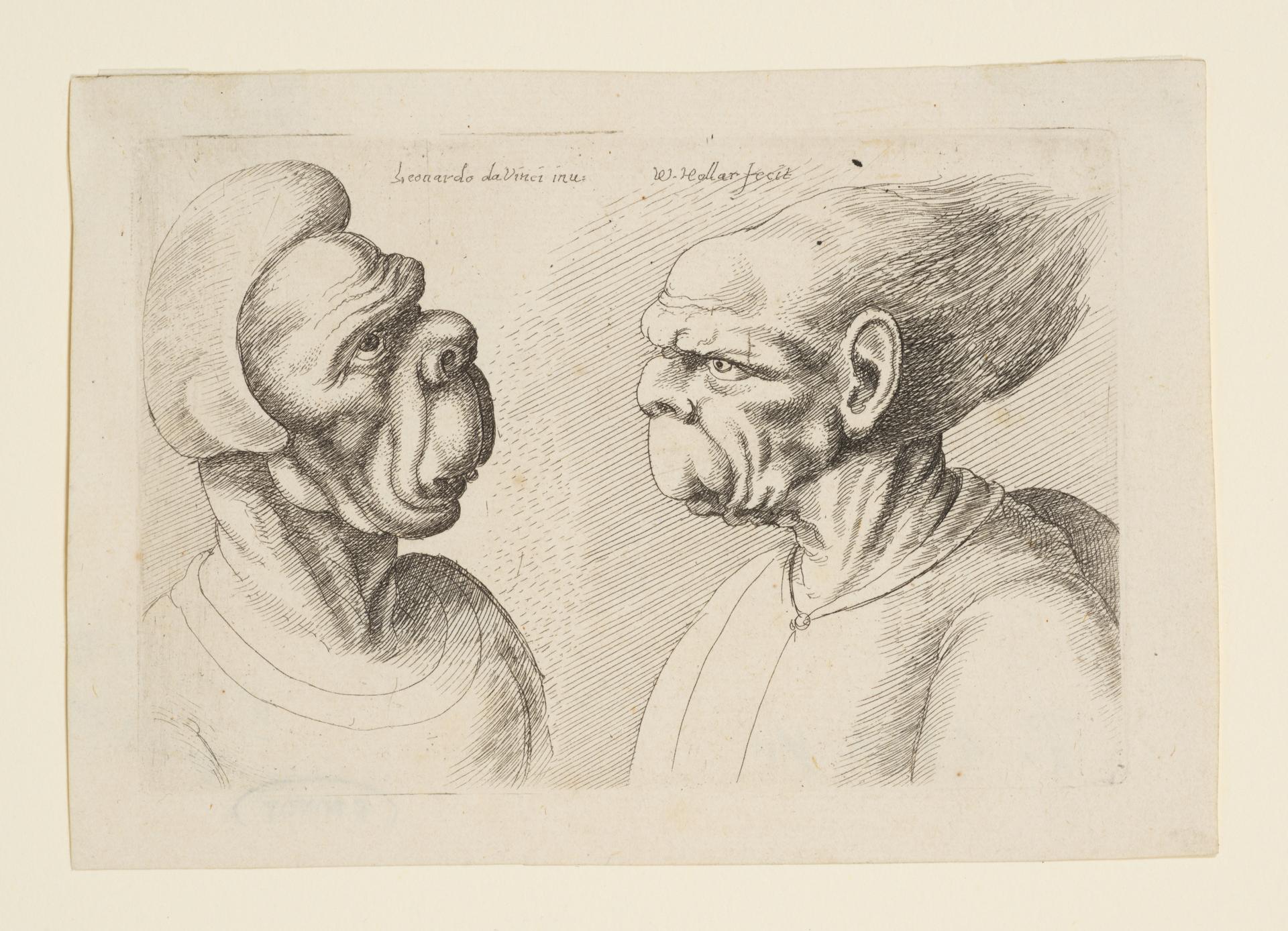
Two Deformed Heads with Very Long Upper Lips
Original title: Two Deformed Heads with Very Long Upper Lips
kurzbeschreibung
Unlike the related head studies of those years, Wenceslaus Hollar here places two faces turned toward each other, their upper lips stretched far beyond any normal measure and their eyes disproportionately large. Made around 1645, the print sets both figures in mirror symmetry and dresses them in plain light garments, so that the distortion of the features becomes the real subject of the etching.
Description
Two heads confront one another, firmly tied to the central axis and thereby calmly balanced. Their faces are plainly deformed: the upper lips pull out unnaturally long, the eyes bulge large. Light, barely worked-out garments lie over the bodies, giving only a few indications of form. This monochrome sheet shows an even distribution of light, as is characteristic of etching. The lines are drawn cleanly and set closely together, revealing the engraver's craft.
Context
The Bohemian-born printmaker Wenceslaus Hollar made this sheet around 1645, during his years in England. It belongs to a group of studies concerned with distorted physiognomies, a motif that appears only sporadically in the Renaissance and Baroque. Often the aim was anatomical exploration or a deliberate rendering of the grotesque in the human face. Hollar was known as a careful reproducer and also worked on independent prints of his own.
Impact
The exaggerated proportions of the heads produce a sense of unease, since they cannot be firmly placed between the grotesque and scientific observation. The mirror-like arrangement and the restrained handling lend the sheet something detached and matter-of-fact; from this the disfigured motifs acquire a curious neutrality.
Technique
The print was made by etching, an intaglio process: the drawing is scratched into an acid-resistant layer on a copper plate and then bitten. Hollar used thin lines and hatching to model faces and garments. Even light and the absence of color follow from the conditions of this process.
AI-generated description text
Source: Metropolitan Museum of Art · Public Domain (CC0 1.0)