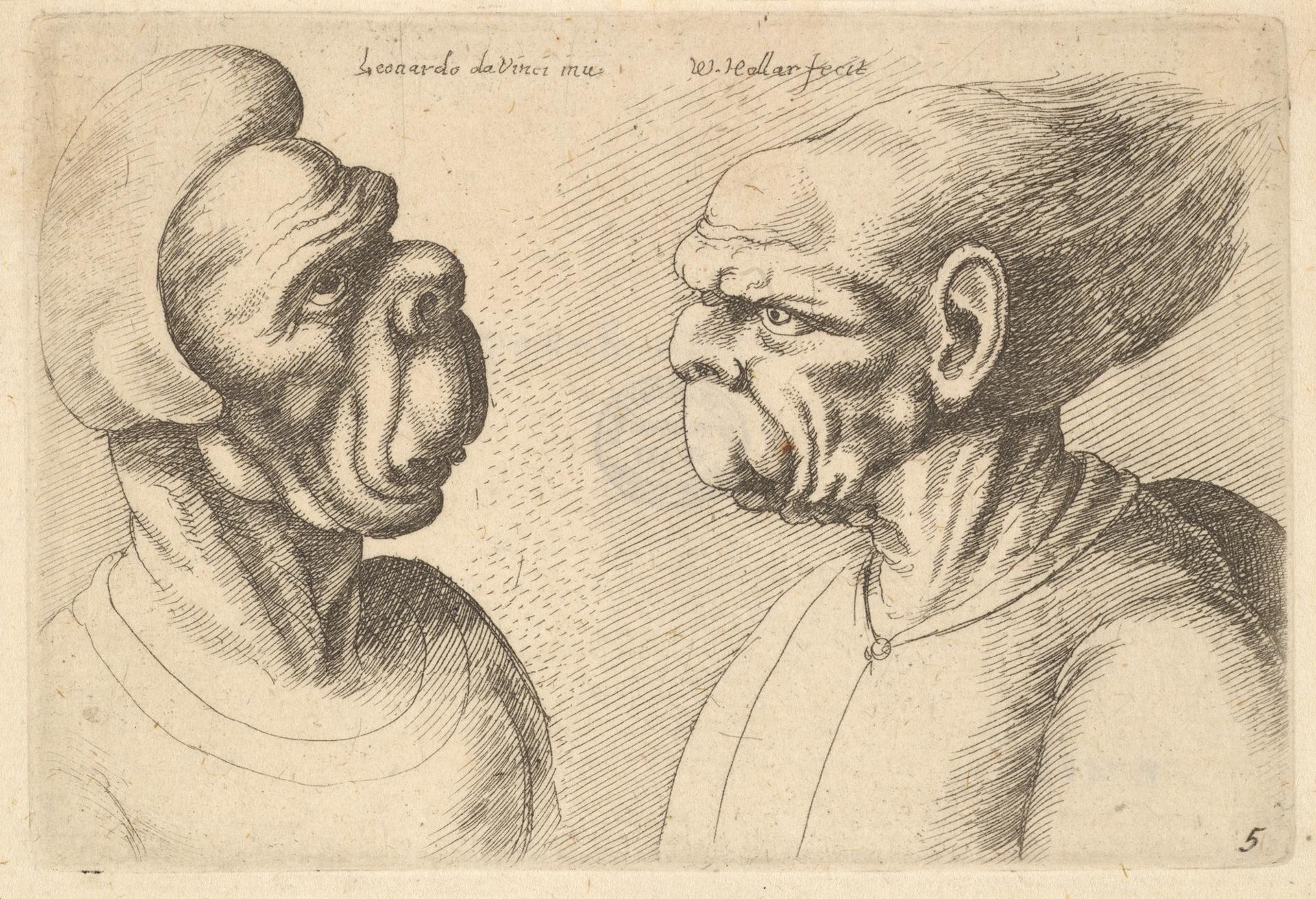
Two Deformed Heads Facing Inwards (1645)
Original title: Two Deformed Heads Facing Inwards
kurzbeschreibung
Wenceslaus Hollar made this etching, Zwei deformierte Köpfe, einander zugewandt, in 1645. It shows two stylized, deformed heads facing each other frontally. The motif goes back to a drawing by Leonardo da Vinci, as the inscription 'L. da Vinci' in the image indicates, and Hollar translated it into print. This is one of several grotesque studies Hollar made after Leonardo.
Description
Two deformed heads turned toward each other dominate the sheet. The left head has an oversized skull with a high forehead and a broad, slightly open mouth, while the right one appears angular and tapering, with a prominent brow line and an equally wide mouth. Both figures wear garment-like clothing that recalls robes or coats. A plain striped background sets off the figures. In the upper half of the image are the inscriptions 'L. da Vinci' and 'W. Hollar fecit', and at lower right the number '5'.
Context
Hollar made the etching in 1645 while working in Antwerp. It belongs to a series of grotesque studies after models by Leonardo da Vinci, which he probably knew through collections or reproductions. Such deformed heads were known in the sixteenth and seventeenth centuries as 'teste caricate' and often served as studies of physiognomy and character. Through his prints, Hollar made Leonardo's ideas accessible to a broad European audience.
Impact
The exaggerated proportions and the direct confrontation of the two heads create an unsettling yet fascinating effect. The reduction to black and white and the clear lines give the sheet graphic precision that emphasizes the grotesque features. The plain background directs attention entirely to the faces and their interaction.
Technique
The etching was made by scratching the drawing into an acid-resistant ground on a copper plate and then biting it with acid. Hollar used fine hatching to model forms and textures, as can be seen in the garments and facial features. The small-format sheet (8.3 × 11.4 cm) was probably printed in an edition intended for collectors.
AI-generated description text
Source: Metropolitan Museum of Art · Public Domain (CC0 1.0)