Mona Lisa (La Joconde)
Original title: Mona Lisa (La Joconde)
kurzbeschreibung
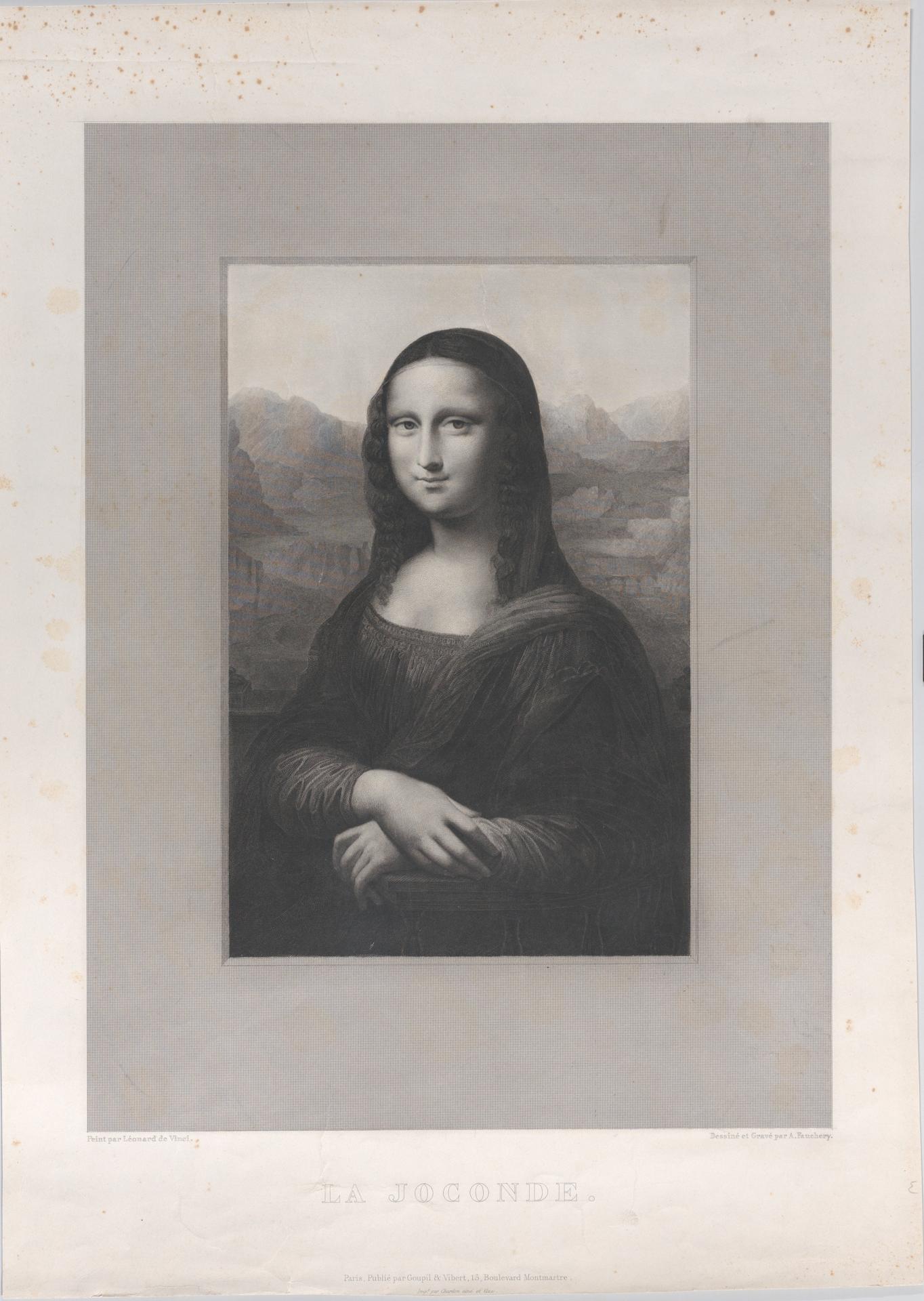
Augustine Fauchery produced this etching, Mona Lisa (La Joconde), between 1820 and 1860 as a graphic reproduction of Leonardo da Vinci's celebrated portrait. It shows a seated woman facing forward with folded hands against an abstract landscape. The work is a black-and-white print, and the image area measures 43.1 × 31.9 cm.
Description
Mona Lisa's figure sits centrally and almost symmetrically within the image. Her upper body faces forward, while her head turns slightly. A dark, heavily folded garment envelops her, and a long strand of hair falls over her left shoulder. Her hands rest one atop the other in her lap. In the distance, simplified mountains and clouds suggest the landscape. The linework is precise and detailed; shading brings out the texture of the fabric and the structure of the hair. A border running around the edge, inscribed “LA JOCONDE,” frames the view.
Context
This etching by Augustine Fauchery dates from the 19th century, when graphic reproductions of famous paintings were widely circulated. Its source was Leonardo's Mona Lisa, held in the Louvre since 1797 and already regarded as an icon of art history. The print likely belonged to a series of engravings intended to make masterpieces accessible to a broader public. Etching was a common method for reproducing artworks in the 19th century.
Impact
The black-and-white treatment gives the famous portrait a graphic severity and directs attention to its structure and line. Without color, the print feels calm and concentrated; the symmetrical arrangement of the figure reinforces a sense of balance. Fabric and hair are rendered in such detail that a tactile quality emerges, emphasizing the technical skill of the etching.
Technique
This etching is an intaglio process: the drawing is scratched into a metal plate, which is then bitten with acid. Varying degrees of etching and the subsequent inking produce the fine lines and shading. The use of black and white is typical of this process, which allows precise reproduction of tonal values.
AI-generated description text
Source: Metropolitan Museum of Art · Public Domain (CC0 1.0)