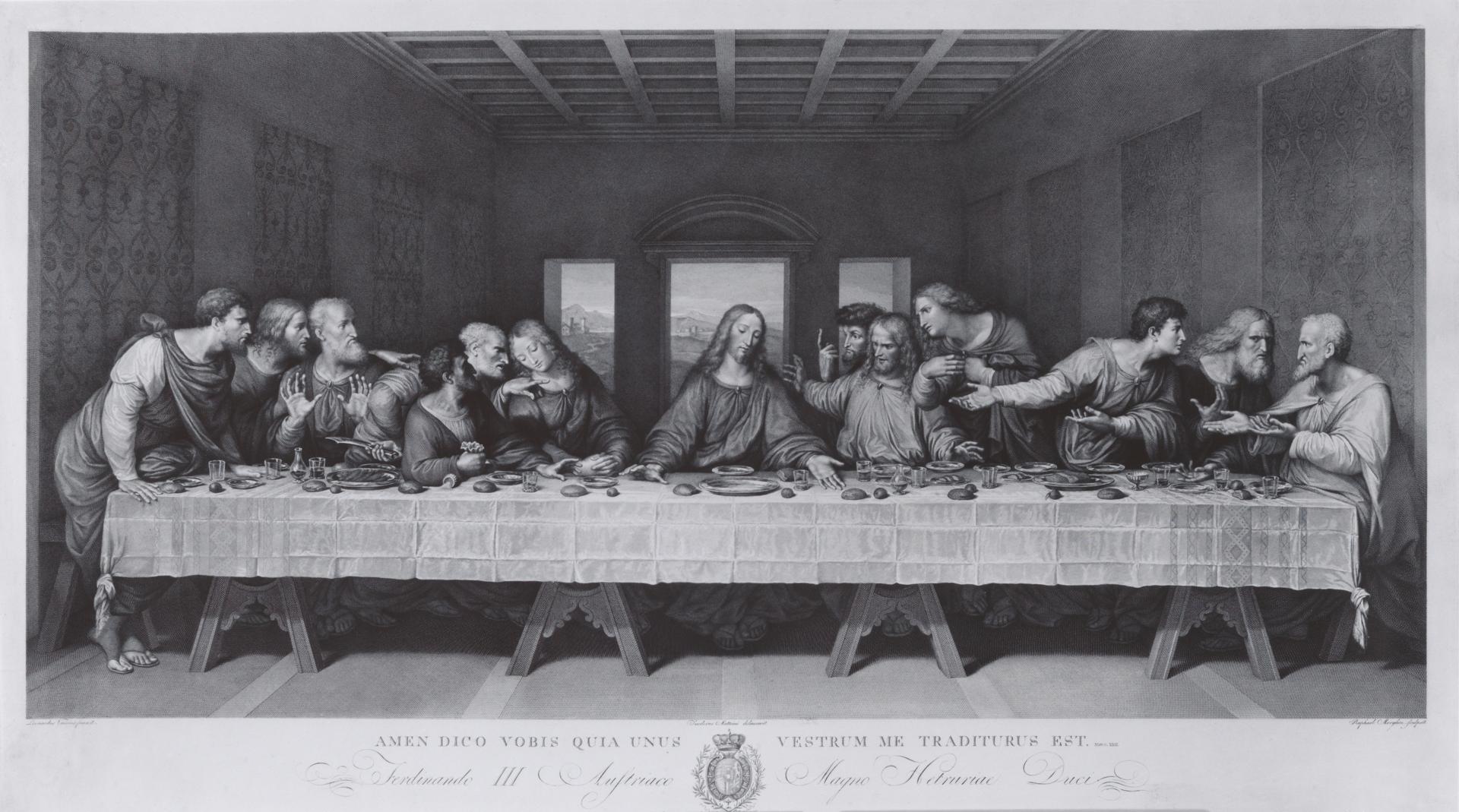
The Last Supper (1800)
Original title: The Last Supper
kurzbeschreibung
Raphael Morghen's engraving of 1800 reproduces the Last Supper of Jesus with his disciples. The sheet is laid out symmetrically, and the image is rendered entirely in shades of grey.
Description
Gathered around a long table set with food and drink is a group of figures in traditional garments. A window opening onto a landscape can be seen behind them, while walls and a wooden floor define the room. The figures strike varied poses and gestures: some converse, others eat or drink. Jesus Christ occupies the middle, and the arrangement is symmetrical. A Latin inscription, presumably a biblical quotation, runs along the lower margin.
Context
This print was made around 1800 by Raphael Morghen, an Italian engraver known for his reproductions of famous paintings. Its model was Leonardo da Vinci's fifteenth-century mural The Last Supper. Engravings circulated widely at the time as a way of bringing artworks to a broader public, and Morghen's sheet belongs to that effort. It is held by the Metropolitan Museum of Art and documents how Leonardo's masterpiece was received in printmaking.
Impact
Calm and solemnity emanate from the even grey tones and clear linework. The symmetrical arrangement stresses Christ's central position and heightens the drama of the moment. Precise execution and the detailed rendering of figures and space shape the impression of the engraving.
Technique
For this engraving, lines were cut into a copper plate and then printed. The grey tones arise from differences in the density and depth of the lines, with no visible shadows. Fine detail can be conveyed by this technique, as the analysis of the image demonstrates.
AI-generated description text
Source: Metropolitan Museum of Art · Public Domain (CC0 1.0)